
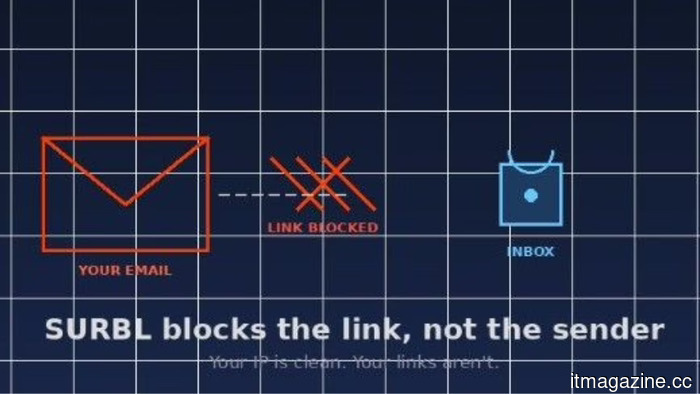
Within SURBL, the email blacklist that evaluates your links rather than your IP address.
Observing email marketers vigilantly tracking their sender IPs, checking daily, carefully warming them, and treating them like precious orchids is not only relatable but also serves as a reminder of how traditional wisdom can leave you vulnerable. The blacklist that may be hindering your campaigns in 2026 likely has little to do with your IP address and more with the contents of your email, particularly the links within it.
This is the unsettling premise of SURBL, the Spam URI Realtime Blocklist. Once you grasp its functionality, many of the “mysterious” delivery failures become much clearer. The research team at Warmy.io has published a comprehensive analysis of what leads to a listing, how to identify it, and how to recover, which we reference throughout this article.
SURBL does not concern itself with the origin of your email but focuses on its destination. While traditional blocklists, such as Spamhaus or Barracuda, assess the sender, SURBL analyzes the content of the message, including every URL in your text, every social media icon, and every tracking pixel.
This difference is significant. A clean sending IP provides no protection if a link in your email directs to a flagged domain. Your message might reach the inbox, but the links are silently disabled, causing your click-through rate to plummet without your knowledge. For a detailed technical explanation of how the system operates, Warmy.io’s SURBL blacklist report is the most comprehensive resource currently available.
Five lists, each addressing a distinct issue
SURBL is not just a single list; it's five lists, each targeting a different type of threat and each requiring a unique solution if you find yourself on one.
1. PH (Phishing): Domains used to harvest credentials or commit identity theft.
2. MW (Malware): Sites that host or distribute spyware, viruses, or ransomware.
3. CR (Cracked Sites): Legitimate websites that have been secretly compromised and exploited by spammers without the owner's knowledge.
4. AB (AbuseButler): Domains flagged due to high-volume sending and automated spam pattern analysis.
5. Multi: A combined super-list that allows mail servers to query all four in one DNS lookup.
The CR list is particularly concerning for legitimate business owners. Your website may appear perfectly normal, functioning well, processing orders, and passing visual checks, while hidden redirect scripts installed by attackers trigger SURBL flags behind the scenes.
How you can end up on this list without wrongdoing
Here's an uncomfortable truth: you don’t need to send spam to get listed on SURBL. This is what differentiates it from nearly all other blacklists and what makes it so bewildering when it occurs.
A compromised WordPress installation can embed redirect scripts that are invisible to you but detectable by SURBL scanners. An affiliate link carries the reputational history of every sender who has ever used it, including those who misused it before you. An insecure contact form on your website can provide spammers with a means to push their links through your domain. Moreover, linking to any domain registered within the past 72 hours is one of SURBL's most potent triggers, as new domains lack history and trust.
The warning signs that are often overlooked
SURBL failures are typically silent, which makes them particularly dangerous. The indicators are present; they just don’t appear to be a blacklisting at first glance.
Be on the lookout for SMTP 554 bounce codes from a clean sending IP (indicating a URI block), an unexplained decline in click-through rates (as Gmail and Outlook use SURBL data to disable links in delivered emails), or "too many hops" notifications when a receiving server reaches its limit attempting to scan your URLs. Any spike in complaints associated with a specific URL rather than your sending domain should also be addressed promptly. Warmy’s deliverability monitoring automatically flags these signals before they escalate into a full listing.
The importance of the sequence in removal
Getting removed from SURBL is not as simple as filling out a form and waiting. The process requires a specific sequence: identify the root cause, completely resolve it, then submit your removal request. Sending a removal request before fixing the underlying issue not only fails but can also hinder progress, as vague submissions without technical documentation are given lower priority.
Start at surbl.org/lookup to confirm which sub-list you have landed on, as this will guide your remediation process. If you're on the CR list, clean your site using Sucuri or a Cloudflare WAF, and document your findings. If you're listed on AB, identify and cease the high-volume behaviors that triggered spam trap hits. Then, file a detailed removal request that specifies the causes and actions taken, avoiding any vague language. A comprehensive step-by-step remediation framework is available in Warmy.io’s SURBL report, including breakdowns designed for technical teams.
Prevention is more cost-effective than a crisis
A few proactive habits can significantly lower the risk of SURBL exposure before it
Other articles
 Experts at MIT have created a unique memory system. While humans may forget, robots will simply retrieve the forgotten item.
Researchers at MIT have created an AI memory system enabling robots to retain information about objects, locations, and details from real-world settings over time.
Experts at MIT have created a unique memory system. While humans may forget, robots will simply retrieve the forgotten item.
Researchers at MIT have created an AI memory system enabling robots to retain information about objects, locations, and details from real-world settings over time.
 General Intuition is securing $300 million for AI developed using gaming data.
The startup turned down OpenAI's $500 million offer for its gaming video data. It is now seeking to raise $300 million at a $2 billion valuation to train AI agents using 2 billion video game clips annually.
General Intuition is securing $300 million for AI developed using gaming data.
The startup turned down OpenAI's $500 million offer for its gaming video data. It is now seeking to raise $300 million at a $2 billion valuation to train AI agents using 2 billion video game clips annually.
 A mutual bank that has been in operation for 201 years has recently established an AI Center of Excellence in collaboration with a startup partner.
Liberty Bank, the oldest mutual bank in the United States with assets totaling $9 billion, has established an AI Center of Excellence in collaboration with enterprise AI partner Flare AI.
A mutual bank that has been in operation for 201 years has recently established an AI Center of Excellence in collaboration with a startup partner.
Liberty Bank, the oldest mutual bank in the United States with assets totaling $9 billion, has established an AI Center of Excellence in collaboration with enterprise AI partner Flare AI.
 A 201-year-old mutual bank has recently established an AI Center of Excellence in collaboration with a startup partner.
Liberty Bank, the oldest mutual bank in the United States with assets amounting to $9 billion, has established an AI Center of Excellence in collaboration with enterprise AI partner Flare AI.
A 201-year-old mutual bank has recently established an AI Center of Excellence in collaboration with a startup partner.
Liberty Bank, the oldest mutual bank in the United States with assets amounting to $9 billion, has established an AI Center of Excellence in collaboration with enterprise AI partner Flare AI.
 BMW cuts profit expectations as China puts pressure on Europe.
BMW has reduced its forecast for the car division's margin to as low as 1%. Chinese manufacturers now account for almost 10% of the car market in Europe, significantly impacting European profits in China.
BMW cuts profit expectations as China puts pressure on Europe.
BMW has reduced its forecast for the car division's margin to as low as 1%. Chinese manufacturers now account for almost 10% of the car market in Europe, significantly impacting European profits in China.
 Spotify introduces Reserved ticketing for dedicated fans.
Spotify's Reserved feature retains concert tickets for Premium subscribers, utilizing listening data, and is debuting in the US via a multi-year exclusive agreement with Live Nation.
Spotify introduces Reserved ticketing for dedicated fans.
Spotify's Reserved feature retains concert tickets for Premium subscribers, utilizing listening data, and is debuting in the US via a multi-year exclusive agreement with Live Nation.
Within SURBL, the email blacklist that evaluates your links rather than your IP address.
SURBL identifies the URLs within your emails instead of the sender's IP address. Just one link to a flagged domain can quietly deactivate every link in a delivered email, and many senders remain unaware that it has occurred.