
Google has launched Android 17, featuring Gemini Intelligence, a foldable gaming mode, and enhanced privacy controls.
TL;DR: Android 17 is launching for Pixel devices today, introducing Bubbles multitasking, a foldable gaming mode, stricter privacy controls, and Gemini Intelligence arriving this summer.
Google is starting to roll out Android 17 for Pixel devices today, bringing multitasking features, a specialized gaming mode for foldable devices, and privacy adjustments that reduce the amount of data apps can collect by default. This update will first be available on Pixel phones and will extend to devices from Samsung, OnePlus, and others throughout 2026. In addition, a feature called Gemini Intelligence, which integrates Google’s AI more thoroughly into the OS, will be available on select flagship devices this summer.
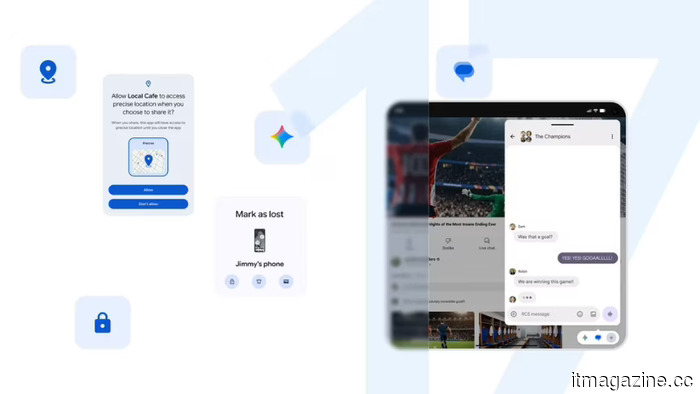
One of the most prominent updates is Bubbles, a floating window feature compatible with any app. Long-pressing an app icon allows it to open as a resizable overlay that remains visible over other content, enabling any app to function as a picture-in-picture window instead of limiting this to messaging applications. On foldable devices like the Galaxy Fold and Pixel 10 Pro Fold, a bubble bar will be permanently positioned at the bottom of the screen for quick access.
Screen Reactions leverages the selfie camera during screen recording to show the user's face alongside what is displayed, merging both feeds into a single video. This feature targets content creators who make walkthroughs, gameplay commentary, or tutorials, removing the need for third-party applications to overlay a webcam feed on screen captures.
Foldable phones receive a dedicated gaming layout that splits the inner display into a 50/50 setup, where the game occupies the top half and a virtual gamepad is on the bottom. The system allows for native controller remapping, enabling users to customize button placement without needing options from game developers. Google also claims to have enhanced memory management for HD gaming, but specific benchmarks have not been released.
The privacy modifications are gradual yet significant. Apps can now request temporary location access, which expires after one session, replacing the previous strict options of “always,” “while using,” and “never.” Users can share specific contacts with an app instead of granting access to their entire address book. A new ‘Mark as Lost’ feature in Find Hub locks a lost device with biometric authentication, and improved Live Threat Detection runs continuously in the background to identify suspicious app activities.
Additionally, Google has decreased the number of permitted PIN attempts before the device initiates progressively longer wait times, slowing down brute-force attacks. The company has not disclosed the new limit or provided a detailed timeline for the waiting intervals.
Gemini Intelligence, previewed at Google I/O in May, will be available this summer on the Samsung Galaxy S26 and Google’s Pixel 10 line as a separate rollout. This represents a deeper incorporation of Gemini into Android’s core functions, although Google has not clarified which specific features will be available at launch versus those arriving in subsequent updates. This distinction is crucial since Android 17 is a platform upgrade accessible to a wide range of devices, while Gemini Intelligence will be limited to devices Google categorizes as “select advanced devices.”
The June Pixel Drop, which accompanies Android 17, introduces features exclusive to Google’s hardware. In Google Photos, conversational editing allows Pixel 10 Pro, XL, Fold, and 10a users to describe image edits in natural language, initially available in Germany, the UK, France, Spain, and Italy. Voice Translate is now available on the Pixel 10a, and Quick Share, compatible with AirDrop, is being extended to the Pixel 9a and 8a after previously being restricted to the Pixel 10 line.
The Pixel Watch will now feature Emergency Sharing, integrating with its existing Car Crash, Fall, and Loss of Pulse detection features, automatically notifying emergency contacts when these sensors are activated. Alongside the Android 17 update, Wear OS 7 is also rolling out to Pixel Watches.
This rollout coincides with the European Commission moving to compel Google to make Android accessible to competing AI assistants under the Digital Markets Act, with a binding decision expected by July. How effectively Google can integrate Gemini into Android without prompting regulatory action in its largest international market remains an unresolved issue. Moreover, Google is in the process of replacing ChromeOS with Android-powered Googlebook laptops that incorporate Gemini at the operating system level, raising the stakes of the EU's interoperability ruling beyond a single phone update.
Android 17 serves as a refinement release rather than a complete overhaul, lacking a redesigned interface or new design language. The foldable gaming mode and Bubbles multitasking cater to hardware categories that have significantly evolved since Android 16, while the privacy features align Android closer to the detailed permission controls iOS has offered for several years. Whether Gemini Intelligence presents a substantial difference upon its release this summer will depend on specifics that Google has yet to disclose.
Other articles
 Google has launched Android 17 for Pixel smartphones.
Android 17 is being released on Pixel devices today, featuring Bubbles, creator tools, and enhancements in security, while Gemini Intelligence will arrive later this summer.
Google has launched Android 17 for Pixel smartphones.
Android 17 is being released on Pixel devices today, featuring Bubbles, creator tools, and enhancements in security, while Gemini Intelligence will arrive later this summer.
 I was part of the inaugural intern group at OpenAI. Here’s what I learned about becoming an engineer native to AI.
Following his experience in OpenAI's inaugural intern cohort, Hamza Mostafa discovered that while AI can enhance engineers' speed, it does not inherently improve their quality. The crucial skill lies in judgment: understanding what to trust, test, and challenge.
I was part of the inaugural intern group at OpenAI. Here’s what I learned about becoming an engineer native to AI.
Following his experience in OpenAI's inaugural intern cohort, Hamza Mostafa discovered that while AI can enhance engineers' speed, it does not inherently improve their quality. The crucial skill lies in judgment: understanding what to trust, test, and challenge.
 Rivian terminates hundreds of employees just a week after commencing R2 deliveries as it aims for its first profitability.
Rivian reduced its workforce in service and customer teams by under 2%, just a week after the start of R2 deliveries. In 2025, the company incurred a loss of $3.6 billion while delivering 42,247 vehicles.
Rivian terminates hundreds of employees just a week after commencing R2 deliveries as it aims for its first profitability.
Rivian reduced its workforce in service and customer teams by under 2%, just a week after the start of R2 deliveries. In 2025, the company incurred a loss of $3.6 billion while delivering 42,247 vehicles.
 A newly discovered Android trojan named Rokarolla is designed to target 217 banking applications and has the ability to capture your PIN, SMS verification codes, and funds from cryptocurrency wallets.
Zimperium's zLabs discovered Rokarolla, an Android banking trojan featuring 137 commands that captures PINs, intercepts SMS messages, hijacks cryptocurrency payments, and disables Play Protect.
A newly discovered Android trojan named Rokarolla is designed to target 217 banking applications and has the ability to capture your PIN, SMS verification codes, and funds from cryptocurrency wallets.
Zimperium's zLabs discovered Rokarolla, an Android banking trojan featuring 137 commands that captures PINs, intercepts SMS messages, hijacks cryptocurrency payments, and disables Play Protect.
 LiberNovo’s Solution to an Expanding Workplace Issue: Ergonomics That Truly Accommodate
Most ergonomic chairs are created with average body types in mind. However, LiberNovo's newest collection adopts a different strategy, featuring the Maxis Series aimed at Big & Tall individuals, the flexibly adaptive Omni Pro, and the user-friendly Omni SE, all providing ergonomic options customized for various users, work habits, and comfort requirements.
LiberNovo’s Solution to an Expanding Workplace Issue: Ergonomics That Truly Accommodate
Most ergonomic chairs are created with average body types in mind. However, LiberNovo's newest collection adopts a different strategy, featuring the Maxis Series aimed at Big & Tall individuals, the flexibly adaptive Omni Pro, and the user-friendly Omni SE, all providing ergonomic options customized for various users, work habits, and comfort requirements.
 Your smart home devices may unknowingly be involved in a cybercrime network.
Certain internet-enabled devices might have concealed software backdoors that enable cybercriminals to direct traffic through home networks, commit fraud, and initiate cyberattacks without the owner's awareness.
Your smart home devices may unknowingly be involved in a cybercrime network.
Certain internet-enabled devices might have concealed software backdoors that enable cybercriminals to direct traffic through home networks, commit fraud, and initiate cyberattacks without the owner's awareness.
Google has launched Android 17, featuring Gemini Intelligence, a foldable gaming mode, and enhanced privacy controls.
Android 17 begins its rollout to Pixel phones today, featuring Bubbles multitasking, gaming for foldable devices, Gemini Intelligence, and updated security defaults.