
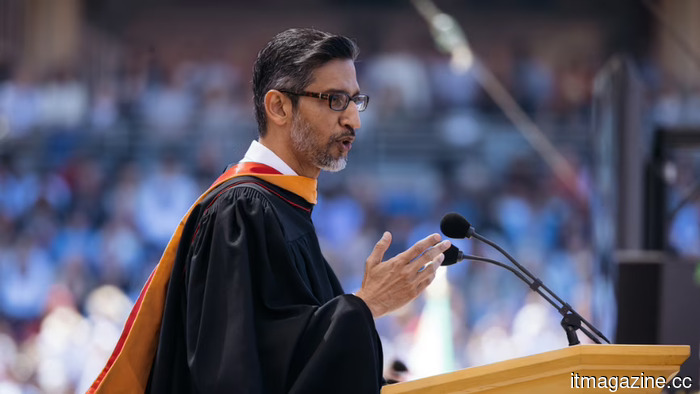
Sundar Pichai from Google opted for a positive outlook on AI at Stanford, yet graduates still chose to walk out.
The individual leading one of the largest artificial intelligence companies globally stood up to speak to Stanford's graduating class and largely chose not to focus on artificial intelligence. Sundar Pichai, the CEO of Google and Alphabet, delivered the address during the university's 135th commencement ceremony on Sunday, June 14, at Stanford Stadium, opting for nearly every topic except the one he is most recognized for.
He acknowledged this omission with a joke, noting that the pressure to discuss AI was inevitable given the last two letters of his last name, before transitioning to what he termed “technology agnostic” advice.
This was a deliberate strategy. Executives in the tech space have faced a challenging graduation season: Eric Schmidt, Pichai’s predecessor at Google, was met with boos at the University of Arizona this year for lauding AI's potential, and Pichai seemed intent on avoiding a similar fate.
Instead, he presented an autobiographical narrative structured around three principles: choose optimism, tackle difficult challenges, and pursue what genuinely excites you. His message of optimism included a personal anecdote.
Upon arriving from Chennai for his first winter quarter, Pichai observed brown hills, only to be corrected by his host, Jane Earl, who said, “We prefer to call it golden.” This reframing from brown to golden became the central metaphor of his speech. He referenced his journey through Google, including the development of Chrome, as support for the other two principles and concluded by urging the graduates to “set your heart ablaze.”
According to him, this was only his second commencement address and his first in front of a live audience; the other was pre-recorded in his backyard in 2020 for a graduating class that could not convene in person. Pichai holds a master's degree in materials science and engineering from Stanford, lending a sense of symmetry to his return.
However, the most noteworthy moment did not occur during his speech. As Pichai took the stage, a group of graduates stood up and exited the stadium. This protest had been planned weeks earlier by Stanford Students for Justice in Palestine, and it was directed not at AI or job losses, but at Google's participation in Project Nimbus, a $1.2 billion contract for Google and Amazon to provide cloud and AI services to the Israeli government.
This distinction is important, as it’s easy to misinterpret the walkout as a reaction to AI, which in this instance would be incorrect. The students were protesting a particular business relationship, not the technology in its general context. Merging the two issues simplifies a deliberate political statement into a more convenient narrative about graduates fearing technology. These two narratives merely coincidentally shared the same stage; they do not represent the same message.
Project Nimbus has been a contentious subject within Google for years. Established in 2021, the contract has sparked ongoing internal protests, including a wave of employee dismissals in 2024 following sit-ins at company offices. It has become a consistent target for campus activists who view the university's connections to the tech industry as fair grounds for protest.
The walkout at Stanford was the latest manifestation of a campaign that has been ongoing well before this commencement, which explains how the organizers were able to prepare for it well in advance.
Collectively, the optics of the event conveyed a significant message. A CEO whose company is aggressively integrating AI into every product spent his time at the podium discussing golden hills and hard work, while the actual disruption of the ceremony revolved around a cloud contract related to defense, rather than his speech. For a leader skilled at maintaining on-message communication, it appears that the least technology-focused message was the safest option this year.
Sundar Pichai’s comments have since been fully published on Google’s blog. For the organizers of the walkout, that act was the main objective, and it occurred before he could finish his opening remarks.
Other articles
 UK regulations for social media users under 16 will extend to gaming and AI chatbots.
Keir Starmer is anticipated to outline limitations on social media usage for those under 16, with restrictions extending to AI chatbots and interactions with strangers in gaming applications.
Schneider Electric and Foxconn collaborate on AI data center infrastructure.
Schneider Electric and Foxconn have revealed a partnership to jointly create reference designs for future AI data centres, with manufacturing expected to begin later this year.
UK regulations for social media users under 16 will extend to gaming and AI chatbots.
Keir Starmer is anticipated to outline limitations on social media usage for those under 16, with restrictions extending to AI chatbots and interactions with strangers in gaming applications.
Schneider Electric and Foxconn collaborate on AI data center infrastructure.
Schneider Electric and Foxconn have revealed a partnership to jointly create reference designs for future AI data centres, with manufacturing expected to begin later this year.
 Tesla provided European regulators with inaccurate self-driving safety information.
A review by Reuters revealed that Tesla provided self-reported FSD safety data to regulators in Sweden and the Netherlands, which researchers claim are misleading.
Tesla provided European regulators with inaccurate self-driving safety information.
A review by Reuters revealed that Tesla provided self-reported FSD safety data to regulators in Sweden and the Netherlands, which researchers claim are misleading.
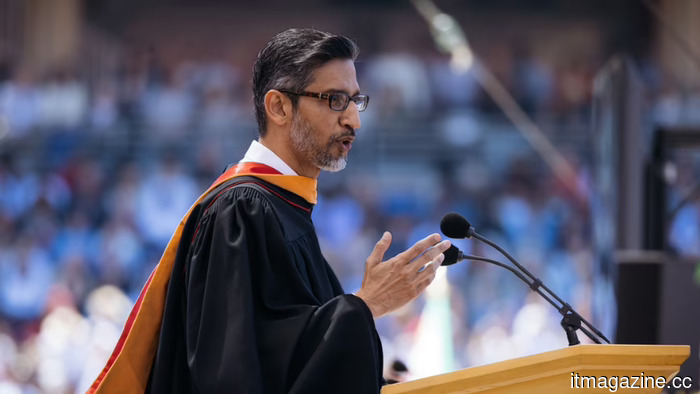 Sundar Pichai of Google opted for a message of optimism regarding AI at Stanford, yet many graduates walked out regardless.
Sundar Pichai from Google delivered the commencement speech for Stanford's Class of 2026, avoiding the topic of AI while students exited in protest of the Project Nimbus contract.
Sundar Pichai of Google opted for a message of optimism regarding AI at Stanford, yet many graduates walked out regardless.
Sundar Pichai from Google delivered the commencement speech for Stanford's Class of 2026, avoiding the topic of AI while students exited in protest of the Project Nimbus contract.
Sundar Pichai from Google opted for a positive outlook on AI at Stanford, yet graduates still chose to walk out.
Sundar Pichai from Google delivered the commencement address for Stanford's class of 2026, avoiding discussions on AI while students exited due to issues related to the Project Nimbus contract.