
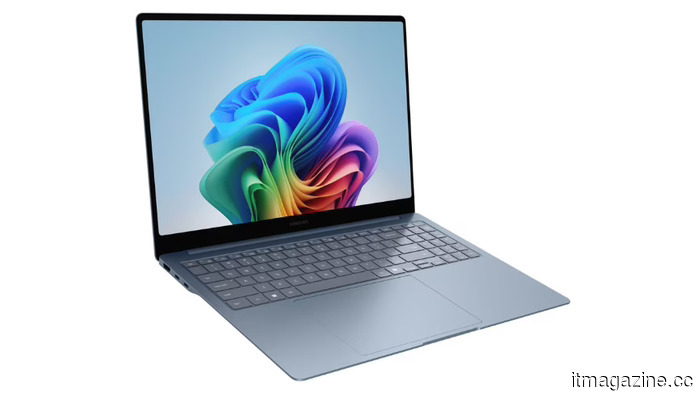
Samsung's Galaxy Book6 Edge, priced at $2,100, comes equipped with 16GB of RAM and is set to be released in 2026.
Samsung has released the Galaxy Book6 Edge, the first laptop featuring Qualcomm’s Snapdragon X2 Elite processor, which offers 80 trillion operations per second thanks to its neural processing unit, doubling the performance of the original Copilot+ PCs. This laptop is also the thinnest Galaxy Book to date, measuring 12.3 millimeters.
In the United States, it retails for $2,099.99 and comes with 16GB of soldered LPDDR5x RAM that cannot be upgraded. This combination of a high price and limited memory in a machine advertised as an AI workstation stands out, especially when compared to Lenovo’s Yoga Slim 7x, which provides 32GB of RAM for $1,899. While Samsung does offer a 32GB option for the Galaxy Book6 Edge in some international markets, the US model is limited to 16GB.
The Snapdragon X2 Elite is Qualcomm’s most powerful laptop chip to date, featuring an 18-core CPU based on the third-generation Oryon architecture, consisting of 12 prime cores and six performance cores. The NPU's 80 TOPS capability is designed for local AI tasks, which is essential for meeting the requirements of Microsoft’s Copilot+ PC designation.
Samsung has equipped the device with a 16-inch Dynamic AMOLED 2X display that supports a resolution of 2880 x 1800 and a refresh rate of 120Hz. The display achieves a brightness of 500 nits and has an anti-reflective coating. Weighing in at 1.55 kilograms, it is lighter than many other 16-inch models.
The battery life is rated at 22 hours per charge with support for 65-watt USB-C charging. The laptop features a reasonably comprehensive selection of ports for its slim profile, including two USB 4.0 Type-C ports, one USB-A port, HDMI 2.1, a microSD card slot, and a 3.5mm audio jack.
Samsung is emphasizing Galaxy AI as a key differentiator. The laptop incorporates various Samsung AI features, such as Circle to Search, Live Translate, Chat Assist, and Note Assist, which are designed to work fluidly across Samsung devices if using a shared account.
However, the broader context is crucial. Microsoft recently made Copilot optional due to a lack of uptake, suggesting uncertainty within the “AI PC” market. Samsung hopes that its integrated Galaxy AI, which is free and seamlessly connects across devices, will attract users more effectively than Microsoft’s standalone offering.
Since its inception, the Copilot+ PC program has evolved, with claims that 93 percent of Windows applications now operate natively on ARM processors, an increase from 87 percent at the first Snapdragon X Elite launch. Features like Recall, Live Captions with translation, and Windows Studio Effects leverage the NPU, although most users may not frequently use them.
The RAM issue is significant for a laptop labeled for AI use. On-device AI processing is memory-intensive, and 16GB may not adequately support demanding tasks like large language models or video processing. A baseline of 32GB would have aligned better with the machine's capabilities and intent. The operating system and various background tasks already utilize a substantial portion of the 16GB, leaving limited capacity for the on-device AI functions that the NPU is meant to enhance.
Samsung has not clarified why the US model is restricted to 16GB when 32GB versions are elsewhere available. The product page notes that the RAM is soldered to the motherboard, indicating no upgrade option. Buyers wishing for 32GB will either need to wait for Samsung to release it in the US or import from another region.
In the competitive landscape, Google has recently discontinued ChromeOS for an Android-based AI laptop called Googlebook, while Apple’s MacBook Neo has introduced pricing below $600 with its A18 Pro chip. The AI laptop market is becoming increasingly crowded, and the Galaxy Book6 Edge is stepping into the premium segment without justifying its price point.
The hardware design is commendable, with Samsung reducing the chassis thickness from 15.5mm in the previous generation to 12.3mm, a decrease of 20%. The Dynamic AMOLED display ranks amongst the best available on Windows laptops.
The Snapdragon X2 Elite should provide actual all-day battery performance, as opposed to the inflated estimates typically given by manufacturers. Samsung claims 22 hours for the Galaxy Book6 Edge.
Connectivity options include Wi-Fi 7 and Bluetooth 5.4. The laptop supports Samsung’s Multi Control feature for using a single keyboard and mouse across devices and Samsung DeX for desktops when connected to an external monitor.
The Galaxy Book6 Edge is now available through Samsung’s website and select retailers in the United States. Whether it offers good value hinges on the importance of 16GB of RAM for potential buyers in 2026, especially in a $2,100 AI laptop where it should be a critical
Other articles
 A single click on a Microsoft link might have emptied your inbox. Here’s how SearchLeak functioned.
Varonis linked three vulnerabilities in Microsoft 365 Copilot Enterprise Search to create a one-click method for data theft that evaded phishing filters and CSP safeguards.
A single click on a Microsoft link might have emptied your inbox. Here’s how SearchLeak functioned.
Varonis linked three vulnerabilities in Microsoft 365 Copilot Enterprise Search to create a one-click method for data theft that evaded phishing filters and CSP safeguards.
 YouTube's AI content cleanup is penalizing human creators who have never revealed their identities.
YouTube has terminated 16 channels that collectively had 4.7 billion views and is experimenting with viewer surveys to identify low-quality AI content. However, faceless creators argue that this enforcement also punishes them.
YouTube's AI content cleanup is penalizing human creators who have never revealed their identities.
YouTube has terminated 16 channels that collectively had 4.7 billion views and is experimenting with viewer surveys to identify low-quality AI content. However, faceless creators argue that this enforcement also punishes them.
 Your Ryzen CPU previously encrypted your RAM, but a firmware update discreetly disabled that feature.
AMD quietly turned off TSME memory encryption on consumer Ryzen processors through a firmware update. This feature remains active on Pro CPUs. AMD has not provided an explanation for this change.
Your Ryzen CPU previously encrypted your RAM, but a firmware update discreetly disabled that feature.
AMD quietly turned off TSME memory encryption on consumer Ryzen processors through a firmware update. This feature remains active on Pro CPUs. AMD has not provided an explanation for this change.
 Huawei's 'chip queen' presents the Tau Scaling Law.
He Tingbo has reemerged to reveal a novel scaling law and LogicFolding architecture that Huawei asserts can achieve 1.4nm chip density by 2031, all without the use of EUV lithography.
Huawei's 'chip queen' presents the Tau Scaling Law.
He Tingbo has reemerged to reveal a novel scaling law and LogicFolding architecture that Huawei asserts can achieve 1.4nm chip density by 2031, all without the use of EUV lithography.
 YouTube's AI content cleanup is penalizing the human creators who chose not to show their faces.
YouTube has shut down 16 channels that accumulated 4.7 billion views and is experimenting with viewer surveys to identify low-quality AI content. However, creators without a visible presence argue that this action unfairly affects them as well.
YouTube's AI content cleanup is penalizing the human creators who chose not to show their faces.
YouTube has shut down 16 channels that accumulated 4.7 billion views and is experimenting with viewer surveys to identify low-quality AI content. However, creators without a visible presence argue that this action unfairly affects them as well.
 Huawei's 'chip queen' reveals the Tau Scaling Law.
He Tingbo has returned to introduce a new scaling law and the LogicFolding architecture, which Huawei asserts can achieve 1.4nm chip density by 2031, all without the use of EUV lithography.
Huawei's 'chip queen' reveals the Tau Scaling Law.
He Tingbo has returned to introduce a new scaling law and the LogicFolding architecture, which Huawei asserts can achieve 1.4nm chip density by 2031, all without the use of EUV lithography.
Samsung's Galaxy Book6 Edge, priced at $2,100, comes equipped with 16GB of RAM and is set to be released in 2026.
Samsung introduced the Galaxy Book6 Edge featuring Qualcomm's Snapdragon X2 Elite and an 80 TOPS NPU, but the $2,100 US version comes with only 16GB of soldered RAM.