
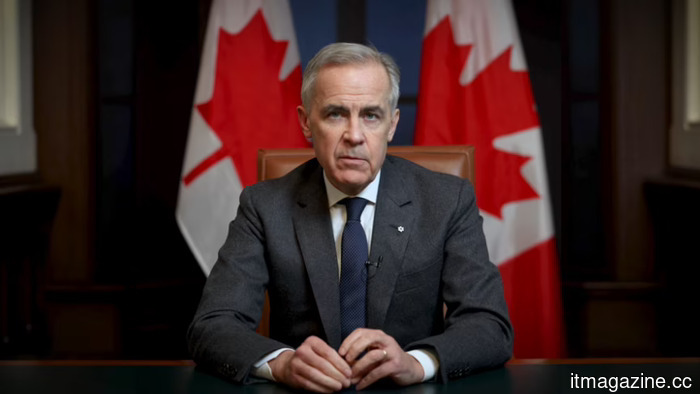
Canada's Carney likens the closure of Anthropic to the 2008 financial crisis, cautioning about the implications of AI.
TL;DR: Mark Carney highlights the risks of AI over-dependence, using the Anthropic model ban as a cautionary tale, similar to the systemic banking issues of 2008, ahead of the G7 summit.
Canadian Prime Minister Mark Carney stated on Sunday that the U.S. export ban that led Anthropic to cease operations for Fable 5 and Mythos 5 illustrates the risks associated with relying on a few dominant AI models. While in Ireland, Carney presented the halt as a warning regarding systemic vulnerabilities, not as a failure of one specific company.
"The current scenario with Mythos and Fable exemplifies what can occur when there’s an over-reliance on certain models," Carney remarked. "No one has acted incorrectly in this instance, but we will be at fault if we merely accept this situation without learning from it and diversifying our approaches."
The former central banker made a direct comparison to the 2008 financial crisis, drawing on his experience leading the Bank of Canada and the Bank of England. He noted, "we see similar issues in terms of model risk," advocating for redundancy and diversity in AI infrastructure, principles that regulators applied to the banking sector following the collapse of Lehman Brothers.
Carney's comparison carries significance due to his background. He served as governor of the Bank of Canada during the 2008 crisis and was the first non-British governor of the Bank of England, where he focused on enhancing the resilience of the financial system. His caution regarding concentrated AI reliance reflects his firsthand experience, rather than mere rhetorical convenience.
He mentioned there's a "good flow of information" between Canadian and U.S. governments on AI matters and recognized that Washington has flagged "some risks" with Anthropic's new models. However, he stressed the need to focus on the structural lesson rather than the specific conflict between Anthropic and the U.S. Commerce Department.
His remarks come just days before the G7 summit in Évian-les-Bains, France, scheduled for June 15-17, where AI governance will be a key topic. Leaders from Anthropic, OpenAI, and Google DeepMind are expected to meet with G7 officials. Carney also noted prior discussions about AI with French President Emmanuel Macron.
"We must progress in AI," Carney stated, while warning that "there will not be a mission accomplished banner at the G7." This indicates that Canada is aiming for concrete commitments on AI diversification rather than just symbolic gestures.
Canada has been active in this regard. On June 4, Carney introduced "AI for All," a $2.3 billion national AI strategy that includes developing sovereign computing infrastructure, building a national supercomputer, and boosting business AI adoption from 12% to 60% by 2034. This strategy explicitly points out the risks of reliance on foreign cloud services.
The Anthropic suspension provides Carney with a tangible example to reference at the G7. A U.S. decision to implement export controls on a specific AI firm has restricted access to its advanced models for users outside the U.S., including allied nations. For G7 countries developing their economies around AI capabilities they do not oversee, the ramifications are significant.
During his visit to Ireland, Carney also finalized a bilateral agreement with Ireland on AI collaboration, technology partnerships, and food security. Ireland currently presides over the EU Council, making it a strategic ally for Canada as it seeks to strengthen European ties in AI, defense, and critical minerals.
This trend is gaining momentum. The EU recently released a tech sovereignty package aimed at reducing dependence on U.S. cloud services. India has proposed a $5 billion sovereign AI fund following the Anthropic suspension. Britain's Cosine is uniting BT, HSBC, and BAE to establish a sovereign frontier model. Carney's analogy from 2008 suggests he perceives these as initial steps in a broader structural shift rather than mere reactions.
Other articles
 Digital Trends Computex 2026 Publisher Awards
Computex 2026 was filled with AI PCs, massive monitors, gaming handhelds, and innovative desktop concepts, but several products stood out amidst the clutter.
Why Apple developed a third-party AI system for Siri and chose not to showcase it at WWDC.
The beta version of Apple's iOS 27 includes an Extensions framework for Claude, Gemini, and ChatGPT integrated within Siri, although this functionality was not highlighted during the WWDC 2026 keynote.
Digital Trends Computex 2026 Publisher Awards
Computex 2026 was filled with AI PCs, massive monitors, gaming handhelds, and innovative desktop concepts, but several products stood out amidst the clutter.
Why Apple developed a third-party AI system for Siri and chose not to showcase it at WWDC.
The beta version of Apple's iOS 27 includes an Extensions framework for Claude, Gemini, and ChatGPT integrated within Siri, although this functionality was not highlighted during the WWDC 2026 keynote.
 From handheld devices to monitors, these were the most significant transformations at Computex 2026.
Following an in-depth experience at Computex 2026, four tech categories distinctly emerged for transforming monitors, portable gaming, creator laptops, and ARM computing through significant innovations.
From handheld devices to monitors, these were the most significant transformations at Computex 2026.
Following an in-depth experience at Computex 2026, four tech categories distinctly emerged for transforming monitors, portable gaming, creator laptops, and ARM computing through significant innovations.
 From handheld devices to monitors, these were the most significant transformations at Computex 2026.
After experiencing firsthand at Computex 2026, these four technology categories distinguished themselves by transforming monitors, handheld gaming, creator laptops, and ARM computing through significant innovations.
From handheld devices to monitors, these were the most significant transformations at Computex 2026.
After experiencing firsthand at Computex 2026, these four technology categories distinguished themselves by transforming monitors, handheld gaming, creator laptops, and ARM computing through significant innovations.
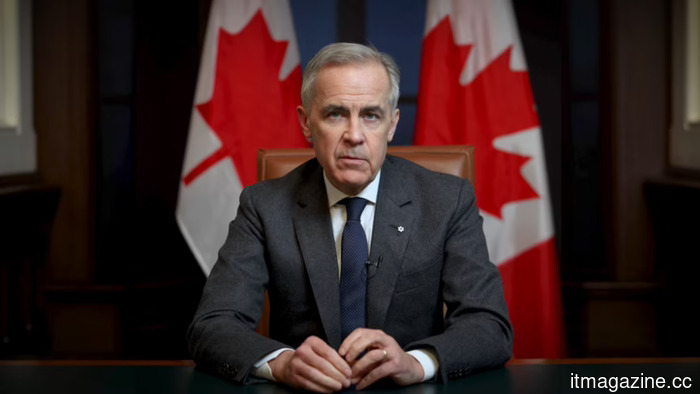 Carney of Canada likens the Anthropic closure to the 2008 financial crisis and issues a warning regarding AI.
PM Carney highlighted that the shutdown of Fable 5 and Mythos 5 illustrates the risks associated with excessive dependence on a limited number of AI models, likening it to the systemic threats posed in 2008.
Carney of Canada likens the Anthropic closure to the 2008 financial crisis and issues a warning regarding AI.
PM Carney highlighted that the shutdown of Fable 5 and Mythos 5 illustrates the risks associated with excessive dependence on a limited number of AI models, likening it to the systemic threats posed in 2008.
 In early 2026, FINQ's AI-managed ETFs subtly surpass Wall Street's performance.
FINQ's two AI-managed ETFs, AIUP and AINT, have surpassed the S&P 500 since their launch on NYSE Arca in February 2026, delivering returns of 15.30% and 27.13%, respectively, compared to the benchmark's 10.07%.
In early 2026, FINQ's AI-managed ETFs subtly surpass Wall Street's performance.
FINQ's two AI-managed ETFs, AIUP and AINT, have surpassed the S&P 500 since their launch on NYSE Arca in February 2026, delivering returns of 15.30% and 27.13%, respectively, compared to the benchmark's 10.07%.
Canada's Carney likens the closure of Anthropic to the 2008 financial crisis, cautioning about the implications of AI.
PM Carney stated that the shutdown of Fable 5 and Mythos 5 illustrates the risks associated with over-dependence on a limited number of AI models, likening it to the systemic threats seen in 2008.