

I tested Acer's latest 5K MiniLED Gaming monitor, and thoughts of OLED kept coming to mind.
If Computex 2026 has shown me anything, it’s that monitor manufacturers are moving away from creating single-purpose devices. They are aiming for displays that can adapt to various uses, effortlessly transitioning between work and recreation without forcing users to make a choice. Acer’s new Nitro XV345CKR P exemplifies this approach, and after experiencing it on the expo floor, I left with a sense of admiration for its potential, while also questioning whether MiniLED truly represents the future of gaming displays.
My relationship with MiniLED has always been somewhat complex. On a large living room television, it excels, as the distance allows the local dimming zones to blend well. However, when the same technology is placed on a monitor just a couple of feet away, admiration for the display turns into scrutiny of its physics.
Acer aims to create a monitor that fulfills multiple roles
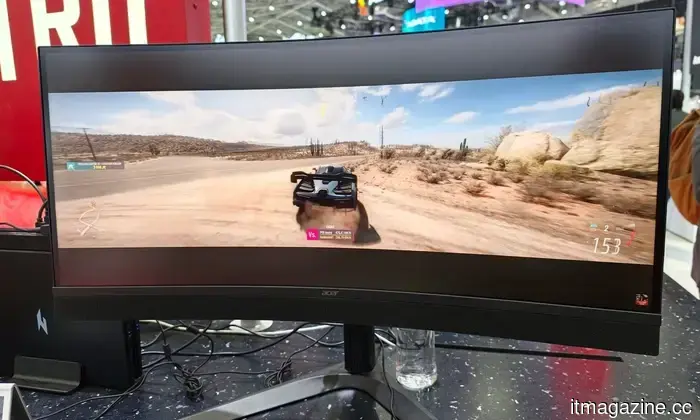
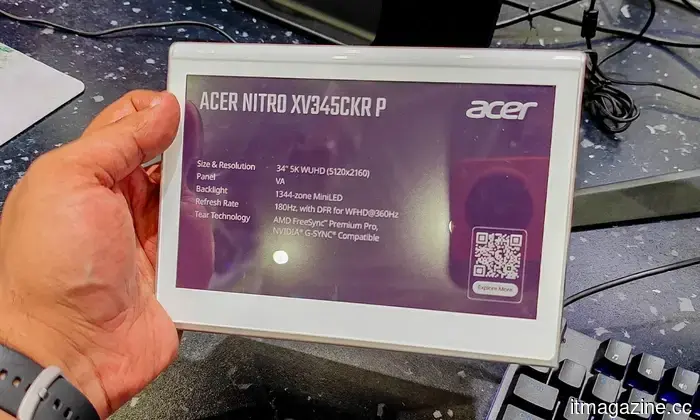
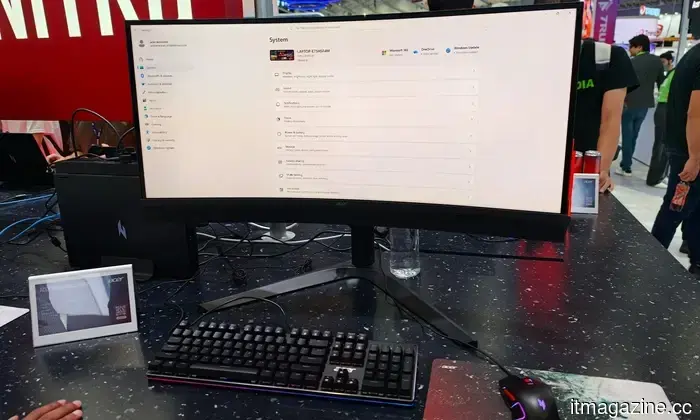
On paper, the Nitro XV345CKR P appears almost too good to be realistic. It features a 34-inch 1500R curved ultrawide screen with a 5K WUHD (5120 x 2160) resolution, which is significantly sharper than the UWQHD OLED ultrawides currently prevailing in the market. This additional resolution not only enhances game visuals but also results in noticeably sharper text and provides far more space for tasks like coding, writing, spreadsheets, or video editing.
Then there’s Acer’s standout feature: Dynamic Frequency and Resolution (DFR). With the push of a button, the monitor can run at 5K and 180Hz for immersive single-player gaming or productivity, and then switch to 2560 x 1080 at 360Hz for competitive gaming where every frame matters. It’s a remarkably inventive concept, positioning Acer as attempting to consolidate both your creator monitor and your gaming monitor into one unit.
The MiniLED implementation is equally ambitious. Equipped with 1,344 local dimming zones and certified for DisplayHDR 1000, the monitor reaches impressive brightness levels and remains completely readable even under the bright lights of the Computex exhibition floor. More significantly, this is not merely another edge-lit VA panel with an impressive label. The densely packed local dimming array offers significantly improved HDR highlights and local contrast, making explosions, reflections, and bright scenes appear far more impactful than they would on a standard LCD monitor.
While the technology impressed me, OLED still occupies a prominent place in my thoughts.
Despite the strong hardware, using the Nitro XV345CKR P reminded me of the intriguing balance between MiniLED and desktop monitors. The close proximity to the display makes the limitations of local dimming far easier to detect. During my experience, I still observed blooming around bright objects set against dark backgrounds; although black levels were better than those of a typical VA panel, they never reached the pixel-perfect darkness that OLED displays have conditioned many enthusiasts to anticipate. This is less a critique of Acer than a limitation inherent to the technology itself.
Nonetheless, MiniLED deserves recognition for its merits. Compared to a traditional edge-lit VA monitor, this implementation stands in a different category altogether, providing outstanding brightness, superior HDR performance, and much improved local contrast. Additionally, it alleviates a concern that continues to worry some consumers about OLED: burn-in. For users who spend all day looking at static toolbars, spreadsheets, or editing timelines before transitioning to gaming, this presents a real advantage.
Ultimately, I don't believe that the Acer Nitro XV345CKR P aims to challenge OLED, and that’s completely acceptable. Instead, it is establishing its own niche, offering a unique mix of sharp 5K visuals, impressive HDR brightness, and the versatility to switch between productivity and high-refresh gaming on a single screen. While many enthusiasts may still lean towards OLED, this innovative MiniLED monitor, if priced appropriately, demonstrates that there is still ample opportunity for advancement beyond self-lit pixels.
Other articles
 Holding out for a drop in smartphone prices? The CEO of Nothing has some disappointing news for you.
According to Carl Pei, the aspect of your phone that often goes unnoticed—RAM—has now become its most costly component.
Holding out for a drop in smartphone prices? The CEO of Nothing has some disappointing news for you.
According to Carl Pei, the aspect of your phone that often goes unnoticed—RAM—has now become its most costly component.
 Hoping for a decrease in smartphone prices? The CEO of Nothing has some discouraging news for you.
According to Carl Pei, the RAM in your phone, which often goes unnoticed, is now its most costly component.
Hoping for a decrease in smartphone prices? The CEO of Nothing has some discouraging news for you.
According to Carl Pei, the RAM in your phone, which often goes unnoticed, is now its most costly component.
 One UI 9 will finally introduce a feature to Samsung phones that many Android devices have already had for years.
The One UI 9 beta seems to introduce a long-awaited status bar feature that enables Galaxy users to monitor real-time Wi-Fi and mobile data speeds without the need for a third-party application.
One UI 9 will finally introduce a feature to Samsung phones that many Android devices have already had for years.
The One UI 9 beta seems to introduce a long-awaited status bar feature that enables Galaxy users to monitor real-time Wi-Fi and mobile data speeds without the need for a third-party application.
 The US government has instructed Anthropic to cease operations of Fable 5 and Mythos 5.
Washington compelled Anthropic to deactivate its most advanced AI models due to a contested jailbreak, just three days following the launch. Anthropic claims that the response is excessive.
The US government has instructed Anthropic to cease operations of Fable 5 and Mythos 5.
Washington compelled Anthropic to deactivate its most advanced AI models due to a contested jailbreak, just three days following the launch. Anthropic claims that the response is excessive.
 The US has instructed Anthropic to discontinue Fable 5 and Mythos 5.
Washington compelled Anthropic to deactivate its most advanced AI models due to a contentious jailbreak, just three days following their release. Anthropic claims that this response is excessive.
The US has instructed Anthropic to discontinue Fable 5 and Mythos 5.
Washington compelled Anthropic to deactivate its most advanced AI models due to a contentious jailbreak, just three days following their release. Anthropic claims that this response is excessive.
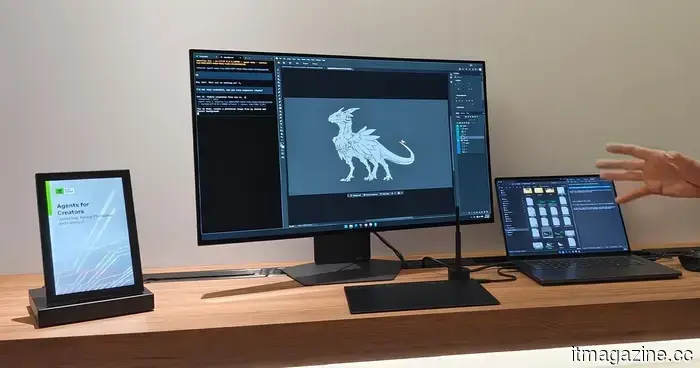 Nvidia's RTX Spark somewhat diminished my dislike for content creation.
Having witnessed the NVIDIA RTX Spark in operation at Computex 2026, I am persuaded that its AI-driven editing features have the potential to spare creators countless hours by removing the most monotonous aspects of video editing.
Nvidia's RTX Spark somewhat diminished my dislike for content creation.
Having witnessed the NVIDIA RTX Spark in operation at Computex 2026, I am persuaded that its AI-driven editing features have the potential to spare creators countless hours by removing the most monotonous aspects of video editing.
I tested Acer's latest 5K MiniLED Gaming monitor, and thoughts of OLED kept coming to mind.
Experimenting with the Acer Nitro XV345CKR P showcases a daring approach to MiniLED gaming monitors, striking a balance between 5K sharpness, HDR vibrancy, and adaptability, while competing with the undeniable attraction of OLED displays.