

Deezer is combating low-quality content with a tool that identifies AI-generated music on streaming services.
The newly introduced free scanner operates across major streaming platforms as Deezer advocates for wider licensing.
Deezer has unveiled a free online AI music detection tool that scans playlists from 20 prominent streaming services for tracks generated by AI. This tool utilizes the same technology that Deezer employs to identify and label synthetic music within its own platform.
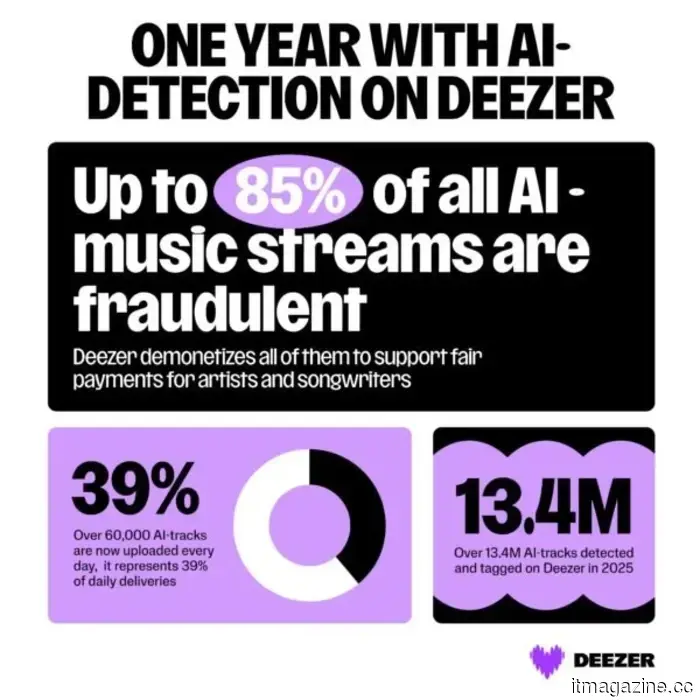
Available in 27 languages, this tool debuts at a time when Deezer reports receiving nearly 75,000 AI-generated tracks daily. This significant volume enhances the launch beyond a mere playlist purification feature; it serves as an avenue for exposing synthetic-track detection to listeners before a consensus on rules is reached in the streaming industry.
Detecting AI music in playlists
According to Deezer, 43% of users arriving from other platforms already have AI-generated tracks in their playlists. For these listeners, the new scanner addresses a fundamental question that many platforms have yet to clarify effectively.
Users can link their streaming accounts, select playlists, and examine the results. Since the scanner operates across 20 popular services, Deezer can showcase its detection system to individuals who do not use its app.
This initiative comes as major music apps explore the limits of generative tools, with Spotify experimenting with AI-created covers and remixes. Deezer, however, concentrates on the subsequent cleanup by identifying AI songs that have already been added to libraries.
The industry's interest in licensing Deezer’s detector
Deezer claims its detection technology can recognize tracks from significant generative music models like Suno and Udio. It is also expandable as the company acquires more data examples from other tools.
The company has reportedly made advancements on a more comprehensive system capable of detecting synthetic content without needing a model-specific training set. This development offers Deezer a business rationale beyond the public playlist scanner. The goal is for platforms, labels, distributors, and rights organizations to adopt this underlying technology to identify machine-generated tracks before they disrupt discovery mechanisms or payment systems.
Implications following the tagging of AI tracks
Deezer indicates that fully AI-generated music constitutes only 1% to 3% of streams on its platform, but claims that as much as 85% of these streams were fraudulent in 2025. When Deezer detects stream manipulation, it excludes those plays from royalty calculations.
The platform has already removed AI-generated tracks from algorithmic recommendations and editorial playlists. Broader strategies, such as changes in supplier policies or demonetization, are still being assessed. For both listeners and the industry, Deezer's key message is clear: detection must occur before trust, royalties, and recommendations can be addressed.
Paulo Vargas is an English major turned reporter turned technical writer, whose career has consistently revolved around…
Jabra Evolve3 75 review: I wore this work headset for weeks, and it was a revelation
Jabra Evolve3 75 illustrates that work headphones can be both stylish and unexpectedly versatile.
Insta360 Luna Ultra brings 8K recording and advanced stabilization to creators
Insta360 has officially introduced the Luna Series, a fresh lineup of compact gimbal cameras developed in collaboration with Leica, led by the new Insta360 Luna Ultra – a dual-lens 8K camera tailored for creators seeking professional-grade stabilization and cinematic image quality in a portable design. The Luna Ultra signifies Insta360’s recent focus on the premium creator and mobile filmmaking segment. The camera integrates a dual-lens configuration with a built-in gimbal system, enabling users to capture ultra-steady footage while shooting handheld or moving through dynamic environments.
A guide to Sony’s 2026 TVs and home theater lineup
Sony’s latest BRAVIA lineup introduces True RGB technology alongside new televisions and home theater audio products. Sony believes it may have found the solution for home theater this year. The company is not only launching new TVs but is also rethinking how televisions reproduce color with a groundbreaking technology called True RGB, while simultaneously expanding its home theater product range with offerings like the BRAVIA Theater Trio. After previewing the lineup in New York, it became evident why Sony thinks True RGB could be a significant aspect of its 2026 offerings. The technology was the highlight of Sony's presentation, but the overarching narrative was equally compelling. The company presented data suggesting that many premium TVs are still fine-tuned for optimal viewing conditions rather than the actual environments where most audiences watch TV. Sony indicated that only about 13% of viewers watch content in settings akin to a movie theater or professional grading suite, while the remaining 87% are viewing in brightly lit living rooms, open floor plans, and spaces with lighting conditions that fluctuate throughout the day.






Other articles
 Bezos's Prometheus secures $12 billion at a $41 billion valuation to develop AI that designs physical products.
Jeff Bezos's AI venture, Prometheus, secured $12 billion from JPMorgan, Goldman Sachs, and BlackRock, reaching a valuation of $41 billion. The company is developing an "artificial general engineer."
Bezos's Prometheus secures $12 billion at a $41 billion valuation to develop AI that designs physical products.
Jeff Bezos's AI venture, Prometheus, secured $12 billion from JPMorgan, Goldman Sachs, and BlackRock, reaching a valuation of $41 billion. The company is developing an "artificial general engineer."
 Coinbase introduces an AI agent capable of trading cryptocurrency and funding research on your behalf.
Coinbase's new AI agent is capable of executing trades, rebalancing portfolios, and purchasing premium data through the x402 protocol. It operates within ChatGPT and Claude via MCP.
Coinbase introduces an AI agent capable of trading cryptocurrency and funding research on your behalf.
Coinbase's new AI agent is capable of executing trades, rebalancing portfolios, and purchasing premium data through the x402 protocol. It operates within ChatGPT and Claude via MCP.
 Why the upcoming AI safety issue revolves around interactions between models.
Once an AI agent possesses tools and has access to a real execution environment, it must be regarded as an untrusted process. Bar Mazuz, a former cyber researcher from Unit 8200, discusses why ensuring the security of communication between agents is the often-ignored infrastructure challenge.
Why the upcoming AI safety issue revolves around interactions between models.
Once an AI agent possesses tools and has access to a real execution environment, it must be regarded as an untrusted process. Bar Mazuz, a former cyber researcher from Unit 8200, discusses why ensuring the security of communication between agents is the often-ignored infrastructure challenge.
 Your ChatGPT costs may soon see a significant reduction.
OpenAI is considering significant price reductions as it competes with Anthropic for clients. With companies hesitant about AI expenses and Google offering lower prices, your costs for AI services may soon decrease.
Your ChatGPT costs may soon see a significant reduction.
OpenAI is considering significant price reductions as it competes with Anthropic for clients. With companies hesitant about AI expenses and Google offering lower prices, your costs for AI services may soon decrease.
 Bezos's Prometheus secures $12 billion at a $41 billion valuation to develop AI for engineering physical products.
Jeff Bezos's AI company Prometheus has secured $12 billion in funding from JPMorgan, Goldman Sachs, and BlackRock, achieving a valuation of $41 billion. The startup is developing an "artificial general engineer."
Bezos's Prometheus secures $12 billion at a $41 billion valuation to develop AI for engineering physical products.
Jeff Bezos's AI company Prometheus has secured $12 billion in funding from JPMorgan, Goldman Sachs, and BlackRock, achieving a valuation of $41 billion. The startup is developing an "artificial general engineer."
 Barcelona's THEKER secures €73M to implement AI-native factory robots that adapt through on-the-job learning.
THEKER secured €73M from CRV, Samsung, and LVMH to develop general-purpose factory robots that can be deployed within days and enhance their capabilities autonomously. This marks Samsung's initial investment in Spain.
Barcelona's THEKER secures €73M to implement AI-native factory robots that adapt through on-the-job learning.
THEKER secured €73M from CRV, Samsung, and LVMH to develop general-purpose factory robots that can be deployed within days and enhance their capabilities autonomously. This marks Samsung's initial investment in Spain.
Deezer is combating low-quality content with a tool that identifies AI-generated music on streaming services.
Deezer's complimentary AI music detector scans playlists on major streaming services, but the more significant development is its initiative to license synthetic-song detection throughout the music industry.