

Google is eager to acquire your app code and is ready to offer payment for it.
Google has been discreetly contacting Android developers with an offer to purchase access to their code. As reported by 404 Media, the company has sent out emails to a select group of Google Play developers, inviting them to participate in a “confidential content offer pilot.”
The email promotes this as a revenue opportunity, stating that developers can “earn money by sharing the code behind your apps, as well as your archived projects.” Google assures that developers maintain their intellectual property rights and that the license offered is non-exclusive.
But what is Google actually seeking the code for?
The report indicates that while the email does not mention artificial intelligence, a link in it leads to a page titled “partnerships to enhance our AI products.” On that page, Google explicitly states it is paying for “non-public content in various media formats” to refine its AI models.
Connecting the dots is straightforward. Google’s Gemini excels in image and text generation but has been lagging in AI coding tools, whereas Anthropic has notably benefited from the success of Claude Code, achieving a valuation higher than that of OpenAI.
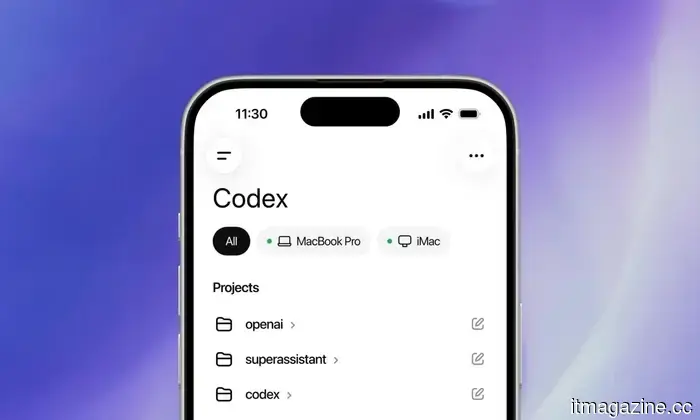
OpenAI has introduced its own Codex app tailored for developers. During the recent Google I/O, the company presented its Antigravity 2.0 IDE capable of creating complete applications.
It appears that Google is looking to train its AI with actual code to enhance its programming abilities, enabling it to compete with Claude Code and ChatGPT’s Codex. Acquiring real-world code from developers serves as a shortcut to bridging that gap.
Is this approach problematic?
While the long-term consequences could be unfavorable for developers, Google’s strategy is not inherently wrong. At least it’s an improvement over training AI on vast numbers of books and online materials without consent, a practice that many AI companies have employed.
Developers maintain their intellectual property, the license is non-exclusive, and they receive payment. However, the lack of transparency in the email is noteworthy. Presenting an AI data acquisition initiative as a mere “revenue opportunity” without any mention of AI seems to suggest that Google is hoping developers won’t probe too deeply into the details.
Rachit is an experienced tech journalist with over a decade of experience covering consumer technology.
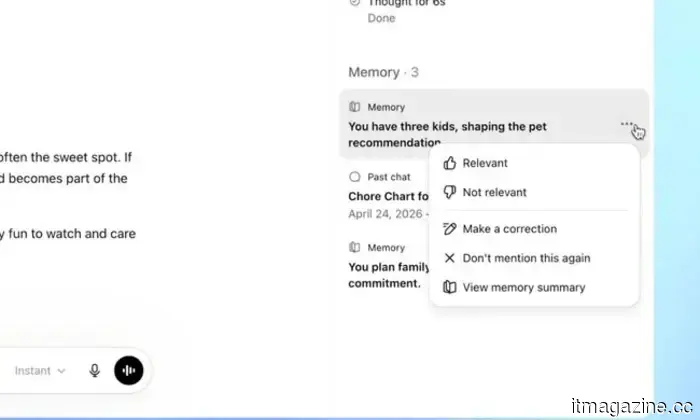
ChatGPT is enhancing its ability to remember your life so that conversations don’t seem odd.
OpenAI's new dreaming system automatically learns from your chat history, keeping that information updated over time.
ChatGPT has long been capable of recalling details about you between conversations, but maintaining the accuracy of those memories over time has been a consistent challenge. OpenAI is now introducing a revamped memory system called "dreaming" to tackle this issue, and it represents the most significant revision of ChatGPT's memory since the feature was launched in 2024.
How the new system functions
Brave Origin is a minimalist browser that eliminates unnecessary jargon, but there’s a cost of $60 for that simplicity.
Brave Origin removes the crypto wallet, AI assistant, rewards program, and more for a one-time payment of $59.99, though critics argue that users can already disable those features without cost.
Brave has built its reputation as a lightweight, privacy-centric alternative to Chrome, but over time it has added a crypto wallet, an AI assistant, a news feed, and a rewards program. In response to user dissatisfaction with these additional features, the company has launched a simplified version of the browser called Brave Origin. However, this version is not available for free unless you're using Linux.
What’s included and what’s omitted
Google will sift through your Gmail inbox if you request it while working in Drive.
Google’s AI can now read your work emails so you won’t have to.
Google is enhancing the capabilities of Gemini within Workspace, allowing users to pull Gmail conversations directly into Ask Gemini while using Drive. This provides the AI assistant with greater access to emails, documents, and folders in a single workspace.
The feature, which is now generally available for qualifying Google Workspace and Google AI subscribers, is designed to assist users in asking more intricate questions while working in Google Drive. Instead of needing to switch back and forth between Gmail and Drive for information gathering, users can now input entire email threads into Gemini alongside files and folders to receive context-aware responses.



Other articles
 Google is so eager for your app code that it's prepared to compensate you for it.
Google is proposing to compensate Android developers for access to their code via a "confidential content offer pilot." While the initiative is presented as a chance to generate revenue, the link provided in the email suggests otherwise.
Google is so eager for your app code that it's prepared to compensate you for it.
Google is proposing to compensate Android developers for access to their code via a "confidential content offer pilot." While the initiative is presented as a chance to generate revenue, the link provided in the email suggests otherwise.
 Open-ear earbuds are finally functioning like true everyday devices.
Shokz OpenDots 2 enhances the case for open-ear earbuds in daily use, featuring improved audio performance, a lighter clip-on design for comfort, more intuitive controls, extended battery life, and some details that were not provided at launch.
Open-ear earbuds are finally functioning like true everyday devices.
Shokz OpenDots 2 enhances the case for open-ear earbuds in daily use, featuring improved audio performance, a lighter clip-on design for comfort, more intuitive controls, extended battery life, and some details that were not provided at launch.
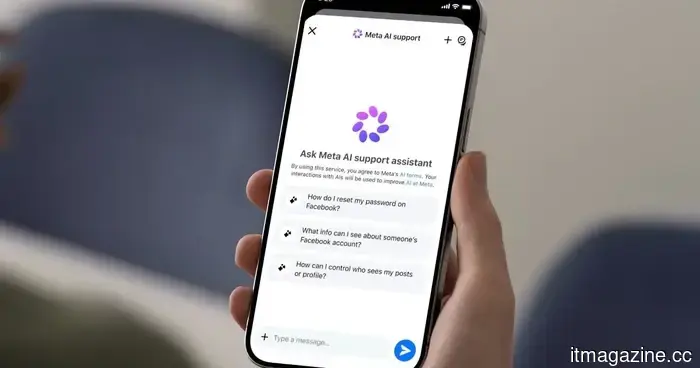 Don't expect to see Meta's Muse Spark AI appearing in your phone applications in the near future.
Meta's upcoming major AI model might not be launched as soon as the company initially anticipated. A report by The Wall Street Journal indicates that Meta has postponed the rollout of its flagship AI model, referred to internally as “Muse Spark,” multiple times, prompting new concerns regarding the company's ambitions and preparedness in the AI space. The delays are said to […]
Don't expect to see Meta's Muse Spark AI appearing in your phone applications in the near future.
Meta's upcoming major AI model might not be launched as soon as the company initially anticipated. A report by The Wall Street Journal indicates that Meta has postponed the rollout of its flagship AI model, referred to internally as “Muse Spark,” multiple times, prompting new concerns regarding the company's ambitions and preparedness in the AI space. The delays are said to […]
 Open-ear earbuds are finally functioning like true daily companions.
Shokz OpenDots 2 enhances the case for open-ear earbuds for everyday use, boasting improved audio quality, lighter clip-on comfort, more intuitive controls, extended battery life, and some omitted details at launch.
Open-ear earbuds are finally functioning like true daily companions.
Shokz OpenDots 2 enhances the case for open-ear earbuds for everyday use, boasting improved audio quality, lighter clip-on comfort, more intuitive controls, extended battery life, and some omitted details at launch.
 Cash App has just introduced a wand for making payments, as phone scans and taps have become quite dull.
Cash App has introduced the Cash App Wand, a $25 keychain accessory equipped with NFC technology that functions like a debit card at any contactless payment terminal.
Cash App has just introduced a wand for making payments, as phone scans and taps have become quite dull.
Cash App has introduced the Cash App Wand, a $25 keychain accessory equipped with NFC technology that functions like a debit card at any contactless payment terminal.
 Coursera aims for users to acquire knowledge via more concise and quicker content.
Coursera has introduced a short-form content feed powered by AI, which provides personalized educational videos tailored to users' interests and learning behaviors.
Coursera aims for users to acquire knowledge via more concise and quicker content.
Coursera has introduced a short-form content feed powered by AI, which provides personalized educational videos tailored to users' interests and learning behaviors.
Google is eager to acquire your app code and is ready to offer payment for it.
Google is proposing to compensate Android developers for permission to access their code via a "confidential content offer pilot." While the initiative is presented as a potential revenue source, the link provided in the email suggests a different narrative.