
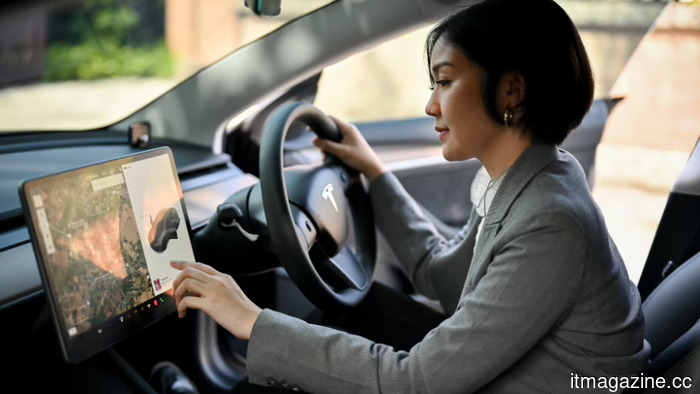
The individuals who developed Tesla's self-driving AI decline to ride in it.
TL;DRA An investigation by Reuters revealed that seven out of nine Tesla data labelers would not use the Full Self-Driving (FSD) feature, reporting that they frequently witnessed the system speeding and malfunctioning on camera.
Reuters spoke with nine former Tesla data labelers and a previous self-driving engineer regarding their opinions on Tesla’s FSD mode. Seven of the nine specialists expressed that they would refuse to ride in a Tesla utilizing FSD, with one emphatically stating they would not do so even for compensation. “We have all seen it fail,” one source shared with Reuters, while the former engineer agreed, stating, “Definitely don’t trust Elon on this,” in reference to Musk's assertion that Tesla vehicles are prepared for "safe unsupervised" driving.
The data labelers were tasked with reviewing hours of FSD footage to improve the vehicle software and prevent previous errors. They had access to extensive proprietary driving data, with at least five of them informing Reuters that they regularly saw videos of Teslas exceeding speed limits while utilizing FSD. This issue of speeding was deemed a low priority by engineering and management, with more focus given to edge cases like unusual road layouts or rare lighting scenarios. Routine speeding, which is a common issue across all journeys, was deprioritized.
This investigation arises as Tesla broadens the FSD's availability to new markets, recently confirming its presence in China, although it remains uncertain if regular consumers can activate the system yet. The FSD (Supervised) feature is categorized as Level 2, necessitating constant driver oversight, while a fully autonomous, unsupervised version is currently being tested solely with a fleet of robotaxis in Austin, Texas.
In recent months, there have been several incidents involving FSD, including Teslas driving into lakes, off bridges, and in front of trains. These are just the incidents reported in the media, while the testimonies from data labelers imply there is a much larger number of internal failures captured in footage.
The disparity between Musk's promises and the actual performance of the system has been an ongoing issue, with Musk pledging fully autonomous driving since 2016 without fulfilling those commitments. The robotaxi service in Austin operates within a geofenced region and includes safety drivers who can assist remotely.
Recent shutdowns of Waymo’s services due to flooding highlighted that even the most advanced autonomous systems face challenges in everyday conditions. Tesla’s methodology contrasts significantly with Waymo's, using camera-only perception as opposed to multi-sensor integration, and converting a consumer vehicle into an autonomous one rather than using a robotaxi designed for that purpose.
The testimony of the data labelers is crucial as these individuals are closest to the actual performance data, without exposure to marketing materials or financial projections. They view countless hours of footage that illustrate the software's behavior on public roads, yet seven out of nine indicated they would not ride in the product they helped develop.
Tesla did not provide a comment to Reuters. The company has previously stated that FSD (Supervised) requires active driver supervision and that its safety metrics indicate the system is safer than human drivers on a per-mile basis, a claim that the former engineer interviewed by Reuters challenged.
This investigation raises a significant question that Tesla's regulatory documents and marketing materials fail to address: if those responsible for training the AI lack faith in it, what justification is there for passengers to trust it?
Other articles
 SoftBank is committing €75 billion to develop 5 gigawatts of AI data centers in France. This marks Son's largest investment in Europe.
The initial phase aims to provide 3.1 GW in northern France by 2031 at a cost of €45 billion. Macron personally engaged with Son, who found the president's dedication to be "impressive."
SoftBank is committing €75 billion to develop 5 gigawatts of AI data centers in France. This marks Son's largest investment in Europe.
The initial phase aims to provide 3.1 GW in northern France by 2031 at a cost of €45 billion. Macron personally engaged with Son, who found the president's dedication to be "impressive."
 Following Google's removal of blue links, DuckDuckGo installations surged by 18%. On Apple devices, the increase reached 70%.
The revamp of Google's AI search at I/O led to a six-day increase in DuckDuckGo installations. Additionally, visits to its AI-free search page climbed by 23%. The CEO described it as an exodus.
Following Google's removal of blue links, DuckDuckGo installations surged by 18%. On Apple devices, the increase reached 70%.
The revamp of Google's AI search at I/O led to a six-day increase in DuckDuckGo installations. Additionally, visits to its AI-free search page climbed by 23%. The CEO described it as an exodus.
 The individuals who developed Tesla's self-driving AI choose not to use it.
A Reuters investigation revealed that individuals involved in training Tesla's self-driving AI often observed it exceeding speed limits. Engineers considered this concern to be of low importance.
The individuals who developed Tesla's self-driving AI choose not to use it.
A Reuters investigation revealed that individuals involved in training Tesla's self-driving AI often observed it exceeding speed limits. Engineers considered this concern to be of low importance.
 DuckDuckGo installations surged by 18% following Google's removal of blue links, with a notable increase of 70% on Apple devices.
The revamp of Google’s AI search during the I/O event led to a six-day increase in DuckDuckGo downloads. There was a 23% rise in traffic to its search page without AI. The CEO refers to it as an exodus.
DuckDuckGo installations surged by 18% following Google's removal of blue links, with a notable increase of 70% on Apple devices.
The revamp of Google’s AI search during the I/O event led to a six-day increase in DuckDuckGo downloads. There was a 23% rise in traffic to its search page without AI. The CEO refers to it as an exodus.
 Twenty former Snap employees have established an angel fund aimed at supporting the next generation of social media. Their belief is that
Ghost Angels is supporting pre-seed to seed AI startups that are developing solutions beyond the ad-algorithm framework. The fund has already invested in five companies and intends to back 15 more.
Twenty former Snap employees have established an angel fund aimed at supporting the next generation of social media. Their belief is that
Ghost Angels is supporting pre-seed to seed AI startups that are developing solutions beyond the ad-algorithm framework. The fund has already invested in five companies and intends to back 15 more.
 A 9-gigawatt data center has caused anger in a Utah community. The governor has just implemented new regulations.
Governor Cox signed an executive order establishing a "higher standard" for the development of data centers following protests triggered by Kevin O'Leary's 40,000-acre Stratos Project.
A 9-gigawatt data center has caused anger in a Utah community. The governor has just implemented new regulations.
Governor Cox signed an executive order establishing a "higher standard" for the development of data centers following protests triggered by Kevin O'Leary's 40,000-acre Stratos Project.
The individuals who developed Tesla's self-driving AI decline to ride in it.
A Reuters investigation revealed that the individuals responsible for training Tesla's self-driving AI frequently observed it exceeding speed limits. Engineers considered this problem to be of minor importance.