
A new era of PCs or the old pain of Windows on Arm
Nvidia, Microsoft, and Arm are once again shaking up the PC market. According to industry media, Nvidia is preparing Arm chips for Windows laptops. If the announcement is confirmed, it will be a new attempt to sell the Windows on Arm business, local AI, and a shift from the traditional architecture. Nvidia, Microsoft, and Arm have synchronously talked about a "new era of PCs." The Verge and Tom’s Hardware linked this signal to the expected Arm chips from Nvidia for Windows laptops. In leaks, they are referred to as N1 and N1X. Nvidia has not officially presented them yet. There are no specifications, delivery timelines, prices, or lists of OEM partners. But if the announcement is confirmed, Nvidia will enter the Windows PC market as one of the suppliers of laptop architecture.
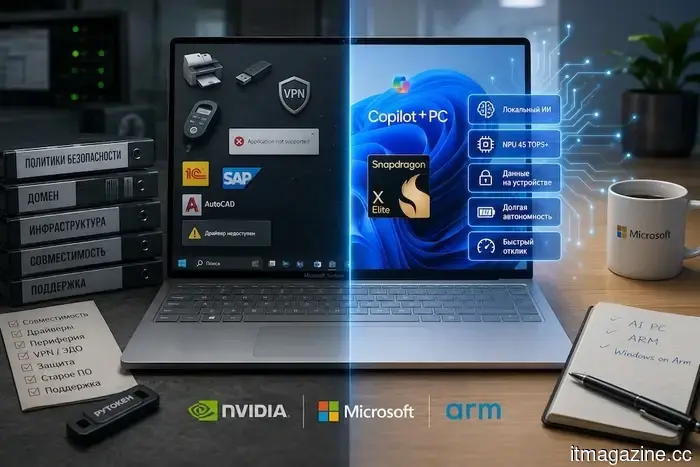
Windows on Arm has long been offered to the market. It promises longer battery life, less heat, quick wake-up from sleep, behavior closer to smartphones, and yet it will be a full-fledged Windows laptop. But for now, everything hinges on the old Windows ecosystem. Applications, drivers, VPNs, security agents, peripherals, corporate policies, industry software. What will happen with compatibility?
Windows on Arm was not invented yesterday.
Microsoft has long been trying to move Windows beyond x86. The legacy of Windows itself is a hindrance. Applications, drivers, industry software, security tools, VPN clients, internal tools, and old peripherals have been built around Intel and AMD for years. It cannot be quickly transferred.
The problem is not even with Arm. Apple has already shown that fast, quiet, and mass-market laptops can be made on this architecture. But Apple controlled the entire transition process. Hardware, system, developers, timelines, rules of the game. Windows does not have that. What was once an advantage of the ecosystem is now holding it back. Windows is strong due to its vast market of compatible software, devices, and corporate tools. But it is precisely this market that is the hardest to transition to a new architecture.
Microsoft is trying to close old weak spots. Emulation of x86 and x64 has noticeably improved. A new series of Windows laptops on Arm has been released on Snapdragon X. These devices can already be evaluated as working laptops, not just a technological experiment.
The next argument has been local AI. This led to the emergence of Copilot+ PC, a class of Windows devices with a powerful NPU for some AI tasks directly on the laptop, without constantly sending data to the cloud. Microsoft proposed a scenario where the laptop itself searches, writes, translates, processes images, analyzes documents, and gradually takes over some work actions through assistants. Arm is needed here for local AI on the working device.
This logic is already visible in devices for local AI. IT-World wrote about systems where an embedded LLM operates on the device, and hardware acceleration through NPU and GPU allows commands to be executed without constant access to the cloud. The main argument in this case is not even effectiveness, but control over data: files and code remain on the machine.
From here, the requirements for hardware are changing. It is no longer just about CPU, memory, and autonomy. A combination of CPU, GPU, NPU, battery, and thermal package is needed. But AI PCs have not yet gained real recognition in business. Local AI must first become part of the workflow. It should reduce time, eliminate manual operations, lower risks, and provide control over data. Without this, it simply makes the laptop more expensive and harder to administer.
Place your bets.
Nvidia does not need just another processor market. It needs a new layer of computing. Server AI has already become its territory. Now the question is whether AI will remain only in data centers or if part of the load will move to the working device. If it moves, the laptop will stop being just a screen for cloud services. For Nvidia, this is a natural expansion of its area of interest.
Microsoft is solving a different task. Windows PCs have relied on compatibility for many years. But Apple Silicon has changed the perception of a good laptop. Quiet, fast, autonomous, without obvious compromise. Microsoft now needs not just to maintain historical compatibility but to give Windows as a platform a new life. Copilot+ PC partially addresses this task. It is not an operating system for the usual fleet but a device for working with modern technologies.
Arm also needs to step out of Apple's shadow. So far, Arm's main success in PCs is the Mac. It has proven that the architecture works in laptops but has not made it a standard outside the Apple ecosystem. If Nvidia and Microsoft present a strong Windows laptop on Arm, the landscape will change. The architecture will have a chance to become a working option for the large PC market.
Laptop manufacturers are counting on a reshaping of the established market. But this will only work if local computing truly takes over the device itself. Snapdragon X has already provided the first experience of using Windows on Arm and has given Microsoft the foundation for Copilot+ PC. Nvidia may try to make this segment more productive and interesting for tasks where graphics, local AI, and data processing are important.
This niche is already visible in current configurations for designers and engineers. IT-World reviewed models with Ryzen AI 9 HX 370, NPU 50 TOPS, and NVIDIA GeForce RTX 5060 or RTX 5070 graphics. This is not a mass office machine but a working tool for graphics, video, engineering tasks, and local AI.
Intel and AMD remain the main barrier. They have proven compatibility, established supply chains and support, a familiar corporate infrastructure, and a vast fleet of x86 applications. IT-World wrote about laptops on Ryzen AI 300 with NPU 50 TOPS, which can already handle AI tasks on the device without sending data to the cloud. If x86 gets NPU and local AI functions, the question arises: why change the architecture?
Therefore, Nvidia, Qualcomm, and Microsoft must demonstrate an advantage that ordinary x86 laptops do not have. Autonomous operation with local models, processing sensitive documents without the cloud, transcribing meetings on the device, searching corporate files without sending data to an external service, heavy scenarios for engineers, designers, analysts, and developers. Without such an advantage, Windows on Arm will remain an interesting alternative but not an obvious choice for the corporate fleet.
A new era of PCs or the old pain of Windows on Arm
Nvidia, Microsoft, and Arm are once again shaking up the PC market. According to industry media, Nvidia is preparing Arm chips for Windows laptops. If the announcement is confirmed, it will be a new attempt to sell the Windows on Arm business, local AI, and a shift from the usual architecture.