
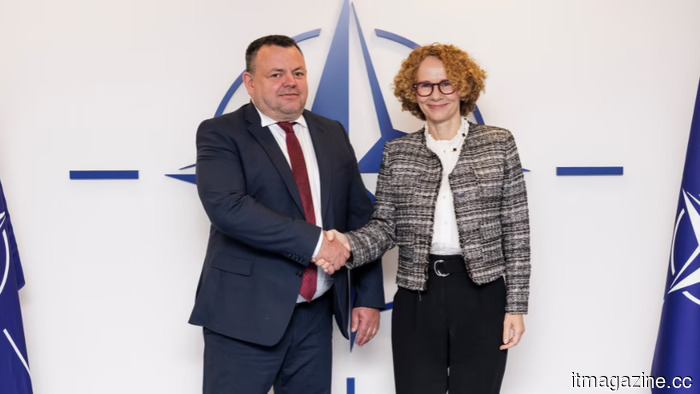
NATO establishes cyber partnerships with Microsoft, Palo Alto, and ESET.
TL;DR
NATO has established formal strategic cybersecurity partnerships with Microsoft, Palo Alto Networks, and ESET, which were announced on 27 May 2026 at the CyCon conference in Tallinn. These partnerships focus on sharing threat intelligence, best practices, and enhancing coordinated cyber defense efforts, while being categorized as non-commercial agreements.
NATO has forged strategic partnerships in cybersecurity with Microsoft, Palo Alto Networks, and ESET, formalizing what it describes as non-commercial agreements intended to bolster collective cyber resilience. The announcement was made on 27 May during the International Conference on Cyber Conflict (CyCon) held in Tallinn, Estonia, organized by NATO’s Cooperative Cyber Defence Centre of Excellence.
These agreements encompass dialogue, information sharing, best practices exchange, and coordinated efforts to tackle mutual threats, without involving commercial contracts or procurement. This distinction is significant as it positions the partnerships as a policy mechanism rather than a vendor relationship, ensuring NATO has organized access to threat intelligence and defensive expertise from three leading cybersecurity firms without the complications associated with procurement processes.
Rationale for the chosen companies
The choice of Microsoft, Palo Alto Networks, and ESET represents the main pillars of the Western cybersecurity framework. Microsoft operates the largest cloud infrastructure that supports NATO member countries and possesses significant insight into threats targeting enterprise and government systems. Palo Alto Networks stands as the largest specialized cybersecurity company by market value and is recognized for its leadership in network security and AI-driven threat detection. ESET, a privately held Slovak company, offers a distinctly European viewpoint and is recognized for its extensive research on advanced persistent threats, particularly concerning state-sponsored groups targeting essential infrastructure in Europe.
ESET's inclusion is particularly noteworthy. Established in Bratislava in 1992, ESET employs around 1,900 staff and has an estimated annual revenue of $612 million, making it Europe’s largest privately-owned cybersecurity firm. Its research teams have diligently tracked and documented campaigns by Russian, Chinese, and North Korean state-affiliated hacking groups for years, including extensive support for Ukrainian cyber defenders since Russia's full-scale invasion in 2022.
ESET's Chief Corporate Solutions Officer, Martin Talian, stated that the company is joining a collaborative initiative aimed at enhancing resilience against threats that undermine societal structures. ESET is also known for exposing the expanded arsenal of the China-aligned APT group Webworm, which has been targeting European governments through backdoors exploiting Discord as a communication source.
The motivation behind the urgency
Jean Charles Ellermann-Kingombe, NATO’s Assistant Secretary General for Cyber and Digital Transformation, framed these partnerships as a reaction to the existing threat landscape. He indicated that both deterrence and defense in cyberspace hinge not only on reliable hardware and software but also on shared norms and principles. This aligns with NATO’s evolving doctrine, which increasingly regards cyberspace as an operational domain equivalent to land, sea, air, and space.
Statistics reinforce this sense of urgency. In 2023, Europe was the most targeted area for cyberattacks, accounting for 32% of global incidents. There was a significant increase in state-sponsored sabotage attacks on European infrastructure, which tripled between 2023 and 2024, impacting transport networks, energy facilities, and communication systems. NATO member states have consistently faced assaults on government ministries, military networks, and civilian critical infrastructure, primarily from Russian and Chinese state-sponsored entities.
These partnerships originated from the 2023 NATO Summit in Vilnius, where allies formally agreed to broaden cooperation with the private sector regarding cyber defense, a recognition that had been long overdue. The vast majority of the digital infrastructure relied upon by NATO allies, from cloud services to telecommunications networks, is owned and managed by private entities. No military alliance can secure cyberspace without organized access to the companies that design and maintain the systems under threat.
What the partnerships will entail
The NATO announcement intentionally lacks specific operational details. The partnerships will allow for dialogue, information exchange, and coordinated initiatives, but they will not involve NATO acquiring products or services from the three firms. The non-commercial framing is crucial for two reasons: it sidesteps the political intricacies of a 32-nation alliance designating preferred vendors, and it emphasizes that the partnerships prioritize shared situational awareness over technology procurement.
In practical terms, this likely implies structured avenues for sharing threat intelligence, joint analyses of emerging threats, and synchronized responses to incidents impacting NATO member infrastructure. All three companies already informally share threat intelligence with national governments and intelligence agencies. The NATO framework formalizes these relationships at the alliance level, creating a unified point of coordination instead of 32 separate agreements.
Strategic significance of a European cybersecurity company at NATO's table
ESET's inclusion alongside Microsoft and Palo Alto Networks holds strategic importance beyond the immediate partnership. NATO has significantly invested in enhancing European technological capabilities, through initiatives like the DIANA accelerator program and the €1 billion NATO Innovation Fund. Having a cybersecurity company headquartered in Europe as part of the alliance's key industry partnerships underscores that European firms possess
Other articles
 Dutch authorities confiscate 800 servers associated with Russian hackers.
Dutch authorities confiscated 800 servers and apprehended two individuals who hosted the Kremlin-associated group NoName057(16), responsible for carrying out DDoS attacks throughout Europe.
Dutch authorities confiscate 800 servers associated with Russian hackers.
Dutch authorities confiscated 800 servers and apprehended two individuals who hosted the Kremlin-associated group NoName057(16), responsible for carrying out DDoS attacks throughout Europe.
 Chile's Atacama Desert is evolving into a global hub for battery production.
ContourGlobal opens a $500 million solar and storage facility in Chile's Atacama Desert. By the end of 2026, Chile anticipates reaching 8,400 MW in battery storage capacity.
Chile's Atacama Desert is evolving into a global hub for battery production.
ContourGlobal opens a $500 million solar and storage facility in Chile's Atacama Desert. By the end of 2026, Chile anticipates reaching 8,400 MW in battery storage capacity.
 In 2025, funding for startups in France decreased by 5% amid an increase in AI concentration.
Les startups françaises ont levé 6,7 milliards d'euros en 2025, en baisse de 5 % par rapport à l'année précédente. Mistral a capté 25 % de l'ensemble des capitaux. L'IA a représenté 43 % des financements, tandis que les sorties ont atteint un plus bas de cinq ans à 5,3 milliards d'euros.
In 2025, funding for startups in France decreased by 5% amid an increase in AI concentration.
Les startups françaises ont levé 6,7 milliards d'euros en 2025, en baisse de 5 % par rapport à l'année précédente. Mistral a capté 25 % de l'ensemble des capitaux. L'IA a représenté 43 % des financements, tandis que les sorties ont atteint un plus bas de cinq ans à 5,3 milliards d'euros.
 Dutch authorities have confiscated 800 servers associated with Russian cybercriminals.
Dutch authorities confiscated 800 servers and detained two individuals who offered hosting services to the Kremlin-affiliated group NoName057(16), known for conducting DDoS attacks throughout Europe.
Dutch authorities have confiscated 800 servers associated with Russian cybercriminals.
Dutch authorities confiscated 800 servers and detained two individuals who offered hosting services to the Kremlin-affiliated group NoName057(16), known for conducting DDoS attacks throughout Europe.
 Talkdesk introduces proactive AI agents for the retail and banking sectors.
Talkdesk introduces proactive AI agents designed for retail and financial services, automating outbound interactions such as cart recovery, loan pre-qualification, and collections.
Talkdesk introduces proactive AI agents for the retail and banking sectors.
Talkdesk introduces proactive AI agents designed for retail and financial services, automating outbound interactions such as cart recovery, loan pre-qualification, and collections.
 Red Magic's latest gaming smartphone, featuring a large battery and liquid cooling system, is launching worldwide.
Red Magic's latest gaming smartphone showcases its cooling system, combining liquid cooling with a large battery and a seamless screen design.
Red Magic's latest gaming smartphone, featuring a large battery and liquid cooling system, is launching worldwide.
Red Magic's latest gaming smartphone showcases its cooling system, combining liquid cooling with a large battery and a seamless screen design.
NATO establishes cyber partnerships with Microsoft, Palo Alto, and ESET.
NATO establishes strategic cybersecurity collaborations with Microsoft, Palo Alto Networks, and ESET during CyCon 2026 in Tallinn, focusing on the sharing of threat intelligence and coordinated defense efforts.