
Stord secures $250 million at a $3 billion valuation to compete with Amazon.
**TL;DR** Stord has raised $250 million at a $3 billion valuation to enhance its warehouse network and invest in AI and robotics, with the goal of providing independent brands the fulfillment speed necessary to compete with Amazon.
Stord, a logistics technology firm that assists retailers in managing inventory, checkout, and fulfillment processes, has secured $250 million in a Series F funding round, bringing its valuation to $3 billion. The round was spearheaded by Strike Capital, with contributions from Founders Fund, Kleiner Perkins, Franklin Templeton, Baillie Gifford, G Squared, and Bond.
This new funding has doubled Stord’s valuation from its previous $1.5 billion raise in 2025, which was secured with $200 million, raising the total capital raised since its inception in 2015 to over $775 million.
Stord's proposition is clear: Amazon's edge lies not in its product range or payment system but in its infrastructure, which ensures customers can buy items with confidence they will arrive the following day. Stord aims to provide similar infrastructure to independent brands lacking Amazon's extensive warehouse network, logistics software, or delivery capabilities.
"That’s the infrastructure we aim to deliver to every independent brand," stated Sean Henry, co-founder and CEO of Stord.
Currently, Stord manages nearly 100 warehouses worldwide and processes over $15 billion in annual gross merchandise value for more than 1,000 customers. It has executed eight acquisitions, including Ware2Go from UPS in 2025, Shipwire from CEVA Logistics in early 2026, and Pitney Bowes' e-commerce fulfillment division.
In conjunction with the funding announcement, Stord revealed the launch of Stord Labs, a facility set up to test robotics and automation systems prior to their implementation across its warehouse network. Henry mentioned that the company is collaborating with over five robotics vendors, though he did not disclose their names. The objective is to leverage AI and robotics to optimize order processing, lower costs, and enhance delivery speeds to levels comparable to Amazon's Prime service.
This move aligns with a wider transformation in logistics strategies among smaller retailers. In May, Amazon introduced 30-minute delivery in several U.S. cities via its Amazon Now program, deployed its millionth warehouse robot in 2025, and achieved a 7 percent retail margin in North America—previously viewed as unattainable for an e-commerce business with low margins. For independent brands, the disparity between their delivery capabilities and those of Amazon is growing.
Stord's strategy focuses on creating a shared logistics framework that consolidates the necessary warehouse density, software integration, and AI-driven inventory management that only the largest retailers can afford independently. This model presents Stord as a viable alternative to either yielding to Amazon's marketplace—where brands sacrifice customer data, pricing control, and margins—or attempting to establish their fulfillment operations from the ground up.
Founded by Henry and co-founder Jacob Boudreau during their time at Georgia Tech's CREATE-X program, Stord achieved unicorn status in 2021 following a $90 million Series D led by Kleiner Perkins. The company navigated the subsequent funding downturn and has now successfully completed three consecutive rounds of $90 million or more.
The investor roster reflects strong confidence in the sector. Founders Fund, which recently closed a $6 billion fund after rapidly deploying $4.6 billion on investments including Anthropic and Anduril, participated alongside Kleiner Perkins, which raised $3.5 billion for AI-centric funds in March. Both are making substantial investments in AI infrastructure across various fields, with logistics being one area where AI spending is resulting in tangible operational improvements.
Stord's challenge lies in executing its vision at scale. Operating nearly 100 warehouses while integrating acquisitions, implementing robotics in its facilities, and sustaining the delivery speed justifying a $3 billion valuation presents significant operational challenges. Shopify attempted to build a similar logistics network but ultimately sold its operation to Flexport in 2023 after realizing it could not compete with dedicated fulfillment providers.
However, the market opportunity remains substantial. Amazon holds about 40 percent of the U.S. e-commerce market, leaving the other 60 percent to brands that largely lack the infrastructure to match Amazon's delivery speeds. If Stord can bridge that gap, at least in part, its $3 billion valuation may very well be seen as a bargain.
Другие статьи
 xAI advises its employees to minimize interactions with Cursor staff.
The former DOGE lawyer from xAI advised employees to restrict their communication with Cursor to mitigate the risk of gun-jumping related to antitrust issues. This guidance came weeks after personnel started collaborating closely in anticipation of a $60 billion deal following the IPO.
Stord secures $250 million at a $3 billion valuation to compete with Amazon.
Logistics startup Stord secured $250 million in funding at a valuation of $3 billion to grow its network of 100 warehouses and implement AI robotics, enabling brands to compete with Amazon's delivery speeds.
Stord secures $250 million at a valuation of $3 billion to compete with Amazon.
Logistics startup Stord secured $250 million at a valuation of $3 billion to grow its network of 100 warehouses and implement AI robotics, enabling brands to compete with Amazon's delivery speeds.
xAI advises its employees to minimize interactions with Cursor staff.
The former DOGE lawyer from xAI advised employees to restrict their communication with Cursor to mitigate the risk of gun-jumping related to antitrust issues. This guidance came weeks after personnel started collaborating closely in anticipation of a $60 billion deal following the IPO.
Stord secures $250 million at a $3 billion valuation to compete with Amazon.
Logistics startup Stord secured $250 million in funding at a valuation of $3 billion to grow its network of 100 warehouses and implement AI robotics, enabling brands to compete with Amazon's delivery speeds.
Stord secures $250 million at a valuation of $3 billion to compete with Amazon.
Logistics startup Stord secured $250 million at a valuation of $3 billion to grow its network of 100 warehouses and implement AI robotics, enabling brands to compete with Amazon's delivery speeds.
 xAI advises its staff to minimize interactions with employees from Cursor.
The former lawyer for xAI who handled DOGE advised employees to reduce communication with Cursor due to potential antitrust risks related to gun-jumping, just weeks after staff members started collaborating closely prior to a $60 billion post-IPO agreement.
xAI advises its staff to minimize interactions with employees from Cursor.
The former lawyer for xAI who handled DOGE advised employees to reduce communication with Cursor due to potential antitrust risks related to gun-jumping, just weeks after staff members started collaborating closely prior to a $60 billion post-IPO agreement.
 An Intel leak forecasts the arrival of the new Nova Lake Edge processors featuring an unusual core configuration.
Intel's Nova Lake Edge is said to exclude P-cores altogether, opting instead for eight E-cores and 12 Xe graphics cores.
An Intel leak forecasts the arrival of the new Nova Lake Edge processors featuring an unusual core configuration.
Intel's Nova Lake Edge is said to exclude P-cores altogether, opting instead for eight E-cores and 12 Xe graphics cores.
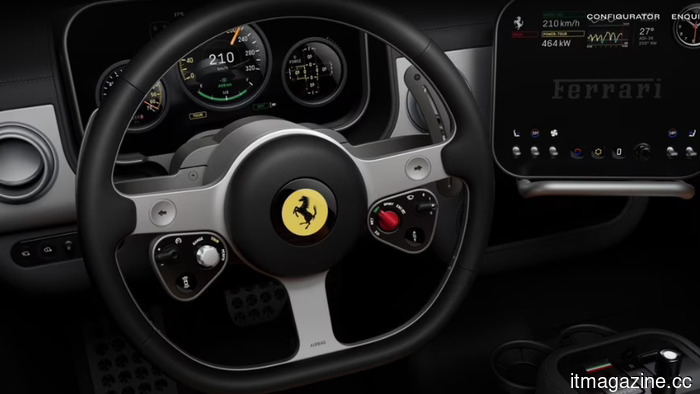 Ferrari shares fall 7% following the unveiling of the Luce electric vehicle.
Ferrari's stock dropped 7% in Milan following the online ridicule and criticism of the Luce's design, resulting in a loss of GBP 3 billion in market capitalization, despite its 1,036 hp and the introduction of 60 new patents.
Ferrari shares fall 7% following the unveiling of the Luce electric vehicle.
Ferrari's stock dropped 7% in Milan following the online ridicule and criticism of the Luce's design, resulting in a loss of GBP 3 billion in market capitalization, despite its 1,036 hp and the introduction of 60 new patents.
Stord secures $250 million at a $3 billion valuation to compete with Amazon.
Logistics startup Stord secured $250 million at a valuation of $3 billion to grow its network of 100 warehouses and implement AI robotics, allowing brands to compete with Amazon's delivery speeds.