
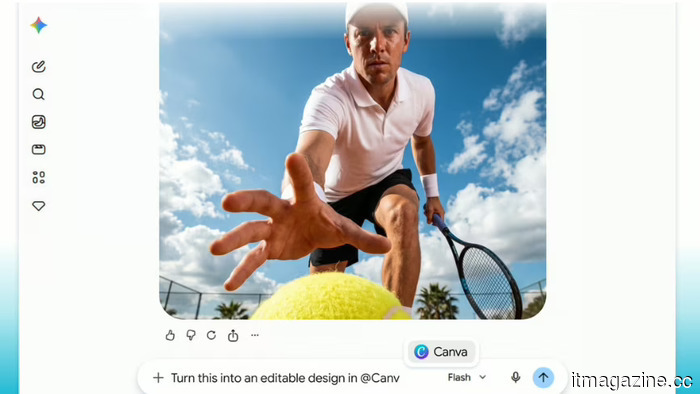
Canva has been introduced in Gemini, now available across all four primary AI assistants.
Canva introduced its Connected App for Google Gemini at Google I/O, completing its integration with all four leading AI assistants. This tool allows users to create on-brand, editable designs based on Gemini prompts, with Magic Layers transforming AI images into layered files.
Over the past year, Canva has quietly positioned itself within all major AI assistants, beginning with Claude, followed by ChatGPT, and then Microsoft Copilot. Google Gemini is the latest addition, finalizing the company's strategy.
The Connected App for Google Gemini, revealed at Google I/O, enables Gemini users to produce, modify, and search for Canva designs straight from their conversations. This integration began rolling out with limited availability on May 19 and will fully expand in the coming weeks.
The concept is simple: users type a prompt into Gemini, and Canva generates a design that is not just a flat image but a fully editable file. If users have a pre-configured Canva Brand Kit, the output will automatically incorporate stored logos, fonts, and color schemes from the initial prompt.
A noteworthy aspect is the integration with Google’s Nano Banana image model. Users can create an image with Gemini’s native functions and then transform it into a layered, editable design using Canva’s Magic Layers tool. This addresses a common issue with AI-generated visuals, which are usually flat files requiring multiple prompts for adjustments. Magic Layers evaluates the image structure and breaks it into separate, movable elements.
“We’re making design accessible wherever people start their work,” commented Anwar Haneef, Canva’s head of ecosystem. This clearly indicates that Canva no longer views itself solely as a destination but rather as foundational infrastructure.
With the launch for Gemini, Canva’s design engine is now integrated into all four primary AI assistants: Claude, ChatGPT, Copilot, and Gemini. Each integration operates through Canva’s API, enabling the assistant to initiate design generation, brand kit access, and template searches without the user needing to leave the conversation.
The timing is essential, as Google introduced Pics at I/O 2026, a rival AI design tool that is embedded in Workspace and generates graphics from text prompts. Adobe’s Firefly has achieved a 41 percent business adoption rate, and Figma has recently launched its own AI agent for canvas design. Canva's strategy is to distribute its tools widely rather than compete for a single platform.
This strategy is proving beneficial commercially. Canva's latest survey shows that nearly all marketers use AI in some capacity for their workflow, although consumers still prefer the human touch. The company now boasts 220 million global users and has positioned its AI 2.0 platform, which launched in March, as a comprehensive operating system for visual content creation.
Canva AI 2.0 already integrates with Slack, Gmail, Google Drive, Calendar, Notion, Zoom, and HubSpot via six intelligent workflows. It can summarize meetings from Zoom transcripts, customize customer emails into personalized sales materials, and create company newsletters. The Gemini integration further expands this network.
A potential risk for Canva is the commoditization of design tools. If all AI assistants can generate acceptable visuals on their own, the worth of a specialized design tool could diminish. Google’s Pics, OpenAI’s image generation, and Adobe’s Firefly are rapidly advancing. Canva's strategy is that brand consistency, editability, and template ecosystems will continue to hold more value than mere visual generation quality, and being integrated everywhere will make it more difficult to replace.
Other articles
 LinkedIn intensifies its efforts to combat low-quality AI content, achieving a 94% accuracy rate in detection.
LinkedIn will limit the visibility of generic AI-generated posts in its recommendations, focusing on engagement bait, recycled thought leadership, and comments from bots.
LinkedIn intensifies its efforts to combat low-quality AI content, achieving a 94% accuracy rate in detection.
LinkedIn will limit the visibility of generic AI-generated posts in its recommendations, focusing on engagement bait, recycled thought leadership, and comments from bots.
 OpenAI plans to submit its IPO application this week, aiming for a $1 trillion launch.
OpenAI is working on a private IPO filing with Goldman Sachs and Morgan Stanley, aiming for a September listing that might value the company at over $1 trillion.
OpenAI plans to submit its IPO application this week, aiming for a $1 trillion launch.
OpenAI is working on a private IPO filing with Goldman Sachs and Morgan Stanley, aiming for a September listing that might value the company at over $1 trillion.
 Stellantis signs agreement that may advantage Jaguar-Land Rover purchasers in the US.
Stellantis and Jaguar Land Rover are considering a partnership in the US that may lower tariffs, enhance local manufacturing, and change the way luxury vehicles are delivered to American consumers.
Stellantis signs agreement that may advantage Jaguar-Land Rover purchasers in the US.
Stellantis and Jaguar Land Rover are considering a partnership in the US that may lower tariffs, enhance local manufacturing, and change the way luxury vehicles are delivered to American consumers.
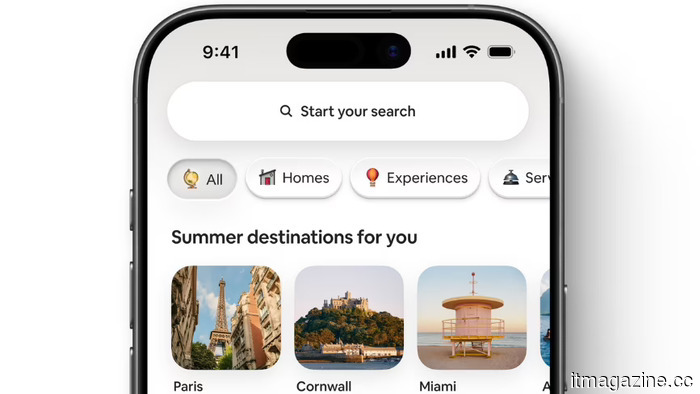 Airbnb introduces hotels, car rentals, and AI assistance in its summer update.
Airbnb's summer 2026 launch introduces boutique hotels in 20 cities, car rental services, luggage storage options, and an AI bot that manages 40% of customer inquiries worldwide.
Airbnb introduces hotels, car rentals, and AI assistance in its summer update.
Airbnb's summer 2026 launch introduces boutique hotels in 20 cities, car rental services, luggage storage options, and an AI bot that manages 40% of customer inquiries worldwide.
 The PlayStation State of Play is back on June 2, featuring Marvel’s Wolverine as the highlight of the event.
Sony has officially revealed a new PlayStation State of Play showcase scheduled for June 2, which will include more than 60 minutes of PS5 game announcements and an exclusive preview of Marvel’s Wolverine.
The PlayStation State of Play is back on June 2, featuring Marvel’s Wolverine as the highlight of the event.
Sony has officially revealed a new PlayStation State of Play showcase scheduled for June 2, which will include more than 60 minutes of PS5 game announcements and an exclusive preview of Marvel’s Wolverine.
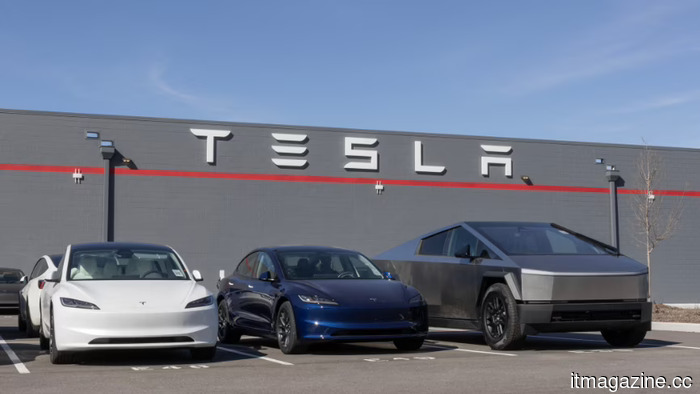 Tesla's Full Self-Driving (FSD) system is now available in Lithuania as the rollout across Europe speeds up.
Lithuania has become the second European nation to authorize Tesla's FSD software, with Greece and Belgium following suit. However, the approval across the EU encounters resistance from Scandinavian countries.
Tesla's Full Self-Driving (FSD) system is now available in Lithuania as the rollout across Europe speeds up.
Lithuania has become the second European nation to authorize Tesla's FSD software, with Greece and Belgium following suit. However, the approval across the EU encounters resistance from Scandinavian countries.
Canva has been introduced in Gemini, now available across all four primary AI assistants.
Canva's newly released Connected App for Google Gemini enables users to create editable designs that align with their brand using text prompts, while Magic Layers converts AI-generated images into layered files.