
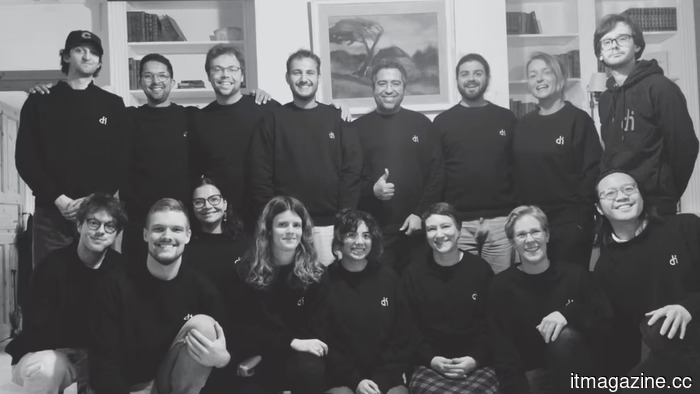
Dunia Innovations in Berlin invests €280 million in a GigaLab focused on autonomous AI materials.
The 6,000-square-metre autonomous R&D facility, supported by Siemens, ABB Robotics, NVIDIA, AWS, and ILS, aims to address the materials-verification challenges that AI-driven design has created in Europe. Dunia Innovations, the Berlin-based deeptech firm developing autonomous infrastructure for materials R&D, unveiled plans on Wednesday for a €280m facility in Berlin named GigaLab, which is intended for the discovery and development of advanced materials at an industrial scale.
Siemens, ABB Robotics, NVIDIA, AWS, and ILS will supply key technologies for the project. The facility is projected to generate over 200 direct jobs and commence operations in 2028. Established in 2022, Dunia operates a comprehensive platform that integrates AI, lab automation, and simulation into a closed-loop system that serves clients in the fields of catalysts, batteries, and semiconductors. The initial version of the platform was launched in 2023, followed by the second-generation IRIS platform, which went live in May 2025.
GigaLab represents Dunia's belief that the emerging bottleneck in the discovery of frontier materials is physical rather than algorithmic, specifically the need for experimental verification to validate the thousands of materials candidates generated by AI models. In the announcement, CEO and co-founder Dr. Alex Hammer emphasized that the fragmentation of the scientific record prevents substantial model training across various domains and that simulation alone cannot accurately predict material behavior under real-world conditions of temperature, pressure, and contamination. “With AI already conceptualizing millions of new materials, the need for experimental validation is skyrocketing,” Hammer stated. “We require facilities that can conduct scientific research at an industrial scale. GigaLab will be the first of its kind to fulfill that need.”
The industrial consortium that Dunia is assembling around the facility is crucial for its strategy. Siemens will provide digital-twin and process-simulation technology; ABB Robotics will offer lab automation for completely autonomous experimentation; AWS will support cloud infrastructure and large-scale analytics; NVIDIA will deliver high-performance computing for AI model training through its Inception program; and ILS will contribute advanced high-throughput parallel testing equipment. Merck has shown interest in GigaLab's potential to accelerate the development of next-generation semiconductor materials. The partnership between Siemens and NVIDIA reflects the collaboration model they've employed in industrial robotics, extending their digital-twin and edge-compute strategies into materials science.
The competitive landscape in Europe is significant in this context. Dr. Dirk Demuth, Head of Corporate Development and co-founder of hte GmbH, highlighted that the depth of integration distinguishes Berlin's GigaLab from earlier iterations of materials-AI infrastructure. “We’re constructing AI, automation, and industrial-grade workflow design together from scratch, rather than merely attaching them,” he remarked.
Dunia is positioning the venture as vital for enhancing European competitiveness, sustainability, and sovereignty, anticipating that GigaLab will attract substantial public co-investment along with funding from venture capital and industrial partners. The company has also proposed a €500m EU-funded materials-testing facility as a longer-term initiative running in parallel.
In terms of funding history, Dunia raised about $11.5m (€10.6m) in October 2024 with backing from French VC Elaia and Swiss VC redalpine, and is actively seeking further capital to finance GigaLab. The European Commission’s Horizon program has also supported Dunia’s work in electrocatalyst discovery through a specific CORDIS grant.
The €280m GigaLab is significantly larger than any previous announcements from Dunia; the company has not yet shared the specifics of the funding sources for its development, but the announcement indicates a mix of venture capital, investments from industrial partners, and anticipated public co-investment from Europe.
This development is situated within the broader European deeptech landscape, where funding structures have often struggled to support the multi-decade, capital-intensive investments essential for frontier materials research. Successful initial funds, like Berlin-based World Fund’s record-setting €300m climate-tech vehicle, are beginning to close this gap from the climate-tech perspective. The €280m commitment for a single facility involving prominent partners such as Siemens, ABB, NVIDIA, and AWS is the most significant European materials-infrastructure announcement this year. Whether the planned 2028 opening timeline is met will depend on how swiftly the public co-investment aspect materializes alongside existing industrial commitments.
Other articles
 Meta provides competing AI chatbots a restricted complimentary access to WhatsApp, adhering to Brussels' conditions.
Meta has submitted a new proposal to the European Commission that would grant competing AI chatbots free access to WhatsApp in Europe, subject to a usage limit, after which a fee per message would apply. The Commission is currently assessing this proposal under the Digital Markets Act.
Meta provides competing AI chatbots a restricted complimentary access to WhatsApp, adhering to Brussels' conditions.
Meta has submitted a new proposal to the European Commission that would grant competing AI chatbots free access to WhatsApp in Europe, subject to a usage limit, after which a fee per message would apply. The Commission is currently assessing this proposal under the Digital Markets Act.
 OpenAI establishes its inaugural international applied-AI laboratory in Singapore, with a commitment of $235 million.
OpenAI is set to establish its first applied-AI lab outside the United States in Singapore, backed by a commitment of S$300 million ($235 million) and plans to increase its workforce to approximately 200 individuals in the coming years.
OpenAI establishes its inaugural international applied-AI laboratory in Singapore, with a commitment of $235 million.
OpenAI is set to establish its first applied-AI lab outside the United States in Singapore, backed by a commitment of S$300 million ($235 million) and plans to increase its workforce to approximately 200 individuals in the coming years.
 Meta provides competing AI chatbots a restricted complimentary access to WhatsApp, based on the conditions set by Brussels.
Meta has submitted a new proposal to the European Commission, providing competing AI chatbots with free access to WhatsApp in Europe up to a certain usage limit, after which a fee per message will be charged. The Commission is currently evaluating this proposal in accordance with the Digital Markets Act.
Meta provides competing AI chatbots a restricted complimentary access to WhatsApp, based on the conditions set by Brussels.
Meta has submitted a new proposal to the European Commission, providing competing AI chatbots with free access to WhatsApp in Europe up to a certain usage limit, after which a fee per message will be charged. The Commission is currently evaluating this proposal in accordance with the Digital Markets Act.
 Meta implements the 10% reduction, beginning with the Singapore office, which receives the notification at 4 am.
On Wednesday, Meta started informing thousands of employees about layoffs, beginning with staff in Singapore at 4 a.m. local time. These reductions honor a commitment made in April to decrease the workforce by approximately 8,000 positions.
Meta implements the 10% reduction, beginning with the Singapore office, which receives the notification at 4 am.
On Wednesday, Meta started informing thousands of employees about layoffs, beginning with staff in Singapore at 4 a.m. local time. These reductions honor a commitment made in April to decrease the workforce by approximately 8,000 positions.
 Google has revealed Pics, an AI image creator integrated into Workspace, aimed at competing with Canva in the realm of precise editing.
Google has unveiled Pics, an AI image generator native to Workspace, which is powered by Nano Banana 2 and features precise editing controls along with integration for Slides and Drive.
Google has revealed Pics, an AI image creator integrated into Workspace, aimed at competing with Canva in the realm of precise editing.
Google has unveiled Pics, an AI image generator native to Workspace, which is powered by Nano Banana 2 and features precise editing controls along with integration for Slides and Drive.
 Alibaba introduces the Zhenwu M890, marking a strong push in China to create an alternative to NVIDIA.
Alibaba's T-Head chip division has introduced the Zhenwu M890, its most advanced AI accelerator to date, and announced that the chip is currently in 'scaled mass production' as China intensifies its efforts to develop a domestic alternative to NVIDIA.
Alibaba introduces the Zhenwu M890, marking a strong push in China to create an alternative to NVIDIA.
Alibaba's T-Head chip division has introduced the Zhenwu M890, its most advanced AI accelerator to date, and announced that the chip is currently in 'scaled mass production' as China intensifies its efforts to develop a domestic alternative to NVIDIA.
Dunia Innovations in Berlin invests €280 million in a GigaLab focused on autonomous AI materials.
Berlin's Dunia Innovations has announced plans for a €280 million, 6,000-square-meter GigaLab aimed at validating AI-created materials on an industrial level.