
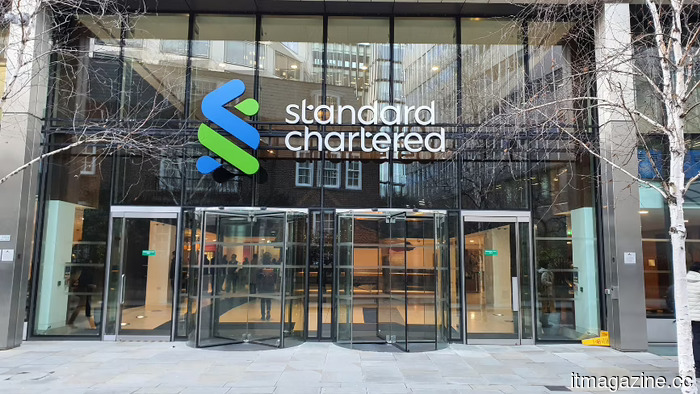
Standard Chartered plans to reduce 7,800 back-office positions due to automation by 2030.
Bill Winters informed investors in Hong Kong that the bank's human resources, risk, and compliance departments will see a reduction of over 15% in the next five years, with the objective of increasing income per employee by 20% by 2028.
During an investor day in Hong Kong on Tuesday, Standard Chartered's CEO, Bill Winters, announced that more than 15% of back-office positions would be eliminated by 2030. This amounts to approximately 7,800 jobs, according to the bank's figures, impacting corporate functions such as human resources, risk, and compliance. The bank aims to enhance income per employee by about 20% by 2028.
The way Winters framed the announcement deserves close attention. "We’re not losing jobs, but we are reducing job roles in favor of machines," he told the audience in Hong Kong, "and this will accelerate as we move forward with AI." Bloomberg reflects Winters' comments even more pointedly, highlighting his assertion that AI will replace "lower-value human capital" within the bank.
This particular framing has historically garnered attention from regulators and unions, and Standard Chartered is likely aware of this, suggesting a deliberate choice of language.
The specifics of the headcount reduction resemble other bank announcements concerning AI. Standard Chartered intends to focus on back-office functions that involve rules-based decision support, document processing, and case management workflows, which have been the most amenable to AI deployment over the last two years.
The reduction of over 15% across five years translates to an approximate 3% annual decline, which the bank claims will be partly managed through natural attrition and partly through internal redeployment into different roles; however, Winters did not provide details on the ratio of these methods. The goal of a 20% improvement in income per employee by 2028 is the operational benchmark against which these cuts are measured.
Standard Chartered is the third major bank to announce a structured AI-related headcount reduction within the past month. The Commonwealth Bank of Australia introduced its first Chief AI Scientist yesterday, as part of a broader AI development effort that has positioned CBA fourth globally on the 2025 Evident AI Index.
These two strategies are not mutually exclusive; leading banks in AI are implementing both on the same balance sheet and within the same quarters, with the difference being which initiative is announced first.
The comparisons within the banking sector have often been minimized in coverage. During earnings calls in the last two quarters, JPMorgan, Citi, HSBC, and Wells Fargo have already indicated that AI-driven headcount efficiencies are now integrated into their long-term operating leverage targets.
Public records suggest that Standard Chartered is the first to explicitly link a specific percentage (over 15%) and a designated area (HR, risk, compliance) to its commitment during a public investor day. This transparency will likely prompt other banks to provide similar disclosures in their upcoming reporting cycles.
The broader signal to the labor market is becoming clearer. Meta recently transitioned 7,000 employees to AI-focused positions while also preparing to reduce its overall workforce by 10% this week. Klarna represents a notable European example of this same approach.
HR Director Magazine highlighted Standard Chartered’s announcement as part of a recognizable pattern across sectors, where large employers are now quantifying AI deployment through specific, time-bound headcount reduction targets for the first time. The political and regulatory fallout from this shift is expected to take longer to materialize than the financial market effects.
The reputational risk associated with Winters's phrasing is significant. UK banking unions, Hong Kong regulators, and Singapore’s Monetary Authority have all expressed greater interest in how major supervised institutions handle AI from a workforce impact perspective. Referring to impacted roles as "lower-value human capital" is likely to arise in regulatory discussions. While the investor audience may have perceived this phrase as part of a productivity narrative, the bank’s regulatory affairs team is undoubtedly preparing for the consequences of this messaging.
Winters did not specify the timeline for the annual cuts, the geographical spread across Standard Chartered’s network in Asia, Africa, and the Middle East, or whether details regarding the redeployment versus attrition ratio will be shared in future reports.
What the announcement does establish is the estimated scale: 7,800 jobs affected over five years, based on one investor day commitment. The first-quarter 2027 reporting will likely be the first instance where the impact on headcount becomes apparent in actual operating expense figures.
Other articles
 Apple's iOS 27 may introduce AI writing tools, an enhanced Siri, and personalized wallpapers.
Apple's iOS 27 might bring AI writing features, enhanced Siri integrations, natural-language shortcuts, and AI-created wallpapers as the company broadens its AI ecosystem.
Apple's iOS 27 may introduce AI writing tools, an enhanced Siri, and personalized wallpapers.
Apple's iOS 27 might bring AI writing features, enhanced Siri integrations, natural-language shortcuts, and AI-created wallpapers as the company broadens its AI ecosystem.
 iOS 27 might resolve a major annoyance with the Shortcuts app, and I’m eager to see it.
Apple is getting ready to implement a significant update for the Shortcuts app in iOS 27. With the help of AI, users will at last be able to create multi-step shortcuts just by describing them in natural language.
iOS 27 might resolve a major annoyance with the Shortcuts app, and I’m eager to see it.
Apple is getting ready to implement a significant update for the Shortcuts app in iOS 27. With the help of AI, users will at last be able to create multi-step shortcuts just by describing them in natural language.
 Apple's iOS 27 may introduce AI writing features, an enhanced Siri, and personalized wallpapers.
Apple's iOS 27 could bring AI writing features, enhanced Siri interactions, natural-language shortcuts, and AI-created wallpapers as the company broadens its AI ecosystem.
Apple's iOS 27 may introduce AI writing features, an enhanced Siri, and personalized wallpapers.
Apple's iOS 27 could bring AI writing features, enhanced Siri interactions, natural-language shortcuts, and AI-created wallpapers as the company broadens its AI ecosystem.
 Australia's biggest pension fund views agentic AI as a technology with the potential to cause significant disruption.
AustralianSuper, the largest pension fund in the country with A$410 billion in assets under management, stated that agentic AI has the potential to change the way it supports its 3.5 million members, comparing its influence to the disruption caused by AI in the retail sector.
Australia's biggest pension fund views agentic AI as a technology with the potential to cause significant disruption.
AustralianSuper, the largest pension fund in the country with A$410 billion in assets under management, stated that agentic AI has the potential to change the way it supports its 3.5 million members, comparing its influence to the disruption caused by AI in the retail sector.
 iOS 27 may resolve a significant issue with the Shortcuts app, and I'm looking forward to it.
Apple is preparing a significant update for the Shortcuts app in iOS 27. With the help of AI, users will now be able to create multi-step shortcuts by simply explaining their needs to the AI in natural language.
iOS 27 may resolve a significant issue with the Shortcuts app, and I'm looking forward to it.
Apple is preparing a significant update for the Shortcuts app in iOS 27. With the help of AI, users will now be able to create multi-step shortcuts by simply explaining their needs to the AI in natural language.
 Italy’s Lexroom achieves a total of $73 million raised, securing $50 million in its Series B funding for civil-law legal AI.
Lexroom, a Milan-based legal AI startup focused on civil law, has secured $50 million in a Series B funding round led by Left Lane Capital.
Italy’s Lexroom achieves a total of $73 million raised, securing $50 million in its Series B funding for civil-law legal AI.
Lexroom, a Milan-based legal AI startup focused on civil law, has secured $50 million in a Series B funding round led by Left Lane Capital.
Standard Chartered plans to reduce 7,800 back-office positions due to automation by 2030.
Standard Chartered's CEO Bill Winters informed investors in Hong Kong that the bank intends to reduce more than 15% of its back-office positions in HR, risk, and compliance by 2030, aiming to increase income per employee by 20% by 2028.