
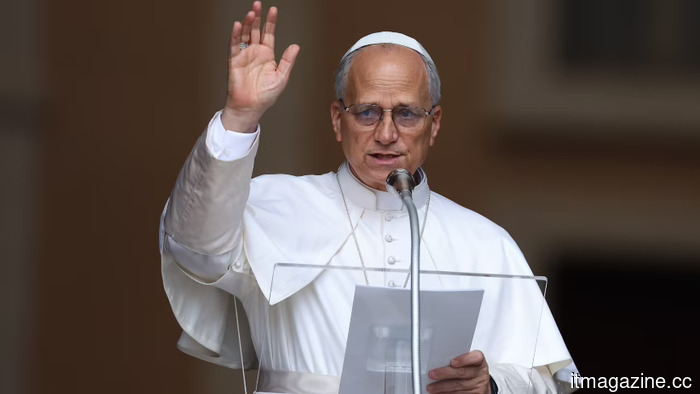
Pope Leo XIV condemns AI warfare and the rearmament of Europe during his first papal visit to La Sapienza since 2008.
TL;DR Pope Leo XIV condemned AI-driven warfare as a “spiral of annihilation” during a significant visit to Rome’s La Sapienza University on May 14, 2026. He criticized the increase in European defense spending at the expense of education and healthcare and called for stricter regulation of AI use in military and civilian contexts.
Pope Leo XIV used his historic visit to Europe’s largest university to criticize the increasing role of artificial intelligence in warfare, expressing that investments in AI weaponry are pushing the world toward a “spiral of annihilation.” At La Sapienza University in Rome, the pontiff urged for better oversight on the development and application of AI in both military and civilian settings, and condemned European governments for boosting defense budgets while neglecting education and healthcare.
This address marked the first papal return to La Sapienza since Pope Benedict XVI canceled a speech planned for 2008 due to protests from faculty and students. Leo received a warm welcome, including greetings from 72 young Palestinians who arrived in Italy from Gaza via a humanitarian corridor coordinated by the Diocese of Rome, the Sant’Egidio Community, and the university. They are set to continue their studies at Sapienza on full scholarships with support provided until 2029.
In his speech, Leo focused on the connections between technology, conflict, and human responsibility, identifying AI as a crucial issue for humanity, particularly in warfare. He argued that the current rise in military investments conflicts with the protection of human life.
He stated, “What is happening in Ukraine, in Gaza and the Palestinian territories, in Lebanon, and in Iran illustrates the inhuman evolution of the relationship between war and new technologies in a spiral of annihilation,” drawing attention to conflicts where AI systems have been deployed or proposed. He contended that AI weapons are currently altering the nature of warfare rather than presenting a future threat.
The pope called for improved monitoring of AI development to ensure it “does not absolve humans of responsibility for their choices and does not exacerbate the tragedy of conflicts.” This sentiment aligns with the Vatican’s longstanding viewpoint, as expressed in its 2020 Rome Call for AI Ethics, advocating that technology should enhance human dignity and never replace human judgment in matters of life and death. Leo highlighted that AI has already been weaponized in ways that exceed existing governance structures designed to regulate it.
Specifically criticizing European defense spending, Leo noted that it surged in 2025 and 2026 amid the war in Ukraine and wider geopolitical unrest. European NATO members increased military spending by 14 percent in 2025, totaling $864 billion—the fastest growth rate since 1953, as per SIPRI. NATO allies also set a new guideline of 3.5 percent of GDP for core defense spending, up from the prior 2 percent target.
The pope contended that this increase in military funding directly detracts from public services, denouncing budgets that enrich “elites who care nothing for the common good” while educational and healthcare sectors suffer. He encouraged students and faculty to shift their focus toward research and education that honors life, “the lives of peoples who cry out for peace and justice.”
Leo’s message was particularly significant given that La Sapienza, founded by Pope Boniface VIII in 1303, is now a secular institution with over 100,000 students. His warm reception, 18 years after his predecessor was effectively disinvited, indicates that Leo’s readiness to engage in political and technological discussions on secular grounds has expanded the Vatican's reach.
The address at La Sapienza is part of a broader initiative by Leo to position the Vatican as a serious participant in AI governance. Two days post-speech, the Vatican announced the formation of an Interdicasterial Commission on Artificial Intelligence, including representatives from seven Vatican departments, such as the Dicastery for the Doctrine of the Faith and the Pontifical Academy of Sciences. This commission will explore AI’s implications for humanity and is coordinated by the Dicastery for Promoting Integral Human Development.
Leo’s anticipated first encyclical, reportedly titled Magnifica Humanitas, will focus on AI within Catholic social teaching, addressing labor, human dignity, and peace. It is expected to draw parallels between the ongoing AI revolution and the industrial changes that prompted Leo XIII’s significant 1891 encyclical Rerum Novarum on workers’ rights. By adopting the name Leo, the American-born pope, Robert Francis Prevost, signaled his intent to address the economic and technological challenges of his time. Governance of AI, who it serves, and whether governance frameworks can keep pace with technology are now officially part of the papacy's agenda.
Papal statements regarding technology do not equate to regulatory power. However, the Vatican's influence in AI ethics is noteworthy. The 2020 Rome Call for AI Ethics, signed by major organizations like Microsoft, IBM, Cisco, and the UN’s Food and Agriculture Organization, established principles such as transparency and accountability,
Другие статьи
 The Steam Controller from Valve has become significantly more valuable beyond the Steam platform.
The main early drawback of the Steam Controller was its strong reliance on Steam. However, with the addition of SDL support, it is expected to be far more practical for non-Steam titles.
The Steam Controller from Valve has become significantly more valuable beyond the Steam platform.
The main early drawback of the Steam Controller was its strong reliance on Steam. However, with the addition of SDL support, it is expected to be far more practical for non-Steam titles.
 Sony wants to assure you that the AI camera on the new Xperia phone is quite impressive.
Sony claims that its AI Camera Assistant recommends settings rather than making edits. However, the before-and-after photos it provided to support this argument seem to unintentionally argue the opposite.
Sony wants to assure you that the AI camera on the new Xperia phone is quite impressive.
Sony claims that its AI Camera Assistant recommends settings rather than making edits. However, the before-and-after photos it provided to support this argument seem to unintentionally argue the opposite.
 The Delhi bench has reached a procedural compromise in Apple’s India App Store case.
The Delhi High Court has instructed Apple to fully collaborate with India's competition authority regarding the App Store antitrust case, while also directing the CCI not to make a final decision before July 15.
The Delhi bench has reached a procedural compromise in Apple’s India App Store case.
The Delhi High Court has instructed Apple to fully collaborate with India's competition authority regarding the App Store antitrust case, while also directing the CCI not to make a final decision before July 15.
 Anthropic is providing the Financial Stability Board with an update on the findings from Mythos.
Anthropic will inform the Financial Stability Board about the cybersecurity weaknesses that its Mythos model has detected in the worldwide financial system.
Anthropic is providing the Financial Stability Board with an update on the findings from Mythos.
Anthropic will inform the Financial Stability Board about the cybersecurity weaknesses that its Mythos model has detected in the worldwide financial system.
 Exadel acquires London-based consultancy Tangent to enhance its AI engineering offerings with experience design.
Exadel has purchased the London-based digital experience consultancy Tangent, integrating its UX, product, and MarTech design expertise into Exadel’s AI-focused engineering services.
Exadel acquires London-based consultancy Tangent to enhance its AI engineering offerings with experience design.
Exadel has purchased the London-based digital experience consultancy Tangent, integrating its UX, product, and MarTech design expertise into Exadel’s AI-focused engineering services.
 Japan has created robotic wolves to deter bear attacks, and they’re selling rapidly.
Japan's unusual "Monster Wolf" robot deterrents are experiencing a significant increase in demand as the nation faces an unprecedented number of bear sightings and incidents.
Japan has created robotic wolves to deter bear attacks, and they’re selling rapidly.
Japan's unusual "Monster Wolf" robot deterrents are experiencing a significant increase in demand as the nation faces an unprecedented number of bear sightings and incidents.
Pope Leo XIV condemns AI warfare and the rearmament of Europe during his first papal visit to La Sapienza since 2008.
The pope cautioned that the conflicts in Ukraine, Gaza, Lebanon, and Iran demonstrate the "inhuman evolution" of warfare and technology. His inaugural encyclical regarding AI and human dignity is anticipated to be released in the coming weeks.