
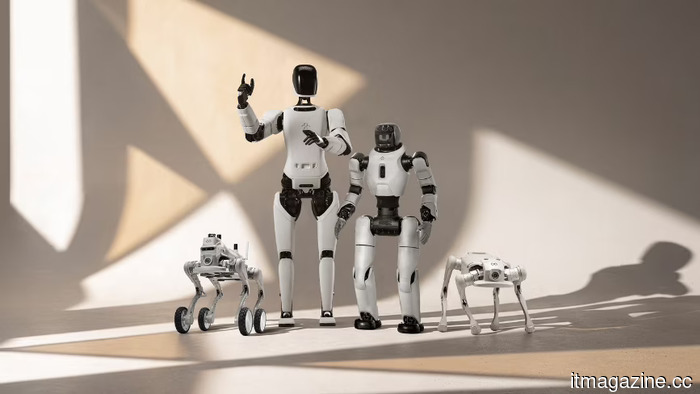
Faraday Future secured $25 million for its shift towards robotics, but the details reveal a different narrative.
**TL;DR** Faraday Future secured $25M through convertible notes for its new robotics venture, with half of the funds held in investor-controlled accounts.
On Thursday, Faraday Future disclosed that it has raised $25 million via convertible promissory notes, bringing its total financing for the past two months to $70 million. The company states this funding is adequate to support Phase 1 of its robotics initiative through the end of 2026. Its stock, traded on Nasdaq under the ticker FFAI, closed below $1 and is currently subject to a notice from Nasdaq regarding its failure to uphold the minimum bid price requirement.
The structure of this fundraising is notable. From the $25 million raised, only $12.5 million directly enters the company's operating account, while the other half is placed into investor-controlled accounts and will only be released to Faraday Future upon the fulfillment of unspecified conditions. Although the press release mentions the “institutional investors’ confidence” in the company, it does not identify any of the investors. The shares related to the convertible notes are unregistered and have trading restrictions. The company's risk factors filed with the SEC highlight that it currently lacks enough share capital to implement its strategy and that seeking shareholder approval for additional shares could lead to “substantial additional dilution.”
Faraday Future is transitioning from electric vehicles to what it labels as “Embodied AI,” aiming to establish itself as a physical AI firm that provides both humanoid and bionic robots. The company reported shipping 68 robots as of April 30, with an annual goal of 1,500 units across four product lines focused on education, security inspection, reception and guided tours, performances, and university research. In its Q1 2026 financial results, it noted that the robotics division achieved positive gross margins and generated revenue, although the total revenue figure was not disclosed.
Additionally, the company has signed a Memorandum of Understanding (MOU) with RobotShop, a Canadian e-commerce platform for robotics, marking its first distribution partner for the robotics line. An MOU is a non-binding agreement and does not imply a firm order.
The company’s corporate history provides essential context. Established in 2014 by Chinese billionaire Jia Yueting, who has been involved in various financial controversies, Faraday Future went public through a SPAC merger in 2021, which prompted an SEC investigation into aspects of the PIPE and SPAC transactions. Wells Notices were issued to the company and certain executives, but the SEC concluded its investigation in March 2026 without taking enforcement action, which the company viewed as a removal of a “major historical overhang.” Additionally, a special committee of independent directors began its own investigation in October 2021.
The electric vehicle segment has struggled to gain significant traction. Since its launch in 2023, Faraday Future’s FF 91, a luxury electric vehicle priced over $300,000, has been delivered in very limited numbers. The company is now focusing on developing what it terms “EAI automotive robots,” effectively AI-enhanced vehicles, alongside its humanoid and bionic robot lines.
The humanoid robotics sector is attracting significant investment in 2026. Morgan Stanley has doubled its estimate for China's humanoid robot sales to 28,000 units this year. Unitree is preparing for a $7 billion IPO after exceeding Tesla in humanoid robot sales. 1X is sending its NEO humanoid to U.S. homes at $20,000 each. Mind Robotics, spun off from Rivian, secured $1 billion in under a year at a $3.4 billion valuation. In this context, Faraday Future's $70 million in convertible debt financing, with half of it conditional, places the company on the outskirts of a market dominated by competitors with significantly greater capital, more formidable production capabilities, and more advanced technology.
Faraday Future's SEC filings cite risk factors that encompass its “dependence on a single OEM for most of its robotics products,” competition from firms “with vastly superior experience, funding, and recognition,” the potential risk of not maintaining its Nasdaq listing, and the requirement for stockholder approval for issuing additional shares that could lead to considerable dilution.
Faraday Future claims it now has the opportunity, for the first time in years, to shift its financing strategies from "liquidity-driven to capital-structure-driven." This reflects a company that has historically secured funding on whichever terms were available. Whether the $70 million in convertible notes, with attached conditions, signifies a true strategic turning point or yet another chapter of optimistic proclamations followed by operational troubles is a question the market has pondered about Faraday Future for nearly a decade.
Goldman Sachs forecasts global shipments of 50,000 to 100,000 humanoid robots in 2026, making Faraday Future's goal of 1,500 units a small fraction of that market. Yet, even this modest target requires successful execution from a company that has
Other articles
 RJ Scaringe has secured $12 billion across three startups, and investors continue to line up.
The founder of Rivian currently manages three companies: Rivian, Also, and Mind Robotics, which together have raised funds that compete with the total amounts in entire VC markets.
RJ Scaringe has secured $12 billion across three startups, and investors continue to line up.
The founder of Rivian currently manages three companies: Rivian, Also, and Mind Robotics, which together have raised funds that compete with the total amounts in entire VC markets.
 A BCG survey reveals that 61% of CEOs believe boards are hastily implementing AI transformations due to the hype influencing their decision-making.
A worldwide survey involving 625 leaders shows a significant disparity between the cautious stance of CEOs and the urgent approach of boards regarding AI. While three-quarters of board members consider their understanding of AI to be strong, almost 40% of CEOs hold a differing opinion.
A BCG survey reveals that 61% of CEOs believe boards are hastily implementing AI transformations due to the hype influencing their decision-making.
A worldwide survey involving 625 leaders shows a significant disparity between the cautious stance of CEOs and the urgent approach of boards regarding AI. While three-quarters of board members consider their understanding of AI to be strong, almost 40% of CEOs hold a differing opinion.
 Four vulnerabilities in OpenClaw enable attackers to exfiltrate data, elevate privileges, and install backdoors via the agent's own sandbox.
Cyera revealed four interconnected vulnerabilities in OpenClaw that can convert a compromised agent into a lasting backdoor. Patches have been released.
Four vulnerabilities in OpenClaw enable attackers to exfiltrate data, elevate privileges, and install backdoors via the agent's own sandbox.
Cyera revealed four interconnected vulnerabilities in OpenClaw that can convert a compromised agent into a lasting backdoor. Patches have been released.
 Asus introduces the 320W ROG Strix Scar 18 featuring the RTX 5090, though it's the CPU that really grabs attention.
The 2026 ROG Strix Scar 18 delivers a total of 320W power, features the world's first 18-inch 4K 240Hz Mini LED display, and comes with a 450W power adapter.
Asus introduces the 320W ROG Strix Scar 18 featuring the RTX 5090, though it's the CPU that really grabs attention.
The 2026 ROG Strix Scar 18 delivers a total of 320W power, features the world's first 18-inch 4K 240Hz Mini LED display, and comes with a 450W power adapter.
 Four vulnerabilities in OpenClaw enable attackers to exfiltrate data, elevate privileges, and insert backdoors via the agent's own sandbox.
Cyera revealed four chainable vulnerabilities in OpenClaw that enable a compromised agent to function as a persistent backdoor. Patches have been released.
Four vulnerabilities in OpenClaw enable attackers to exfiltrate data, elevate privileges, and insert backdoors via the agent's own sandbox.
Cyera revealed four chainable vulnerabilities in OpenClaw that enable a compromised agent to function as a persistent backdoor. Patches have been released.
 John Collison from Stripe states that agentic commerce will fundamentally change the landscape of online shopping.
The co-founder of Stripe claims that using keyword search to make purchases is "absurd," suggesting that AI agents will compel retailers to reconsider their entire approach.
John Collison from Stripe states that agentic commerce will fundamentally change the landscape of online shopping.
The co-founder of Stripe claims that using keyword search to make purchases is "absurd," suggesting that AI agents will compel retailers to reconsider their entire approach.
Faraday Future secured $25 million for its shift towards robotics, but the details reveal a different narrative.
The struggling electric vehicle manufacturer states that $70 million in convertible notes will support its AI robotics strategy. Its shares are trading under $1, and Nasdaq has issued a warning regarding potential delisting.