
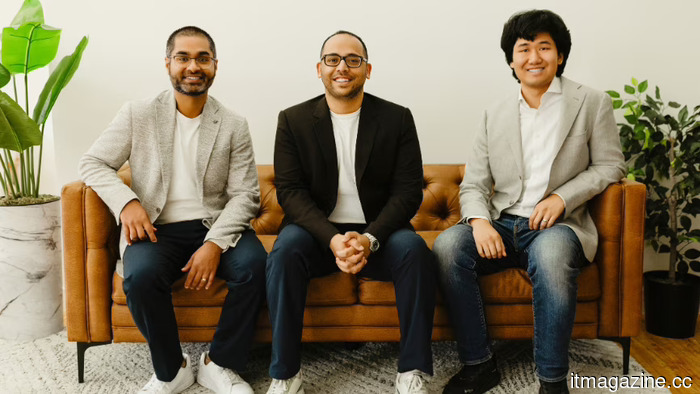
Graphon AI secures $8.3 million in seed funding to develop a pre-model intelligence layer for enterprise AI.
Graphon AI has emerged from stealth mode, securing $8.3 million in seed funding to create a "pre-model intelligence layer" designed to uncover relationships across diverse enterprise data before they reach a foundational model. The funding round, led by Novera Ventures, also saw contributions from Perplexity Fund, Samsung Next, GS Futures, Hitachi Ventures, and others. The company derives its name from a mathematical concept that was co-formalized by its technical advisors, professors Jennifer Chayes and Christian Borgs from UC Berkeley. Founded by Arbaaz Khan (CEO), Deepak Mishra (COO), and Clark Zhang (CTO), the team includes members from Amazon, Meta, Google, Apple, NVIDIA, and NASA. An early client, GS Group from South Korea, has adopted Graphon for analytics in convenience stores and assessing safety at construction sites.
The company's name is indicative of its focus. Graphon AI, which revealed itself publicly on Wednesday with $8.3 million in seed funding, takes its name from a mathematical concept that many in the AI field may not be familiar with and which its prominent advisors helped develop. A graphon represents the limit of a sequence of dense graphs: a continuous function that illustrates the relational structure as networks expand infinitely. This concept lies at the intersection of pure mathematics and theoretical computer science, forming the basis of a startup that asserts it has established the essential layer between enterprise data and the models intended to interpret it.
The company's premise is simple, despite the complex mathematics involved. Current large language models (LLMs) are capable of processing approximately one million tokens simultaneously. However, enterprises possess trillions of tokens contained within documents, videos, audio files, images, logs, and databases. The prevalent technique known as retrieval-augmented generation (RAG) can surface relevant content from this vast sea but falls short in identifying relationships between data that have not been pre-associated. An LLM utilizing RAG can address questions about a specific document but cannot analyze how that document relates to a surveillance video, compliance log, and customer database unless those connections have already been mapped out.
Graphon's solution operates outside the model rather than within it. By leveraging graphon functions—a mathematical framework that translates the academic concept into a software layer—the system processes multimodal data and systematically identifies relational structures, creating what the company terms persistent relational memory. The ideal outcome is to present a representation of an organization’s data that any foundational model or agent framework can access, unconstrained by context limitations.
The technical team includes Arbaaz Khan as CEO, Deepak Mishra as COO, and Clark Zhang as CTO. The wider team reportedly consists of former researchers and engineers from Amazon, Meta, Google, Apple, NVIDIA, the Samsung AI Center, MIT, Rivian, and NASA. More noteworthy are the technical advisors: Jennifer Chayes, dean of the College of Computing, Data Science, and Society at UC Berkeley, and Christian Borgs, a UC Berkeley computer science professor, are both acknowledged as advisors. Borgs was part of the group that, alongside Chayes, László Lovász, Vera Sós, and Katalin Vesztergombi, formalized the graphon as a mathematical notion in 2008. The company is essentially commercializing a framework conceived by its advisors.
Chayes and Borgs expressed in a joint statement that their approach prioritizes relational structure as a crucial component of the AI stack, rather than something inferred after the fact. This distinction holds significance, as most existing AI systems treat data as isolated items to be retrieved, rather than as interconnected networks to be preserved.
The seed funding round was spearheaded by Novera Ventures' Arvind Gupta, who marked Graphon as his fund’s inaugural investment from its primary vehicle. Gupta, known for founding IndieBio, a life-sciences accelerator, is pivoting towards an AI infrastructure firm, suggesting he recognizes a structural connection between the challenges Graphon intends to tackle and the complex, multimodal data issues prevalent in scientific computing.
The investment landscape is notably diverse. Perplexity Fund, the $50 million venture arm of the AI search entity, contributed alongside Samsung Next, Hitachi Ventures, GS Futures (GS Group's venture arm), Gaia Ventures, B37 Ventures, and Aurum Partners, linked to the San Francisco 49ers ownership group. This mix indicates a deliberate approach to strategic diversity; the participation of a search-AI firm, a consumer electronics leader, a Japanese industrial powerhouse, and a South Korean conglomerate emphasizes that the context-window problem Graphon addresses is a shared concern across varied industries. GS Group, one of South Korea’s largest conglomerates engaged in energy, retail, and construction, is an early adopter, with vice president Ally Kim noting the implementation of their multimodal AI solutions for analyzing customer behavior in convenience stores and enhancing safety via CCTV at construction sites.
Graphon's strategy mirrors a broader transition in the AI infrastructure sector. In recent
Other articles
 Dell is introducing Alienware laptops aimed at budget-conscious gamers, even if that requires using older chips.
Dell has introduced the Alienware 15 together with the Dell 14S and 16S, emphasizing more affordable pricing, AI capabilities, and a balanced performance suitable for various user groups.
Dell is introducing Alienware laptops aimed at budget-conscious gamers, even if that requires using older chips.
Dell has introduced the Alienware 15 together with the Dell 14S and 16S, emphasizing more affordable pricing, AI capabilities, and a balanced performance suitable for various user groups.
 HMRC has granted a £175 million AI contract to the British company Quantexa in an effort to address the £46.8 billion tax gap.
HMRC has entered into a 10-year agreement worth £175 million with Quantexa, a company based in London, to implement AI for detecting fraud and ensuring tax compliance as part of a significant move towards digital sovereignty.
HMRC has granted a £175 million AI contract to the British company Quantexa in an effort to address the £46.8 billion tax gap.
HMRC has entered into a 10-year agreement worth £175 million with Quantexa, a company based in London, to implement AI for detecting fraud and ensuring tax compliance as part of a significant move towards digital sovereignty.
 HMRC grants £175 million AI contract to British company Quantexa to address the £46.8 billion tax gap.
HMRC has entered into a 10-year agreement worth £175 million with London-based Quantexa to implement AI for the purposes of fraud detection and ensuring tax compliance, marking a significant shift towards digital sovereignty.
HMRC grants £175 million AI contract to British company Quantexa to address the £46.8 billion tax gap.
HMRC has entered into a 10-year agreement worth £175 million with London-based Quantexa to implement AI for the purposes of fraud detection and ensuring tax compliance, marking a significant shift towards digital sovereignty.
 BCG educates AI sales agent Jamie on its top products as well as their biggest errors.
BCG's AI agent Jamie is trained by analyzing call transcripts from top sellers as well as their least effective practices. Vercel has already reduced its sales development representative team from 10 to 1 by employing a similar strategy.
BCG educates AI sales agent Jamie on its top products as well as their biggest errors.
BCG's AI agent Jamie is trained by analyzing call transcripts from top sellers as well as their least effective practices. Vercel has already reduced its sales development representative team from 10 to 1 by employing a similar strategy.
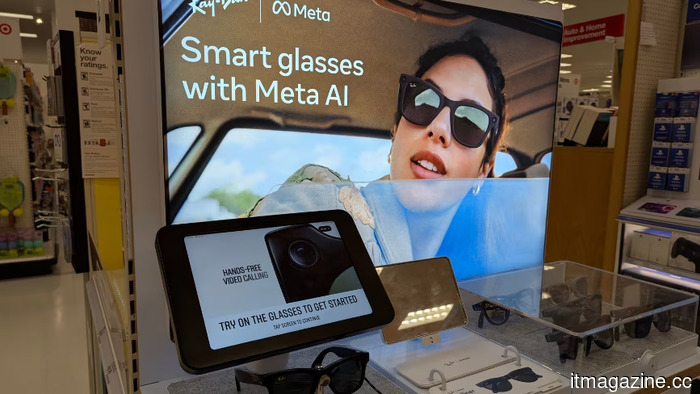 Meta's smart glasses are flying off the shelves, but those who are being recorded without their knowledge have no recourse.
Meta has sold 7 million pairs of Ray-Ban smart glasses and controls 82% of the market. There are reports of women being filmed without their knowledge, lawsuits are increasing, and companies like Apple, Google, and Snap are looking to enter the market.
Meta's smart glasses are flying off the shelves, but those who are being recorded without their knowledge have no recourse.
Meta has sold 7 million pairs of Ray-Ban smart glasses and controls 82% of the market. There are reports of women being filmed without their knowledge, lawsuits are increasing, and companies like Apple, Google, and Snap are looking to enter the market.
 Meta is experimenting with an AI bot intended to replicate the same online foolishness seen with AskGrok on X.
Meta is experimenting with an AI bot on Threads that functions similarly to Grok on X, publicly replying to user mentions within discussions.
Meta is experimenting with an AI bot intended to replicate the same online foolishness seen with AskGrok on X.
Meta is experimenting with an AI bot on Threads that functions similarly to Grok on X, publicly replying to user mentions within discussions.
Graphon AI secures $8.3 million in seed funding to develop a pre-model intelligence layer for enterprise AI.
Former researchers from Amazon and Meta have founded Graphon AI, securing $8.3 million in seed funding. The startup is developing a relational data layer that operates ahead of the model, with backing from Perplexity Fund and Samsung Next.