
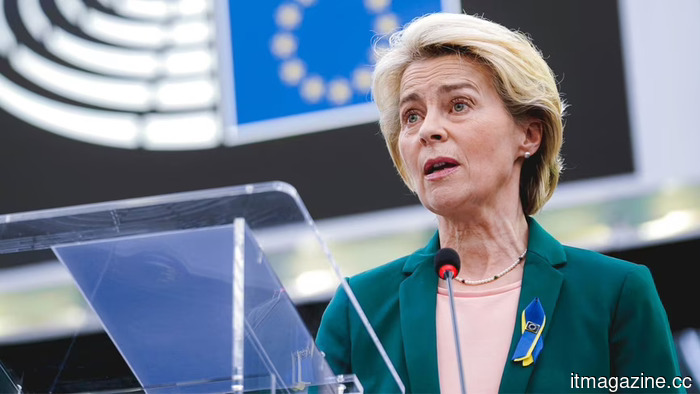
Ursula Von der Leyen advocates for age protections on social media across the EU to safeguard children.
The president of the European Commission announced that the EU's age-verification application is technically complete and that subsequent rules regarding minimum social-media ages are being developed. France, Spain, and several other countries are progressing on their own initiatives.
On Tuesday, European Commission President Ursula von der Leyen outlined the EU's strategy to enhance online protections for children. She informed MEPs that the bloc's age-verification app is ready for public use and that a Commission-led initiative on minimum social-media ages is underway.
This announcement comes in the wake of various national legislations passed by EU member states prior to any overarching EU regulation. France enacted a law in January 2026 prohibiting under-15s from accessing social-media platforms due to a public health emergency. Spain has proposed a ban for those under 16, while Austria, Denmark, and Slovenia are formulating rules that set age limits at 14, 15, and 15, respectively. Italy and Ireland are considering restrictions for users under 15 and under 16.
The Commission’s preferred method has yet to be finalized. The European Parliament is advocating for a uniform minimum age of 16, but von der Leyen indicated that the Commission intends to consult experts to determine the suitable age threshold first.
The Digital Services Act already mandates that large online platforms assess and address risks to children, and various enforcement actions and risk-assessment audits are being conducted against specific platforms.
The age-verification system referenced by von der Leyen was created by the Commission’s digital-identity team and employs zero-knowledge cryptographic techniques to verify if a user meets the required age threshold without revealing their actual age, identity, or personal information.
The Commission states that the app is ready for member states to implement; however, the timing of the rollout will be up to each state. This initiative is part of a broader enforcement cycle under the DSA. Platforms such as Meta, TikTok, X, and Snap are currently under active investigation by the Commission regarding their management of minors, with some findings anticipated in the next year.
The Commission has also directed Apple and Google to incorporate the age-verification system at the operating system level.
Industry responses have been cautious, with platform operators arguing that strict age thresholds may divert minors to unregulated or non-EU services, and that the technical challenges of implementing age verification widely are significant.
Child-safety advocates have urged the Commission to expedite its actions, highlighting an increase in self-reported harm and the documented correlation between high social media usage and declining mental health among adolescents.
Von der Leyen expressed a preference for a unified EU regulation instead of 27 distinct national laws, stating, "This is a question for Europe to answer together," during her remarks to MEPs in Strasbourg. "Children should be protected in the same way wherever they live in our Union."
A formal proposal from the Commission is anticipated before the autumn break, while the national laws already enacted will continue to be enforced in the interim. Member-state regulators will uphold existing DSA obligations regardless of when a new age-related framework is established.
Privacy advocates have voiced concerns about the wider rollout of age-verification infrastructure, arguing that even zero-knowledge systems may evolve towards identity verification over time.
The Commission has asserted that the system is specifically designed to prevent this shift; however, full details regarding governance and audit processes have yet to be released.
Other articles
 Google reports that AI is being misused on an industrial scale for cyberattacks, and it has recently intercepted one.
Google prevented the first verified cyberattack powered by AI, in which hackers utilized AI to identify and exploit a previously unknown software vulnerability.
Google reports that AI is being misused on an industrial scale for cyberattacks, and it has recently intercepted one.
Google prevented the first verified cyberattack powered by AI, in which hackers utilized AI to identify and exploit a previously unknown software vulnerability.
 China generates $500 million each hour from exports, propelled by the growth of AI products.
Goldman Sachs and Nomura indicate that approximately 50% of the growth in Chinese exports for April was driven by AI-related products, with total exports reaching a record high of $359 billion.
China generates $500 million each hour from exports, propelled by the growth of AI products.
Goldman Sachs and Nomura indicate that approximately 50% of the growth in Chinese exports for April was driven by AI-related products, with total exports reaching a record high of $359 billion.
 BYD's newest electric vehicle is priced at just over $10,000, has a range of 250 miles, and includes LiDAR technology as well.
BYD has introduced the 2026 Seagull, starting at $10,300, with an optional LiDAR driver-assist package that incorporates features typically found in high-end EVs into one of the most budget-friendly electric cars globally.
BYD's newest electric vehicle is priced at just over $10,000, has a range of 250 miles, and includes LiDAR technology as well.
BYD has introduced the 2026 Seagull, starting at $10,300, with an optional LiDAR driver-assist package that incorporates features typically found in high-end EVs into one of the most budget-friendly electric cars globally.
 Prosus aims to raise $3.6 billion from Just Eat as part of its expansion in the European food delivery market.
Prosus aims to achieve $3.6 billion in yearly revenue from Just Eat Takeaway, the European food delivery company it acquired for €4.1 billion in 2025.
Prosus aims to raise $3.6 billion from Just Eat as part of its expansion in the European food delivery market.
Prosus aims to achieve $3.6 billion in yearly revenue from Just Eat Takeaway, the European food delivery company it acquired for €4.1 billion in 2025.
 Sony aims for AI to create shareable highlights from your gaming experiences.
Sony has submitted a patent for an AI system that identifies and transforms your greatest gaming moments into refined, shareable highlight cards and collectibles.
Sony aims for AI to create shareable highlights from your gaming experiences.
Sony has submitted a patent for an AI system that identifies and transforms your greatest gaming moments into refined, shareable highlight cards and collectibles.
 Adfin secures $18 million in Series A funding from Index Ventures for agentic business finance.
London-based fintech Adfin has secured $18 million in Series A funding, led by Index Ventures, to expand its platform for facilitating money movement for small and medium-sized enterprises (SMEs).
Adfin secures $18 million in Series A funding from Index Ventures for agentic business finance.
London-based fintech Adfin has secured $18 million in Series A funding, led by Index Ventures, to expand its platform for facilitating money movement for small and medium-sized enterprises (SMEs).
Ursula Von der Leyen advocates for age protections on social media across the EU to safeguard children.
Ursula von der Leyen has announced that the EU's age-verification app is prepared, and the upcoming focus will be on rules established by the Commission regarding minimum social media ages for children.