
Thailand greenlights $29 billion worth of projects, including the expansion of TikTok's data center.
On Wednesday, Bangkok’s Board of Investment approved six significant investments, including three data centres. While the focus is primarily on the TikTok investment, the broader narrative highlights Thailand's emerging role in the regional AI infrastructure sector.
Typically, Thailand’s Board of Investment (BOI) is not widely recognized internationally, with its press releases garnering limited attention. However, as reported by Bloomberg on Wednesday, the BOI authorized a substantial set of investment approvals amounting to approximately $29 billion (around ₿958 billion at current exchange rates), with the most notable project being TikTok's data-centre expansion, valued at ₿842 billion, or about $25 billion. Out of the six approved ventures, three are dedicated to data centres or data-hosting infrastructure, making up nearly $27 billion or 93 percent of the total approvals. This indicates that Thailand aims to attract foreign capital specifically via data-centre development, and global hyperscalers and platform operators have recognized Thailand as a viable destination for such investments.
Detailed specifics of TikTok's project reveal a significant enlargement of its current operations in Thailand. Previously, ByteDance had pledged about $8.8 billion to Thailand’s data centres over five years, evolving from an earlier $3.8 billion commitment initially approved by the BOI in January 2025. The latest ₿842 billion approval, equating to roughly $25 billion, surpasses all previous commitments combined.
This new initiative entails the installation of servers, expansion of data storage, and scaling of processing capacity across Bangkok, Samut Prakan, and Chachoengsao provinces. The investment entity is TikTok System (Thailand) Co., Ltd., while the overarching corporate structure operates through TikTok Pte. Ltd., the Singapore-based unit of ByteDance that manages the company’s operations in Asia. The investment qualifies for a five-year corporate income tax exemption under Thailand’s BCG (Bio-Circular-Green) industrial promotion framework.
In addition to substantial infrastructure investment, the Bangkok Post noted that TikTok has pledged to develop digital literacy and e-commerce curriculum programs aimed at supporting Thai entrepreneurs and the broader digital labor force. Although such commitments are standard for BOI-approved foreign investments of this magnitude, they also signify TikTok's intention to position itself as a strategic partner to the Thai government, rather than solely as a source of foreign capital.
While the TikTok project is the primary focus, the remaining approved projects offer further insights. Skyline Data Center and Cloud Services Co., a subsidiary of the UAE-based DAMAC Group, is set to invest ₿46 billion (~$1.4 billion) in a data centre that will support a 200-megawatt IT load in Chachoengsao Province. Additionally, Siam AI Corporation, a Thai firm, plans to invest ₿3.25 billion in cloud services centered on AI applications. Together, these three data-centre projects account for around $27 billion of the total $29 billion in approvals on Wednesday.
The geographical concentration of these investments is also noteworthy. Chachoengsao Province, located on the outskirts of Bangkok, is becoming Thailand’s primary data-centre hub, with developments from TikTok, Skyline, and several previously approved hyperscaler projects all situated in the same area. Thailand has attracted significant data-centre investments from AWS, Google, NextDC, CtrlS Datacenters, and Singapore-based GDS IDC Services, along with Chinese-linked investments from ByteDance and the newly approved Skyline project. This emerging cluster is structurally reminiscent of what Singapore represented a decade ago and what Malaysia has more recently become.
Several factors contribute to Thailand's newfound attractiveness as an investment destination. One critical structural reason for Wednesday’s approvals extends beyond tax incentives; Singapore’s data-centre moratorium, lifted in 2022 but not completely reset, has led to a surge of unmet regional demand. Although Malaysia is the next largest alternative in Southeast Asia, it faces constraints related to power supply and water availability for cooling data centres. Earlier this year, we noted the sale of Bain Capital’s stake in Bridge Data Centres at a $5 billion valuation, with ByteDance as the primary tenant. This platform includes six data centres in Malaysia and two in Thailand, highlighting how TikTok's demand is expanding operations in Thailand due to regional capacity constraints.
Thailand's unique advantages are evident in the approved projects. The BCG industrial promotion framework provides cleaner tax incentives than those found in competing regions.
Additionally, the situation with China sheds light on further motivations. ByteDance has strategically utilized Southeast Asian data-centre facilities to access Nvidia GPUs that U.S. export controls restrict from reaching mainland China. Thailand's neutral diplomatic stance, its proximity to ByteDance’s primary user areas, and the absence of substantial U.S. export-control reciprocity make it an exceptionally favorable location for such investments. This $25 billion announcement illustrates both a success in Thailand’s industrial policy and an extension of ByteDance’s regional compute-arbitrage approach.
Tik
Other articles
 LiveEO secures €28 million for its satellite technology focused on civil infrastructure.
LiveEO has secured a first close of €28 million in its upcoming funding round, as the company broadens its operations into defence ISR while continuing its civil-infrastructure business.
LiveEO secures €28 million for its satellite technology focused on civil infrastructure.
LiveEO has secured a first close of €28 million in its upcoming funding round, as the company broadens its operations into defence ISR while continuing its civil-infrastructure business.
 Ametek is set to acquire Indicor's instrumentation divisions for $5 billion.
Ametek is set to spend approximately $5 billion to acquire the test-and-measurement divisions of Indicor, which is part of a Clayton, Dubilier & Rice industrial portfolio.
Ametek is set to acquire Indicor's instrumentation divisions for $5 billion.
Ametek is set to spend approximately $5 billion to acquire the test-and-measurement divisions of Indicor, which is part of a Clayton, Dubilier & Rice industrial portfolio.
 LiveEO secures €28 million for its satellite technology focused on civil infrastructure.
LiveEO has successfully completed a €28 million first close in its upcoming funding round, as the company diversifies into defence ISR in addition to its civil infrastructure operations.
LiveEO secures €28 million for its satellite technology focused on civil infrastructure.
LiveEO has successfully completed a €28 million first close in its upcoming funding round, as the company diversifies into defence ISR in addition to its civil infrastructure operations.
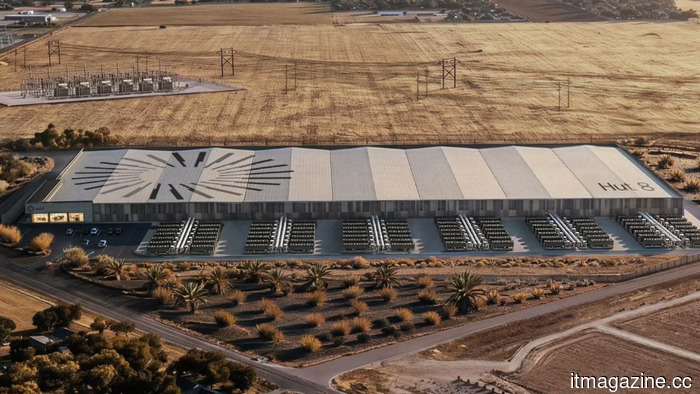 Hut 8 has entered into a 15-year lease worth $9.8 billion for the initial phase of its AI data center in Texas.
Hut 8 has entered into a 15-year lease for 352 MW at its Beacon Point Texas AI data-center campus with an undisclosed investment-grade tenant, valued at $9.8 billion.
Hut 8 has entered into a 15-year lease worth $9.8 billion for the initial phase of its AI data center in Texas.
Hut 8 has entered into a 15-year lease for 352 MW at its Beacon Point Texas AI data-center campus with an undisclosed investment-grade tenant, valued at $9.8 billion.
 Beijing's lobbying campaign regarding the EU Cybersecurity Act depicted through statistics
A study by KPMG, commissioned by the China Chamber of Commerce to the EU, estimates that the revision of the bloc's proposed Cybersecurity Act would amount to $432.83 billion.
Beijing's lobbying campaign regarding the EU Cybersecurity Act depicted through statistics
A study by KPMG, commissioned by the China Chamber of Commerce to the EU, estimates that the revision of the bloc's proposed Cybersecurity Act would amount to $432.83 billion.
 Thailand has given the green light to $29 billion worth of projects, including the expansion of TikTok's data center.
Thailand's BOI approved $29 billion in foreign investments, which includes a $25 billion expansion of TikTok's data center, positioning Thailand as the leader in Southeast Asia.
Thailand has given the green light to $29 billion worth of projects, including the expansion of TikTok's data center.
Thailand's BOI approved $29 billion in foreign investments, which includes a $25 billion expansion of TikTok's data center, positioning Thailand as the leader in Southeast Asia.
Thailand greenlights $29 billion worth of projects, including the expansion of TikTok's data center.
Thailand's BOI approved $29 billion in foreign investments, which includes a $25 billion expansion of TikTok's data center, positioning Thailand as the leader in Southeast Asia.