
Anthropic and Wall Street are creating a $1.5 billion pipeline for private equity.
A joint venture involving Blackstone, Hellman & Friedman, Goldman Sachs, and General Atlantic will integrate Claude into the portfolio companies of these buyout firms. OpenAI's DeployCo was the first to arrive, but this new venture is larger.
Over the past month, a certain business school question has been tacitly answered without any formal inquiry: which holds greater value for a frontier-model company, the next $50 billion investment from a venture capital firm or a permanent distribution network to the operational companies of the world's largest private equity firms? Anthropic has been addressing this second aspect.
On Sunday evening, the Wall Street Journal reported that Anthropic was nearing completion of a joint venture valued at approximately $1.5 billion with a select group of Wall Street firms, with an announcement anticipated as early as Monday. The WSJ indicates that both Anthropic and buyout firm Blackstone are anchoring the deal at around $300 million each, while Goldman Sachs is participating as a founding investor with about $150 million, and General Atlantic along with other firms will cover the remainder. We previously discussed the outlines of this venture last month when the anticipated figure was around $1 billion; the final amount is closer to $1.5 billion.
The investors will establish a vehicle that functions as a blend of a consulting arm and a deployment factory, assisting the private equity backers’ portfolio companies in incorporating Claude into their everyday operations.
The proposition is clear: buyout firms manage thousands of operating businesses spanning health care, logistics, manufacturing, and financial services, each representing a potential customer for Anthropic. Pitching individually to each one over the standard enterprise software cycle would take years, but this joint venture streamlines the timeline to mere months.
Thus, this initiative is less about launching a product and more about building a sales infrastructure.
OpenAI was the first to initiate such a venture, but it is smaller in scale. The structural model will seem familiar as OpenAI unveiled a similar joint venture, DeployCo, last month, backed by TPG, Bain Capital, Advent International, Brookfield, and Goanna Capital. These five private equity firms collectively committed around $4 billion, with OpenAI contributing $500 million and having the option for an additional $1 billion. The DeployCo vehicle is expected to achieve a valuation of $10 billion in a round closing in early May, with OpenAI ensuring its private equity investors an annualized return of 17.5 percent over five years.
Anthropic’s structure features important differences. While the total commitment is lower in absolute dollars, it is more concentrated, with Anthropic contributing a similar amount to its largest financial partner. There has been no public reporting of guaranteed returns.
The investor roster boasts prestigious names but is less diverse: Blackstone is the world’s largest alternative asset manager, Hellman & Friedman is known for disciplined large-cap buyouts, Goldman Sachs stands out, and General Atlantic brings a growth-equity aspect to the venture.
Each party essentially bets on a distinct proposition. OpenAI’s DeployCo focuses on scale: quickly pulling as many private equity portfolios as possible into a controlled channel. In contrast, Anthropic’s venture emphasizes credibility: embedding Claude within a smaller number of high-profile financial firms whose endorsement can promote the model to the broader market.
The timing is strategic. Anthropic has received pre-emptive offers for a round possibly worth around $50 billion, at a valuation estimated between $850 billion and $900 billion, with a decision by the company’s board anticipated in May, and an IPO possibly set for as early as October 2026.
Anthropic’s reported annualized revenue run rate has reportedly risen from approximately $9 billion at the end of 2025 to about $30 billion by the end of March 2026. For a successful public offering at such valuations, the company must showcase not just its model capabilities but also sustainable enterprise revenue at scale.
A joint venture that integrates Claude into the operations of three or four leading buyout firms creates the type of revenue growth that public market investors tend to favor.
Moreover, it holds narrative significance. In this context, Claude is not simply a chat product or a developer API, but rather an essential piece of enterprise infrastructure integrated into the operational frameworks of businesses that significantly impact the real economy.
There are precedents for this strategy in Anthropic’s experience. Goldman Sachs has spent several months internally testing Claude as a foundation for autonomous agents in accounting and compliance, with embedded Anthropic engineers reportedly dedicating six months to co-develop systems at the bank.
JPMorgan Chase and Goldman Sachs have also been exploring Anthropic’s Mythos model through a Project Glasswing initiative focused on AI cyber-risk. The new joint venture aims to commercialize those trials.
For the buyout firms, the rationale is clear-cut. Private equity returns increasingly hinge on operational enhancements at portfolio companies rather than financial engineering at the holding company level. The theoretical next significant efficiency lever is AI deployment
Other articles
 OpenAI's Codex now includes a small AI pet that keeps you informed as you program.
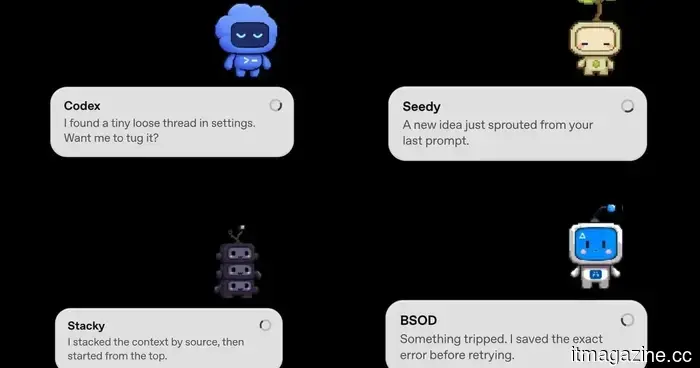
OpenAI has launched Codex Pets, which are optional animated companions for its Codex desktop application. These pets appear on your screen and monitor the actions of the coding agent as they happen in real-time.
OpenAI's Codex now includes a small AI pet that keeps you informed as you program.
OpenAI has launched Codex Pets, which are optional animated companions for its Codex desktop application. These pets appear on your screen and monitor the actions of the coding agent as they happen in real-time.
 I utilize AI on a daily basis — here are three reasons why I chose to pay for Claude instead of ChatGPT.
I sought out a more effective AI and ultimately transformed my work processes. What began as mere curiosity has evolved into a resource I depend on daily.
I utilize AI on a daily basis — here are three reasons why I chose to pay for Claude instead of ChatGPT.
I sought out a more effective AI and ultimately transformed my work processes. What began as mere curiosity has evolved into a resource I depend on daily.
 Anthropic and Wall Street are creating a $1.5 billion pipeline for private equity.
Anthropic is concluding a $1.5 billion joint venture with Blackstone, Hellman & Friedman, Goldman Sachs, and General Atlantic to implement Claude in private equity portfolio companies.
Anthropic and Wall Street are creating a $1.5 billion pipeline for private equity.
Anthropic is concluding a $1.5 billion joint venture with Blackstone, Hellman & Friedman, Goldman Sachs, and General Atlantic to implement Claude in private equity portfolio companies.
 I used the iPhone Air for six months, and here’s the one thing I miss.
The iPhone Air surprised me in ways I hadn't anticipated. Six months in, it remains my preferred iPhone, but there's one feature I keep wishing for.
I used the iPhone Air for six months, and here’s the one thing I miss.
The iPhone Air surprised me in ways I hadn't anticipated. Six months in, it remains my preferred iPhone, but there's one feature I keep wishing for.
 OpenAI's Codex now features a small AI companion that provides updates as you code.
OpenAI has launched Codex Pets, which are optional animated companions for its Codex desktop application. These pets will be displayed on your screen and monitor the activities of the coding agent in real-time.
OpenAI's Codex now features a small AI companion that provides updates as you code.
OpenAI has launched Codex Pets, which are optional animated companions for its Codex desktop application. These pets will be displayed on your screen and monitor the activities of the coding agent in real-time.
 Meta would prefer to exit New Mexico rather than redesign its applications for children.
New Mexico is requesting a Santa Fe judge to mandate changes to algorithms, implement age verification, and create a $3.7 billion fund for teen mental health, targeting Meta. The company has warned of the possibility of exiting the market.
Meta would prefer to exit New Mexico rather than redesign its applications for children.
New Mexico is requesting a Santa Fe judge to mandate changes to algorithms, implement age verification, and create a $3.7 billion fund for teen mental health, targeting Meta. The company has warned of the possibility of exiting the market.
Anthropic and Wall Street are creating a $1.5 billion pipeline for private equity.
Anthropic is completing a $1.5 billion joint venture with Blackstone, Hellman & Friedman, Goldman Sachs, and General Atlantic to implement Claude in portfolio companies of private equity.