

The shift in venture capital from software to deep tech is driven by several factors.
For over twenty years, software has significantly influenced the direction of venture capital. It was efficient, scalable, and for a long time, it was unparalleled in producing substantial returns. Investors invested heavily in SaaS platforms, marketplaces, and digital infrastructure, trusting a model that emphasized speed, low marginal costs, and rapid growth. I experienced this era firsthand and, like many others, recognized its immense potential.
However, I now observe a distinct shift. Venture capital is increasingly gravitating toward deep tech builders, and this is not merely a niche focus. It is becoming a significant component of capital allocation. This shift is driven by structural factors rather than ideological ones.
One of the most significant changes has been the breakdown of the long-held belief that hardware cannot deliver venture-scale returns. This belief influenced investment behaviors for years, deterring capital from sectors that required time, infrastructure, and in-depth engineering expertise. Yet, this assumption has been challenged in undeniable ways. Companies like SpaceX have shown that hardware-intensive businesses can yield strong and sustainable returns, fundamentally altering expectations about what is achievable.
The repercussions of this shift are still emerging. Even though extraordinary outcomes like SpaceX are uncommon, the precedent it sets is crucial. It has reshaped how investors regard risk, capital efficiency, and long-term value generation, as well as how founders approach company-building.
Meanwhile, the economics of software have changed in ways that are less favorable than previously. The notion of zero marginal cost still applies, but it does not tell the whole story. The cost of customer acquisition has risen, competition has intensified, and maintaining customer retention now demands continuous investment. Many companies are finding that staying competitive and visible necessitates ongoing capital investment and aggressive spending.
The emergence of artificial intelligence has further accelerated this trend. AI has lowered the barriers to entry for creating software products, which is powerful but introduces a new challenge. If a product can be duplicated quickly, maintaining a competitive edge becomes tenuous. Differentiation shifts from the product itself to aspects like distribution, marketing, and capital, which is not a sustainable advantage for most firms.
Conversely, deep tech functions under a distinct set of constraints. It requires time, resources, and specialized knowledge. For years, these factors were perceived as drawbacks, but they are increasingly recognized as advantages. The challenges of creating in the physical realm produce natural barriers to entry, necessitate rigorous execution, and compel teams to address real problems before scaling up.
I have witnessed this firsthand. During my tenure at SpaceX and in my subsequent ventures, I observed how these constraints influence outcomes. Physics cannot be bypassed. You cannot deploy unfinished systems into reality and expect success. This level of discipline fosters a different type of company, one that is more challenging to establish but also more difficult to duplicate.
There are also often-overlooked structural advantages. Once a deep tech company secures a foothold, it can access capital sources that are typically unavailable to most software firms. Options like asset-backed lending, infrastructure financing, and long-term contracts become feasible. These avenues enable companies to scale more capital-efficiently over time, even if the initial funding is higher.
The talent landscape is also transforming. A decade ago, the majority of leading engineering talent gravitated toward software. Today, that distribution is shifting. The impact of SpaceX and similar organizations has inspired a new generation of builders focused on aerospace, energy, manufacturing, and defense. This shift is evident in the growing demand, with estimates suggesting the sector could require 3.8 million new workers by 2033, with 1.9 million roles potentially going unfilled.
Government support has also contributed to this change. Early-stage funding mechanisms, especially in areas linked to national infrastructure and defense, have helped mitigate some of the initial challenges associated with deep tech. While this does not eliminate complexity, it alters the landscape enough to encourage more private capital involvement.
What I find most intriguing is that this transition is still in its early stages. Many generalist venture firms are just beginning to allocate resources to deep tech, which often constitutes a small portion of their portfolios. Nonetheless, the trend is unmistakable: more investors are entering this space, more founders are emerging in it, and more capital is flowing in.
At the same time, global instability has highlighted the importance of physical systems. Supply chains, energy production, and industrial capacity have shifted from abstract concerns to central components of economic resilience. This reality is prompting both governments and investors to rethink where innovation must occur.
None of this implies that software is fading away. It remains crucial. However, it is no longer the sole frontier. The forthcoming generation of transformative companies will not exist solely in the digital sphere; they will function at the intersection of software and the physical world, addressing problems that demand both. After all, Silicon Valley's roots lie in hardware. Although this may seem like a distant past, the current trend is reverting to the once-strong emphasis on hardware, continuing the evolution of the tech landscape
Other articles
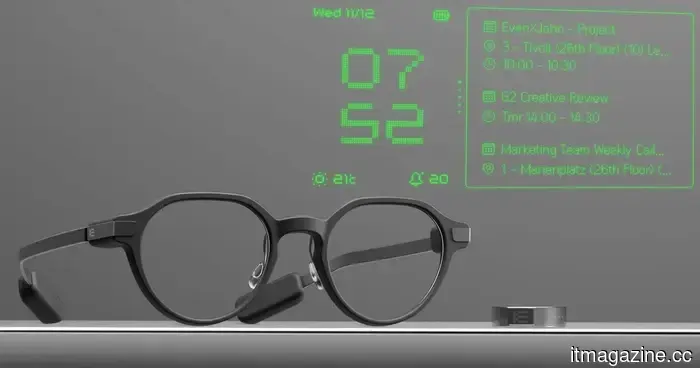 Even Reality's smart glasses deliver the coding terminal directly to your eye.
Even Realities' most recent G2 update introduces Terminal Mode to its smart glasses, enabling developers to oversee AI coding agents, track their progress, and communicate via the integrated microphone without needing to be tied to a laptop.
Even Reality's smart glasses deliver the coding terminal directly to your eye.
Even Realities' most recent G2 update introduces Terminal Mode to its smart glasses, enabling developers to oversee AI coding agents, track their progress, and communicate via the integrated microphone without needing to be tied to a laptop.
 This adorable watch is disguised as a Game Boy Color. And indeed, it is capable of running games.
A uniquely crafted wristwatch incorporates genuine Game Boy Color hardware, enabling it to operate real cartridges, although the small screen and controls make it more remarkable than functional.
This adorable watch is disguised as a Game Boy Color. And indeed, it is capable of running games.
A uniquely crafted wristwatch incorporates genuine Game Boy Color hardware, enabling it to operate real cartridges, although the small screen and controls make it more remarkable than functional.
 The Clicks Communicator phone, featuring a QWERTY keyboard, has finally received its launch date.
The Clicks Communicator is a $500 tribute to those who believe that touchscreens were a misstep, and incredibly, despite all challenges, it could potentially be released this year.
The Clicks Communicator phone, featuring a QWERTY keyboard, has finally received its launch date.
The Clicks Communicator is a $500 tribute to those who believe that touchscreens were a misstep, and incredibly, despite all challenges, it could potentially be released this year.
 Dell 34 Plus USB-C monitor review: An ultrawide beauty with delightful surprises
The Dell 34 Plus USB-C is a stylish ultrawide monitor with a 120Hz refresh rate, excelling in productivity thanks to its smart port hub, impressive design, and single-cable ease, making it well worth the investment.
Dell 34 Plus USB-C monitor review: An ultrawide beauty with delightful surprises
The Dell 34 Plus USB-C is a stylish ultrawide monitor with a 120Hz refresh rate, excelling in productivity thanks to its smart port hub, impressive design, and single-cable ease, making it well worth the investment.
 Valve has announced that development for the Steam Deck 2 is progressing well, but has not provided any further details.
Valve has announced that the development of the Steam Deck 2 is progressing rapidly; however, the company is not sharing specific details yet as it anticipates a significant advancement in hardware.
Valve has announced that development for the Steam Deck 2 is progressing well, but has not provided any further details.
Valve has announced that the development of the Steam Deck 2 is progressing rapidly; however, the company is not sharing specific details yet as it anticipates a significant advancement in hardware.
 Amazon attempted to sell office software but did not succeed. It is now wagering that the concept of office software is outdated.
TL;DRAWS introduced AI-driven business applications, including Connect Decisions for supply chain management and Connect Talent for recruitment, alongside Connect Health starting in March. This marks their entry into the $300 billion SaaS market, competing with Microsoft, Oracle, and Salesforce. AWS CMO Jul
Amazon attempted to sell office software but did not succeed. It is now wagering that the concept of office software is outdated.
TL;DRAWS introduced AI-driven business applications, including Connect Decisions for supply chain management and Connect Talent for recruitment, alongside Connect Health starting in March. This marks their entry into the $300 billion SaaS market, competing with Microsoft, Oracle, and Salesforce. AWS CMO Jul
The shift in venture capital from software to deep tech is driven by several factors.
Venture capital is expanding its focus beyond software, as deep technology, artificial intelligence, and innovations in the physical world are reshaping long-term value generation and investment approaches.