

Ensuring the future of AI: How Tresor Lisungu Oteko is connecting cloud systems with post-quantum security.
As artificial intelligence systems rapidly scale across enterprise environments, a critical gap has become increasingly difficult to overlook: security is not evolving at the same speed as deployment. Organizations are incorporating AI into production workflows, customer platforms, and decision-making systems, yet many still do not possess strong frameworks to ensure these systems are secure, trustworthy, and resilient. This growing tension between innovation and security is influencing the next phase of enterprise technology. It is also where professionals like Tresor Lisungu Oteko are focusing their efforts.
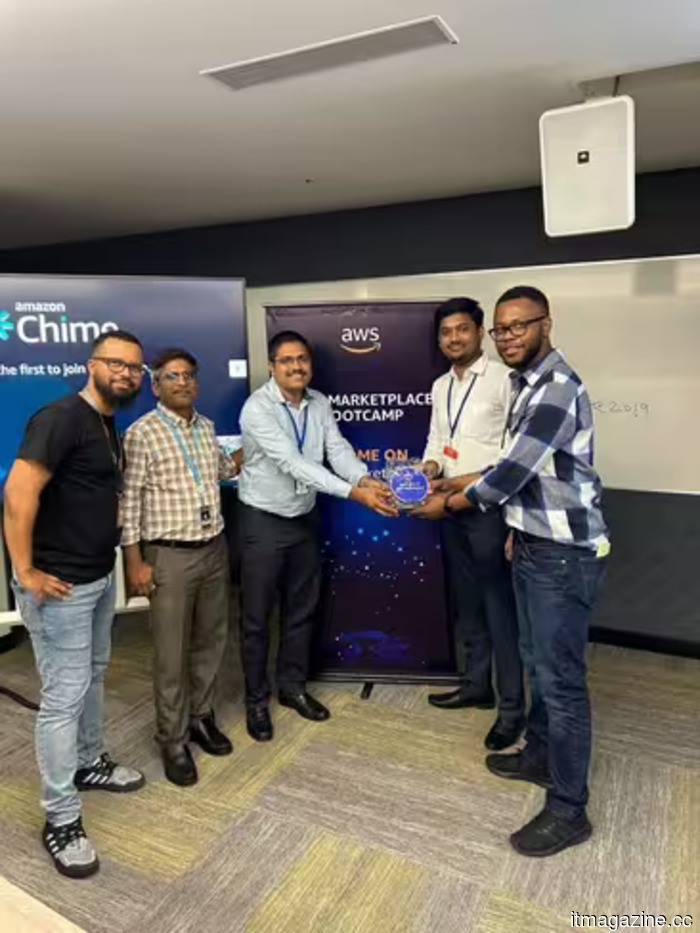
Currently serving as a Subject Matter Expert Lead at AWS Marketplace, Oteko works at the intersection of cloud infrastructure, AI systems, and secure software delivery. His focus is not only on enabling organizations to scale AI-powered solutions but also on tackling the more profound challenge of how to deploy these systems safely in increasingly complex environments.
**The Missing Layer in AI Adoption**
While AI adoption continues to accelerate, many enterprises face a structural challenge: deploying models is often simpler than securing them. AI systems introduce new categories of risk, from data exposure and model manipulation to vulnerabilities in API-driven architectures. As these systems become integrated into critical business processes, the consequences of failure or compromise become significantly more severe. Traditional security models are often not equipped to handle the dynamic and distributed nature of modern AI systems. This has led to an emerging need for approaches that embed security directly into system design rather than treating it as a secondary layer.
Oteko’s work reflects this shift. Instead of solely concentrating on performance or scalability, he is part of a broader movement aimed at constructing AI systems that are secure by design—systems that can scale without introducing new failure points.
**Bridging Research and Real-World Systems**
One defining characteristic of Oteko’s work is his ability to navigate both academic research and enterprise implementation. He is completing a PhD in Electrical and Electronic Engineering Science, with research focused on deep learning, cryptography, and biometric authentication. His academic contributions, showcased on his Google Scholar profile, include multiple peer-reviewed publications in pattern recognition and AI-driven cryptographic systems, with one paper receiving over 50 citations. Additionally, he serves as a reviewer for IEEE Access and Springer Nature, reflecting recognition within the global research community tackling some of the most pressing challenges in AI and cybersecurity.
What makes this work particularly relevant is its direct application. As organizations struggle to transition AI systems from experimentation to production, the capacity to merge theoretical research with practical deployment becomes increasingly invaluable.
**Securing AI at Scale in the Cloud**
At AWS Marketplace, Oteko’s role concentrates on enabling software vendors to deploy and scale their solutions efficiently, reliably, and securely. Cloud marketplaces are becoming a central distribution layer for enterprise software, including AI-driven applications. However, they also introduce new complexities related to integration, compliance, and system integrity.
Through his work, Oteko has contributed to frameworks and practical guidance that assist organizations in onboarding and operating software more effectively. His published AWS contributions, such as "Successfully Testing Your SaaS Listing in AWS Marketplace" and "Speed Product Provisioning with Customized SaaS Landing Page Fields," offer actionable insights for vendors navigating cloud distribution. While these efforts enhance speed and scalability, they also bolster the consistency and reliability of software delivery and maintenance across the ecosystem, crucial as AI systems move into production at scale.
For a broader context on how AI marketplaces are reshaping software distribution, publications like The Next Web have emphasized the increasing role of platform ecosystems in enterprise AI adoption.
**Preparing for a Post-Quantum Future**
Beyond current challenges, a more fundamental shift is on the horizon: the long-term impact of quantum computing on modern encryption. Many of today’s widely used cryptographic systems could become vulnerable in a post-quantum world. Although practical quantum threats may still be years away, the urgency to develop quantum-resistant security approaches is already driving research and innovation.
Oteko’s future work aligns closely with this direction. His focus on AI-enhanced cryptography and quantum-resistant systems reflects a proactive approach to security, anticipating emerging risks rather than merely reacting to them. By investigating how machine learning can integrate with next-generation cryptographic techniques, he is contributing to efforts aimed at building systems that remain secure even as underlying technologies evolve.
**From Infrastructure to Trust**
The evolution of enterprise technology is increasingly defined not just by what systems can do, but by how much they can be trusted. As AI becomes more deeply integrated into critical workflows across finance, healthcare, telecommunications, and beyond, the significance of trust, reliability, and security continues to grow. Organizations are no longer evaluating systems solely based on performance; they are also assessing resilience, compliance, and long-term risk.
Industry research, including McKinsey's State of AI report, highlights that many organizations still face challenges in securely and efficiently moving AI into production environments. Professionals who can operate across these dimensions—combining technical expertise, system-level thinking, and security awareness—are becoming essential to the next generation of technology leadership.
**A Forward-Looking Perspective**
Looking ahead
Other articles
 James Zou from Stanford aims for a $1 billion valuation for his AI physiology startup, which is supported by research published in Nature and an FDA-approved cardiac AI.
James Zou from Stanford aims for a $1 billion valuation for his AI physiology startup, which is supported by research published in Nature and an FDA-approved cardiac AI.
James Zou from Stanford aims for a $1 billion valuation for his AI physiology startup, which is supported by research published in Nature and an FDA-approved cardiac AI.
 Meta reduces its workforce by 8,000 positions, while Microsoft presents its inaugural buyout offers as major tech companies shift their payroll budgets towards AI capital investments.
On the same day, Meta and Microsoft cut up to 23,000 jobs. Both companies announced record earnings and are reallocating the savings towards AI infrastructure valued in the hundreds of billions.
Meta reduces its workforce by 8,000 positions, while Microsoft presents its inaugural buyout offers as major tech companies shift their payroll budgets towards AI capital investments.
On the same day, Meta and Microsoft cut up to 23,000 jobs. Both companies announced record earnings and are reallocating the savings towards AI infrastructure valued in the hundreds of billions.
 The Porsche Cayenne Coupe Electric makes its debut with 1,139 horsepower and a range of 669 kilometers, as the company shifts away from its all-electric strategy.
The Cayenne Coupe Electric produces 1,139 horsepower, can charge in 16 minutes, and has a starting price of $113,800. Porsche is introducing it alongside internal combustion engine variants following a 93% drop in profits and a strategic pullback from electrification.
The Porsche Cayenne Coupe Electric makes its debut with 1,139 horsepower and a range of 669 kilometers, as the company shifts away from its all-electric strategy.
The Cayenne Coupe Electric produces 1,139 horsepower, can charge in 16 minutes, and has a starting price of $113,800. Porsche is introducing it alongside internal combustion engine variants following a 93% drop in profits and a strategic pullback from electrification.
 Meta reduces its workforce by 8,000 positions, while Microsoft introduces its first-ever buyout offers as major tech companies shift their payroll expenses into investments in AI.
Meta and Microsoft cut up to 23,000 jobs on the same day. Both companies announced record earnings and are reallocating the savings towards AI infrastructure valued at hundreds of billions.
How web intelligence is driving the next generation of AI infrastructure.
Web intelligence is advancing to accommodate the scale and intricacy of contemporary AI systems, transitioning from multimodal AI to LLM search and data pipelines.
Meta reduces its workforce by 8,000 positions, while Microsoft introduces its first-ever buyout offers as major tech companies shift their payroll expenses into investments in AI.
Meta and Microsoft cut up to 23,000 jobs on the same day. Both companies announced record earnings and are reallocating the savings towards AI infrastructure valued at hundreds of billions.
How web intelligence is driving the next generation of AI infrastructure.
Web intelligence is advancing to accommodate the scale and intricacy of contemporary AI systems, transitioning from multimodal AI to LLM search and data pipelines.
 Porsche Cayenne Coupe Electric makes its debut featuring 1,139 hp and a range of 669 km as the company steps back from its all-electric strategy.
The Cayenne Coupe Electric boasts 1,139 hp, can be charged in 16 minutes, and has a starting price of $113,800. Porsche is introducing it alongside internal combustion engine (ICE) variants following a 93% drop in profits and a strategic pullback from electrification.
Porsche Cayenne Coupe Electric makes its debut featuring 1,139 hp and a range of 669 km as the company steps back from its all-electric strategy.
The Cayenne Coupe Electric boasts 1,139 hp, can be charged in 16 minutes, and has a starting price of $113,800. Porsche is introducing it alongside internal combustion engine (ICE) variants following a 93% drop in profits and a strategic pullback from electrification.
Ensuring the future of AI: How Tresor Lisungu Oteko is connecting cloud systems with post-quantum security.
As AI adoption grows, security risks are increasing. Tresor Lisungu Oteko is focusing on the convergence of cloud, AI, and cryptography to develop more secure enterprise systems.