
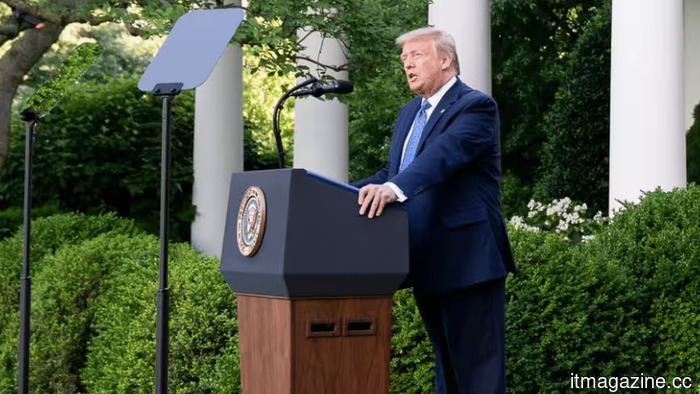
The United States has recently instructed China to cease its imitation of American AI. However, implementing this directive will be the challenging aspect.
Summary: The White House Office of Science and Technology Policy (OSTP) issued a policy memo accusing China of large-scale theft of U.S. artificial intelligence models, pledging to share intelligence with American AI companies and to consider accountability actions. In February, OpenAI accused DeepSeek of distilling its models, while Anthropic identified DeepSeek, MiniMax, and Moonshot AI for creating 24,000 fake accounts that generated over 16 million interactions with its Claude model. The Deterring American AI Model Theft Act (H.R. 8283) was introduced on April 15. This memo comes three weeks before a scheduled summit between Trump and Xi on May 14.
On Wednesday, the White House accused China of engaging in “industrial-scale” theft of American AI technology, releasing a memo promising to share intelligence with U.S. AI companies regarding foreign distillation efforts and exploring ways to hold those responsible accountable. Michael Kratsios, head of the OSTP, stated that the U.S. has evidence that foreign entities, primarily from China, are conducting extensive distillation campaigns to misappropriate American AI innovations. The memo is released shortly before a Trump-Xi summit planned for May 14, framing the protection of AI technology as both a national security necessity and a bargaining tool.
Distillation is the method at the heart of the controversy. This approach does not involve stealing model weights or breaching servers. Instead, a distiller inputs numerous meticulously crafted queries into a cutting-edge AI model, collects the generated responses, and utilizes them to train a more affordable rival model that mimics the original's capabilities at a lower cost. Essentially, this technique learns from the outputs of the original model rather than its underlying structure. The legal implications of this method remain ambiguous, while the strategic consequences are clearer.
The OSTP memo builds upon allegations made by U.S. AI companies since February. OpenAI formally notified the House Select Committee on China on February 12 about DeepSeek distilling its models. OpenAI reported discovering accounts linked to DeepSeek employees that utilized methods to bypass access restrictions, channeling queries through obscured third-party proxies to extract responses on a large scale. OpenAI’s terms of service expressly forbid the use of outputs to develop “imitation frontier AI models.” DeepSeek has not publicly addressed these claims.
On February 23, Anthropic released more detailed evidence, naming three Chinese companies. It stated that DeepSeek had conducted over 150,000 exchanges with Claude pertaining to foundational logic and alignment techniques, while MiniMax recorded the highest volume of traffic with more than 13 million exchanges. Moonshot AI generated over 3.4 million exchanges aimed at agentic reasoning, tool use, programming, and computer vision. Anthropic indicated that it identified around 24,000 fraudulent accounts across these three firms, responsible for generating over 16 million exchanges with Claude. These accounts employed jailbreaking tactics to uncover proprietary information and circumvented geographic restrictions through commercial proxy services.
By early April, OpenAI, Anthropic, and Google had begun sharing intelligence about distillation threats through the Frontier Model Forum, a consortium established in 2023 alongside Microsoft. This arrangement is reminiscent of cybersecurity threat-sharing models: when one company identifies an attack pattern, it informs the others. The collaboration among these three strong competitors reflects the seriousness with which they view this threat. DeepSeek demonstrated that achieving frontier AI performance no longer necessitates Silicon Valley-level resources, leading the U.S. government to question how much of this efficiency was legitimately obtained versus how much was illicitly acquired.
The OSTP memo acts as a policy declaration rather than an executive order or binding regulation. It instructs federal agencies to coordinate intelligence with U.S. AI developers regarding foreign distillation attempts, assist the industry in enhancing technical defenses, and examine accountability options for foreign actors. No specific sanctions, additions to entity lists, or enforcement measures were disclosed. The memo's actual impact will hinge on subsequent actions.
Congress is working in parallel. On April 15, Representative Bill Huizenga introduced the Deterring American AI Model Theft Act of 2026, co-sponsored by Representative John Moolenaar, who chairs the House Select Committee on China. The legislation mandates that the government identify entities employing “improper query-and-copy techniques” and impose sanctions via the Commerce Department's blacklist. The House Select Committee held a hearing on April 16 titled “China’s Campaign to Steal America’s AI Edge,” featuring witnesses from Brookings, the Silverado Policy Accelerator, and the America First Policy Institute. The issue enjoys bipartisan backing. Roll Call reported that “winning the AI arms race appeals to both parties.”
The legal rationale for prosecution remains vague. The Protecting American Intellectual Property Act, enacted in January 2023, permits sanctions for trade secret theft, but whether extracted model outputs qualify as trade secrets under existing laws is unclear. The South China Morning Post highlighted that Anthropic's distillation allegations “reveal an AI training grey area
Other articles
 Data from 500,000 UK Biobank volunteers is being offered for sale on Alibaba after Chinese research institutions violated access agreements.
Health information from 500,000 volunteers in the UK Biobank was listed for sale on Alibaba after three Chinese research organizations breached data-sharing agreements. The ICO is currently conducting an investigation.
Data from 500,000 UK Biobank volunteers is being offered for sale on Alibaba after Chinese research institutions violated access agreements.
Health information from 500,000 volunteers in the UK Biobank was listed for sale on Alibaba after three Chinese research organizations breached data-sharing agreements. The ICO is currently conducting an investigation.
 Volvo's parent company has created an elegant electric sedan priced at $14,300, which will unfortunately be unavailable to US consumers.
The Geely Galaxy A7 EV features a conventional design, boasts a claimed range of 550km, and is priced to compete with many rivals. However, this electric sedan launched in China seems destined to stay unattainable for buyers in the US.
Zapata Quantum secures $15 million following its exit from bankruptcy.
Zapata Quantum has secured $15 million following a close call with liquidation in 2024 and a two-phase restructuring that dealt with $18.7 million in debt.
Rilian secures $17.5 million to advance agentic AI for sovereign defense.
Rilian secures $17.5 million in funding, spearheaded by 8VC, to implement agentic AI in air-gapped defense and sovereign cloud settings.
Volvo's parent company has created an elegant electric sedan priced at $14,300, which will unfortunately be unavailable to US consumers.
The Geely Galaxy A7 EV features a conventional design, boasts a claimed range of 550km, and is priced to compete with many rivals. However, this electric sedan launched in China seems destined to stay unattainable for buyers in the US.
Zapata Quantum secures $15 million following its exit from bankruptcy.
Zapata Quantum has secured $15 million following a close call with liquidation in 2024 and a two-phase restructuring that dealt with $18.7 million in debt.
Rilian secures $17.5 million to advance agentic AI for sovereign defense.
Rilian secures $17.5 million in funding, spearheaded by 8VC, to implement agentic AI in air-gapped defense and sovereign cloud settings.
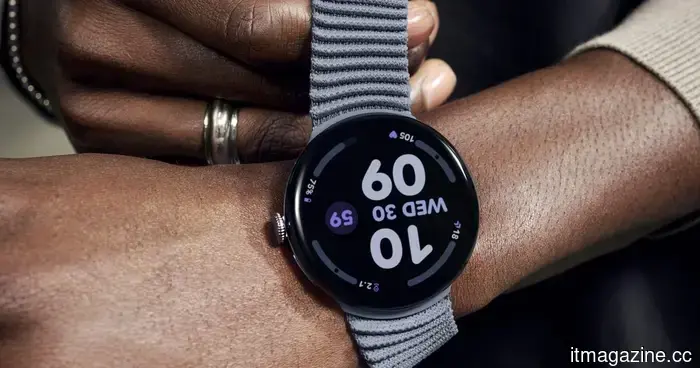 Fall Detection is a fantastic feature of smartwatches, but Google is prioritizing "account first!"
Google might soon necessitate a Google account for the Pixel Watch Fall Detection feature, bringing an end to one of the more adaptable setup options for this feature. This change will also include a grace period prior to enforcement, according to recently found app strings.
The EU is set to compel Google to make Android accessible to ChatGPT and Claude as part of the Digital Markets Act.
The European Commission is preparing regulations that will mandate Google to provide competing AI assistants with the same access to Android as Gemini, with a final decision expected by July 2026.
Fall Detection is a fantastic feature of smartwatches, but Google is prioritizing "account first!"
Google might soon necessitate a Google account for the Pixel Watch Fall Detection feature, bringing an end to one of the more adaptable setup options for this feature. This change will also include a grace period prior to enforcement, according to recently found app strings.
The EU is set to compel Google to make Android accessible to ChatGPT and Claude as part of the Digital Markets Act.
The European Commission is preparing regulations that will mandate Google to provide competing AI assistants with the same access to Android as Gemini, with a final decision expected by July 2026.
The United States has recently instructed China to cease its imitation of American AI. However, implementing this directive will be the challenging aspect.
The OSTP reports that China is conducting large-scale operations to extract US AI models. OpenAI, Anthropic, and Google are collaborating to share threat intelligence. Meanwhile, Congress is in the process of creating sanctions.