
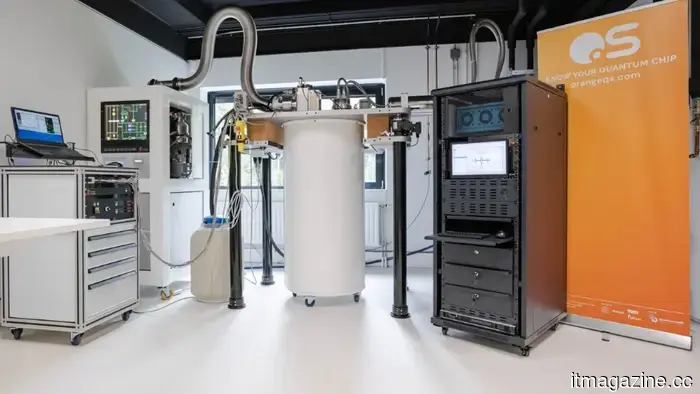
OrangeQS secures €15 million in seed funding.
The Dutch startup, which is the sole provider of a specialized commercial solution for testing quantum chips, has secured an additional €3 million extension to its seed round from the European Innovation Council Fund, which was initially raised in June 2025.
This new funding will support the MAX Partnership Programme, designed to give quantum chip manufacturers a formal opportunity to influence the development of OrangeQS's next-generation high-throughput testing equipment.
OrangeQS, based in Delft and originating from QuTech and TNO, has completed a second tranche of its seed round, bringing the total funding to €15 million. The extra €3 million is sourced from the European Innovation Council Fund, which invests in European deep-tech startups.
Zeina Chebli, an investor from the EIC Fund, is joining the board of OrangeQS as part of this investment. In June 2025, the company successfully closed a €12 million first tranche, led by Icecat Capital, with contributions from Cottonwood Technology Fund, QBeat Ventures, QDNL Participations, and InnovationQuarter Capital, marking the largest seed round in the Dutch quantum sector to date.
In tandem with the funding, OrangeQS is introducing the OrangeQS MAX Partnership Programme, a framework that allows quantum chip manufacturers to steer specific aspects of the MAX product and technology roadmap in return for their commitment to the platform.
The founding members of this program include Rigetti Computing, a US-listed superconducting quantum company; QuantWare, a Dutch startup specializing in superconducting quantum processor chips; and Peak Quantum, which has recently secured €5 million in total funding.
Each member collaborates with OrangeQS while retaining their intellectual property separately, collectively guiding the creation of a testing platform that must remain compatible with various hardware architectures concurrently.
Though not glamorous, the challenge OrangeQS addresses is fundamentally important. Quantum chips, whether based on superconductors or semiconductors, cannot function at room temperature. They necessitate environments at millikelvin temperatures, minimal electromagnetic noise, and precise control of microwave signals.
Currently, testing a single chip takes weeks, consuming both costly equipment and skilled operators, making it a bottleneck as quantum chip development shifts from academic settings to large-scale manufacturing. Scaling chip production is unfeasible if the characterization process for each chip is lengthier than its production.
OrangeQS's primary product, the MAX, is high-throughput industrial testing equipment designed to evaluate chips in days rather than weeks and is already operational at IQM's facility in Espoo, Finland.
The FLEX, their second product, is a more customizable, R&D-oriented system being utilized by institutions like the Karlsruhe Institute of Technology, the University of Napoli, Chalmers Next Labs, Berkeley Lab’s Advanced Quantum Testbed, and QuTech in Delft. Both systems run on the open-source operating system, OrangeQS Juice.
The partnership program is initially focused on parallel and non-destructive testing technologies, which enable multiple quantum chips to be characterized at the same time without causing damage, thus addressing throughput and yield challenges.
In conjunction with this announcement, OrangeQS has released a white paper outlining its technical roadmap, positioning itself within a trend seen in other deep-tech infrastructure ventures: instead of competing to create the quantum computer itself, it aims to produce the essential equipment required by all quantum computer manufacturers, independent of which hardware architecture eventually dominates.
The company currently employs around 30 staff members with backgrounds in experimental physics, systems engineering, and aerospace engineering. With the influx of new funding, it intends to increase production capacity, expand its team, and enhance the MAX to accommodate more complex multi-qubit chips.
Other articles
 DeepWay secures $310 million in pre-IPO funding.
DeepWay secures $310 million in pre-IPO funding in preparation for its listing in Hong Kong, with Australian superannuation fund NGS Super participating as an international investor.
DeepWay secures $310 million in pre-IPO funding.
DeepWay secures $310 million in pre-IPO funding in preparation for its listing in Hong Kong, with Australian superannuation fund NGS Super participating as an international investor.
 SpaceX's public IPO submission verifies that Musk and insiders maintain significant voting power.
SpaceX's public S-1 reveals that Musk holds approximately 79% of the voting rights while having around 42% equity, thanks to a dual-class structure. The company aims for a $1.75 trillion IPO in June, potentially raising up to $75 billion.
SpaceX's public IPO submission verifies that Musk and insiders maintain significant voting power.
SpaceX's public S-1 reveals that Musk holds approximately 79% of the voting rights while having around 42% equity, thanks to a dual-class structure. The company aims for a $1.75 trillion IPO in June, potentially raising up to $75 billion.
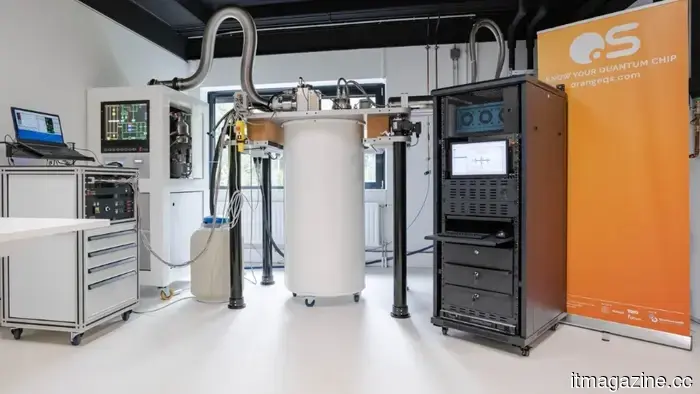 OrangeQS completes a €15 million seed funding round.
OrangeQS secures €15M in seed funding supported by the EIC Fund and initiates the MAX Partnership Programme in collaboration with Rigetti, QuantWare, and Peak Quantum.
OrangeQS completes a €15 million seed funding round.
OrangeQS secures €15M in seed funding supported by the EIC Fund and initiates the MAX Partnership Programme in collaboration with Rigetti, QuantWare, and Peak Quantum.
 Meta has recruited five founders from the Thinking Machines Lab, including an engineer associated with a reported $1.5 billion valuation.
Meta has methodically recruited five original members of Mira Murati's Thinking Machines Lab following her refusal of a $1 billion acquisition offer, altering its AI division.
Meta has recruited five founders from the Thinking Machines Lab, including an engineer associated with a reported $1.5 billion valuation.
Meta has methodically recruited five original members of Mira Murati's Thinking Machines Lab following her refusal of a $1 billion acquisition offer, altering its AI division.
 Meta has recruited five founders from Thinking Machines Lab, including an engineer reportedly valued at $1.5 billion.
Meta has methodically recruited five initial members of Mira Murati's Thinking Machines Lab after she turned down a $1 billion acquisition proposal, resulting in a transformation of its AI division.
Meta has recruited five founders from Thinking Machines Lab, including an engineer reportedly valued at $1.5 billion.
Meta has methodically recruited five initial members of Mira Murati's Thinking Machines Lab after she turned down a $1 billion acquisition proposal, resulting in a transformation of its AI division.
 A leak of the Xperia I VIII design suggests that Sony remains stuck in the past.
The brand that previously spearheaded innovation now seems to be drawing from trends that have already faded.
A leak of the Xperia I VIII design suggests that Sony remains stuck in the past.
The brand that previously spearheaded innovation now seems to be drawing from trends that have already faded.
OrangeQS secures €15 million in seed funding.
OrangeQS has successfully completed a €15M seed funding round supported by the EIC Fund and has initiated the MAX Partnership Programme in collaboration with Rigetti, QuantWare, and Peak Quantum.