
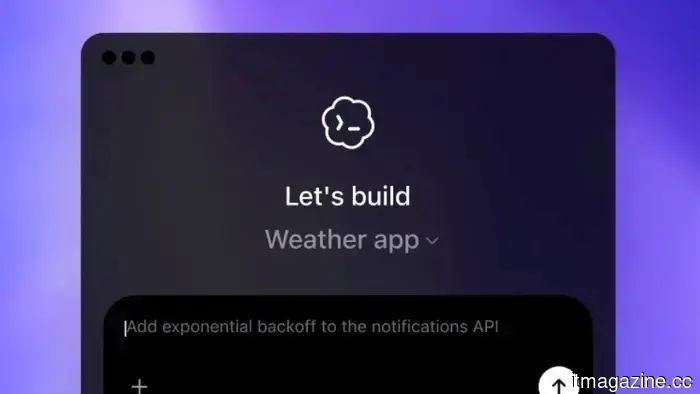
OpenAI Codex Chronicle records your Mac screen to create AI context, utilizing cloud processing and lacking encryption.
Summary: OpenAI has introduced Chronicle, a research preview feature in Codex for Mac that captures screenshots at intervals, transfers them to OpenAI’s servers for processing, and saves text summaries as local unencrypted Markdown files to provide the AI assistant with contextual information regarding user activities. This feature is not available in the EU, UK, and Switzerland, necessitates a Pro subscription costing $100 or more per month, and is compatible solely with Apple Silicon. It marks OpenAI’s inaugural foray into ambient screen-aware AI on desktops, opting for cloud processing and utility rather than the local-first privacy frameworks employed by rivals such as Screenpipe and the now-defunct Rewind AI.
Chronicle allows Codex to recognize recent user activities without requiring prior explanations. However, it involves sending desktop screenshots to OpenAI for analysis, contrasting with the privacy-forward approach taken by many in the field. The feature is a part of a major update that has transitioned Codex from being a coding assistant to a versatile AI workspace, adding capabilities for controlling Mac apps via its own cursor, an in-app browser, image creation, persistent memory, and over 90 plugins. More than one million developers have utilized Codex, and usage doubled after the launch of the GPT-5.2-Codex model in December.
How Chronicle functions
Chronicle operates by running background processes that regularly capture screenshots of the user’s screen. These screenshots are sent to OpenAI’s servers, where they undergo optical character recognition and visual analysis to create text summaries. These summaries are saved as Markdown files in a local folder at ~/.codex/memories_extensions/chronicle/. When users later interact with Codex, these memory files inform its context, enabling it to recall which applications were in use, documents being viewed, code being written, and conversations occurring—all without requiring users to restate anything.
The original screenshots are temporarily stored in a system temp directory and are automatically deleted after six hours. OpenAI asserts that screenshots are not retained on its servers post-processing and are not utilized for training purposes. In contrast, the generated memory files remain indefinitely on the user's machine as unencrypted text files.
Greg Brockman, OpenAI’s president, described the feature as “an experimental feature giving Codex the ability to see and have recent memory over what you see, automatically giving it full context on what you’re doing. Feels surprisingly magical to use.”
The privacy framework
Chronicle necessitates the granting of macOS Screen Recording and Accessibility permissions. It is exclusive to Apple Silicon Macs running macOS 14 or later and is accessible only to ChatGPT Pro users who subscribe for $100 or more monthly. Its unavailability in the EU, UK, and Switzerland implies that OpenAI recognizes the feature's incompatibility with GDPR standards concerning data minimization and purpose limitation.
In contrast, Microsoft Recall, which debuted on Windows Copilot+ devices, captures screenshots every few seconds and stores them in an encrypted local database, with all processing conducted by a neural processing unit on the device. No screenshot data departs the machine. Chronicle adopts a different stance: while reports and summaries are kept locally, the processing occurs in the cloud. Recall secures its database with encryption and requires biometric authentication via Windows Hello, whereas Chronicle keeps its memories as unencrypted Markdown files accessible to any running process.
OpenAI’s own documentation candidly acknowledges the risks involved. Chronicle “increases the risk of prompt injection” as malevolent content on websites could be captured in a screenshot and misinterpreted as instructions by the AI. The memories directory “might contain sensitive information.” Additionally, it “uses rate limits quickly,” which may constrain Pro users’ Codex usage due to Chronicle’s background activities.
OpenAI advises users to pause Chronicle before meetings or when dealing with sensitive materials. This recommendation implies an acknowledgment that the feature could capture undesirable content, effectively shifting the responsibility of risk management onto the user.
The category and its downfalls
The history of screen-aware AI assistants has been uneven. Rewind AI, the most notable early competitor, rebranded to Limitless before being acquired by Meta in December 2025. The Mac application was subsequently discontinued, and screen capture was disabled. Microsoft’s Copilot has experienced a 39% drop in subscribers over six months, partly due to trust concerns that also encompass Recall. A security researcher demonstrated in early 2026 that Recall’s encrypted database could still be compromised, thus amplifying existing apprehensions.
The open-source alternative, Screenpipe, promotes a local-first strategy: ongoing screen and audio capture processed entirely on-device, available for a $400 one-time fee and devoid of recurring cloud dependencies. Perplexity’s Personal Computer software adopts a different strategy, transforming a Mac mini into a persistent AI agent with access to local files and applications, although it also relies on cloud processing for underlying intelligence.
The underlying trend in this category is clear: as screen-aware AIs become more effective, their demand for data escal
Other articles
 Tim Cook steps down as CEO of Apple; John Ternus takes over.
Tim Cook will assume the role of executive chairman on September 1, as John Ternus, the head of Apple's hardware engineering, steps in as CEO of the $4 trillion company.
Tim Cook steps down as CEO of Apple; John Ternus takes over.
Tim Cook will assume the role of executive chairman on September 1, as John Ternus, the head of Apple's hardware engineering, steps in as CEO of the $4 trillion company.
 WhatsApp Plus subscription testing at €2.49 per month joins Instagram Plus in Meta's effort to introduce premium features across its apps.
WhatsApp is trialing a subscription service priced at EUR 2.49 per month, which includes chat themes, icons, and ringtones. This comes after the introduction of Instagram Plus, as Meta expands its paid options throughout its ecosystem of 3.3 billion users.
WhatsApp Plus subscription testing at €2.49 per month joins Instagram Plus in Meta's effort to introduce premium features across its apps.
WhatsApp is trialing a subscription service priced at EUR 2.49 per month, which includes chat themes, icons, and ringtones. This comes after the introduction of Instagram Plus, as Meta expands its paid options throughout its ecosystem of 3.3 billion users.
 Musk disregards Paris prosecutors in the Grok child pornography inquiry while the US Department of Justice declines to provide assistance.
Musk did not show up before Paris prosecutors who are looking into Grok's estimated 23,000 child sexual images, as the US Department of Justice declined to assist with the French investigation.
Musk disregards Paris prosecutors in the Grok child pornography inquiry while the US Department of Justice declines to provide assistance.
Musk did not show up before Paris prosecutors who are looking into Grok's estimated 23,000 child sexual images, as the US Department of Justice declined to assist with the French investigation.
 Motorola has just released the Android 17 beta for additional Razr and Edge devices.
Motorola is expanding access to the Android 17 beta for additional premium smartphones, including two Razr models and the Edge 50 Ultra, across multiple regions.
Motorola has just released the Android 17 beta for additional Razr and Edge devices.
Motorola is expanding access to the Android 17 beta for additional premium smartphones, including two Razr models and the Edge 50 Ultra, across multiple regions.
 The LG 77-inch C5 OLED is now priced at $1,999, and no other option at this screen size and price offers comparable picture quality.
The LG C5 has earned its status as the OLED standard for a valid reason, and the 77-inch model is currently priced at $1,999.99, reflecting a $1,700 discount from its comparison value of $3,699.99. With that size and price, this television transforms the aesthetic and ambiance of a living room, and the OLED evo panel beneath...
The LG 77-inch C5 OLED is now priced at $1,999, and no other option at this screen size and price offers comparable picture quality.
The LG C5 has earned its status as the OLED standard for a valid reason, and the 77-inch model is currently priced at $1,999.99, reflecting a $1,700 discount from its comparison value of $3,699.99. With that size and price, this television transforms the aesthetic and ambiance of a living room, and the OLED evo panel beneath...
 Testing for a WhatsApp Plus subscription priced at EUR 2.49 per month has commenced, joining Instagram Plus in Meta's initiative for cross-app premium offerings.
WhatsApp is piloting a subscription model priced at EUR 2.49 per month, which includes features like chat themes, icons, and ringtones. This comes in the wake of Instagram Plus, as Meta develops paid options within its ecosystem of applications catering to 3.3 billion users.
Testing for a WhatsApp Plus subscription priced at EUR 2.49 per month has commenced, joining Instagram Plus in Meta's initiative for cross-app premium offerings.
WhatsApp is piloting a subscription model priced at EUR 2.49 per month, which includes features like chat themes, icons, and ringtones. This comes in the wake of Instagram Plus, as Meta develops paid options within its ecosystem of applications catering to 3.3 billion users.
OpenAI Codex Chronicle records your Mac screen to create AI context, utilizing cloud processing and lacking encryption.
Codex's Chronicle function takes screenshots on Mac, processes them on OpenAI's servers, and keeps unencrypted text memories stored locally. It is not available in the EU.