
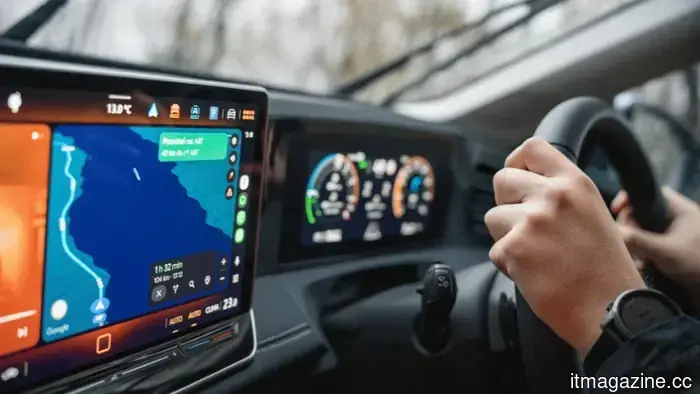
Uber will now dispatch a courier to your location for a $5 fee to return your purchases.
Uber has introduced a service that sends a gig worker to your location to pick up items you wish to return to a retailer, for a fee of $5 per pickup. This feature, named Return a Package, can be accessed in the Uber Eats app throughout nearly 5,000 cities in the US and works in conjunction with nine retail partners, including Target, Best Buy, and Dick’s Sporting Goods. A courier arrives, retrieves the item, and returns it to the store. Uber One members get a discounted rate of $3.
This service has several limitations. Items must be purchased via Uber Eats, must have a value exceeding $20, should not be over $100 in value or 30 pounds in weight, and must adhere to each retailer's return policy. Customers can request the return of up to five packages at once. These restrictions indicate that Return a Package is not a substitute for visiting a UPS Store or printing a shipping label; instead, it offers convenience for a specific group of purchases made through Uber’s own marketplace.
The returns challenge
According to the National Retail Federation, retail returns in the US reached $850 billion in 2025, with online purchases being returned at about double the rate of items bought in physical stores. Handling a single return costs retailers between $10 and $65 when considering shipping, labor, inspection, and restocking. Additionally, return fraud contributed to $103 billion in losses. For retailers, reverse logistics represent an operational challenge that grows alongside e-commerce and shows no signs of reducing.
Uber's proposition is that its existing courier network, which also delivers food and groceries, can naturally extend to handling returns given the existing logistics infrastructure. The added cost of incorporating a return pickup into a courier's route is minimal if the courier is already nearby. The $5 fee covers Uber’s share and compensates the driver for what is generally a brief trip. For customers, this service removes the hassle of packaging an item, locating a label, and visiting a drop-off site during working hours.
The competitive environment is full. UPS has acquired Happy Returns from PayPal and is shifting the service from FedEx Office sites to The UPS Store network, providing box-free, label-free return options at thousands of locations. Amazon manages its own returns through partnerships with Whole Foods and Kohl’s, as well as its own locker network. FedEx and USPS have their own drop-off facilities. What Uber offers is the on-demand pickup feature: no travel, no waiting in line, and no need to leave home.
Uber's logistics growth
Return a Package builds on Uber Connect, a peer-to-peer delivery service initiated in 2023 that allows customers to send items to USPS, UPS, or FedEx locations via a courier. This new service introduces the reverse process: instead of dropping off a pre-labeled package, the courier comes to pick up an item and returns it directly to the retailer on behalf of the customer.
This fits into a wider strategic initiative. Uber has been intentionally broadening its focus beyond ride-hailing and food delivery into logistics, autonomous vehicles, and fleet services. Over the past year, the company has signed a $1.25 billion deal for robotaxi services with Rivian, launched robotaxi trials with Wayve and Nissan in Tokyo, begun testing autonomous ID. Buzz minibuses with Volkswagen’s MOIA in Los Angeles, and resumed operations of Motional robotaxis in Las Vegas. While the returns service may lack the dramatic nature of these other efforts, it follows the same strategic rationale: every package that moves through Uber’s network reinforces its courier infrastructure as a versatile logistics platform.
The financial justification for growth is robust. Uber’s delivery revenue reached $4.9 billion in Q4 2025, reflecting a 30% increase year-over-year, amid total annual revenue of $52 billion and gross bookings of $193 billion. The company generated $10 billion in free cash flow for the year. Uber does not require returns to be a significant revenue source; rather, it needs them to enhance the frequency of app usage and the volume of tasks that its courier fleet can accomplish each hour. Both aspects are crucial for the unit economics that render its delivery business profitable.
The boundaries of convenience
The limitation to purchases made via Uber Eats is the most critical constraint. This means Return a Package is not applicable for the vast majority of online returns, such as those from Amazon, direct-to-consumer brands, or any retailers not part of Uber’s marketplace. A customer purchasing a blender from Target through Uber Eats can have it picked up, but if they buy the same blender from Target.com, they cannot. This significantly confines the service’s usefulness and reinforces its function as a retention mechanism for Uber Eats instead of a standalone logistics solution.
The $100 maximum value and 30-pound weight restrictions further limit its applicability. Higher-value electronics, furniture, and appliances—which tend to have higher return rates—are excluded. While the nine launch retailers cover a decent range of
Other articles
 Zoom introduces World ID verification to ensure that meeting attendees are genuine humans and not deepfakes.
Zoom incorporates World's Deep Face biometric verification to show "Verified Human" badges during meetings, as losses from deepfake fraud exceed $200 million in just one quarter.
Zoom introduces World ID verification to ensure that meeting attendees are genuine humans and not deepfakes.
Zoom incorporates World's Deep Face biometric verification to show "Verified Human" badges during meetings, as losses from deepfake fraud exceed $200 million in just one quarter.
 Allbirds rebrands itself as NewBird AI and shifts its focus from footwear to GPU cloud computing.
Allbirds sold its shoe brand for $39 million, obtained $50 million in funding, and is rebranding as NewBird AI to rent GPUs—its stock initially rose 600% before falling by 35%.
Allbirds rebrands itself as NewBird AI and shifts its focus from footwear to GPU cloud computing.
Allbirds sold its shoe brand for $39 million, obtained $50 million in funding, and is rebranding as NewBird AI to rent GPUs—its stock initially rose 600% before falling by 35%.
 Geely EX5: the $15,300 electric SUV equipped with luxury amenities, now available in 35 nations.
The starting price of Geely's EX5 is $15,300, featuring massaging seats, a 1,000W audio system, and a range of 610 km. It is currently exported to 35 countries, offering a significantly lower price than European electric vehicles by thousands.
Geely EX5: the $15,300 electric SUV equipped with luxury amenities, now available in 35 nations.
The starting price of Geely's EX5 is $15,300, featuring massaging seats, a 1,000W audio system, and a range of 610 km. It is currently exported to 35 countries, offering a significantly lower price than European electric vehicles by thousands.
 Canva and Anthropic introduce Claude Design for AI-enhanced visual creation.
Canva's Design Engine fuels Claude Design, enabling users to generate on-brand visuals from text in Claude, while Canva AI 2.0 launches agentic orchestration and workspace connectors.
Canva and Anthropic introduce Claude Design for AI-enhanced visual creation.
Canva's Design Engine fuels Claude Design, enabling users to generate on-brand visuals from text in Claude, while Canva AI 2.0 launches agentic orchestration and workspace connectors.
 Zoom introduces World ID verification to ensure that meeting participants are real humans and not deepfakes.
Zoom incorporates World's Deep Face biometric verification to showcase "Verified Human" badges during meetings, as losses from deepfake fraud exceed $200 million in just one quarter.
Zoom introduces World ID verification to ensure that meeting participants are real humans and not deepfakes.
Zoom incorporates World's Deep Face biometric verification to showcase "Verified Human" badges during meetings, as losses from deepfake fraud exceed $200 million in just one quarter.
 Anthropic's Amodei is heading to the White House as Washington debates access to Mythos.
Dario Amodei from Anthropic meets with Susie Wiles at the White House to address the standoff with the Pentagon, while US agencies and UK banks are looking to gain access to Mythos, its AI model for discovering zero-day vulnerabilities.
Anthropic's Amodei is heading to the White House as Washington debates access to Mythos.
Dario Amodei from Anthropic meets with Susie Wiles at the White House to address the standoff with the Pentagon, while US agencies and UK banks are looking to gain access to Mythos, its AI model for discovering zero-day vulnerabilities.
Uber will now dispatch a courier to your location for a $5 fee to return your purchases.
Uber's Return a Package service dispatches a courier to pick up items purchased via Uber Eats and return them to Target, Best Buy, and seven additional retailers for a fee of $5, or $3 for Uber One members.