

Google Cloud strengthens its AI infrastructure collaboration with Intel, focusing on Xeon and specialized chips.
In summary: Google Cloud and Intel have revealed an expanded multi-year partnership focused on AI infrastructure that includes CPU deployment and the co-development of custom chips. Google Cloud will persist in utilizing Intel’s Xeon 6 processors throughout its global operations for C4 and N4 instances, while both companies are broadening their collaboration on custom Infrastructure Processing Units intended to relieve networking, storage, and security tasks from host CPUs in large-scale AI settings. This announcement comes on the heels of Intel’s stock price rising about 33% within the week, just two days after the company became the foundry partner for Tesla’s Terafab megaproject.
The core argument of this partnership, as articulated by both firms, highlights that GPU accelerators alone are inadequate for the requirements of contemporary AI infrastructure. Intel's CEO, Lip-Bu Tan, stated in a release accompanying the announcement that: "AI is transforming the way infrastructure is constructed and expanded. Scaling AI necessitates more than just accelerators—it demands balanced systems. CPUs and IPUs are pivotal in delivering the performance, efficiency, and flexibility that modern AI workloads require." This wording is intentional. Over the past two years, Intel has shifted its focus from the general-purpose computing market it previously dominated to emphasizing the crucial role of CPUs and custom infrastructure silicon in AI implementations, which the GPU-centric perspective has consistently overlooked.
Amin Vahdat, Google’s Senior Vice President and Chief Technologist for AI infrastructure, elaborated from the demand perspective, saying, “CPUs and infrastructure acceleration remain foundational to AI systems—from training orchestration to inference and deployment. Intel has been a reliable partner for almost two decades, and their Xeon roadmap assures us that we can continue to meet the escalating performance and efficiency requirements of our workloads." Highlighting the partnership as a commitment to a long-term CPU roadmap, rather than a single procurement agreement, is noteworthy: it suggests that Google has planned its infrastructure architecture several years in advance based on Intel’s product development trajectory, which includes both the Xeon series and the custom IPU collaboration.
The collaboration’s CPU component revolves around Intel’s Xeon 6 processor family, which is being used by Google Cloud across its workload-optimized C4 and N4 instance types. Google claims that C4 instances offer more than 2.0 times the total cost of ownership advantage compared to previous configurations, a statistic that reflects the performance gains and power efficiency that Intel promotes as key competitive advantages for Xeon 6. This agreement extends beyond the current generation, as Google has committed to a multi-generational partnership aligned with Intel’s Xeon roadmap. This means that Google's infrastructure planning includes anticipated future CPU releases from Intel as a known factor, not a speculative one. Concurrently, Google is enhancing its commitments to custom silicon on the accelerator front, supplying Anthropic with approximately one gigawatt of TPU capacity through Broadcom in a deal anchoring Anthropic’s AI infrastructure through 2027 and beyond, illustrating how Google is simultaneously expanding its infrastructure portfolio across both standard and custom silicon.
Understanding the CPU architecture context is essential for grasping why this commitment is being publicized now. As AI workloads transition from GPU-intensive training phases, which are typically centralized among a limited number of hyperscalers, to distributed, latency-sensitive, and continuous inference across extensive server farms, the underlying economic model of AI infrastructure shifts. Inference imposes ongoing demands on CPU resources for orchestration, data pre-processing, and system management that training processes do not require. Google’s investment in Xeon 6 for its C4 and N4 instances stems partly from the belief that inference economics will prioritize CPU efficiency in the years to come.
The strategic focus on the custom IPU program is another critical element of the partnership. IPUs are custom ASIC-based programmable accelerators intended to manage networking, storage, and security tasks that would typically burden host CPUs, allowing those CPUs to concentrate solely on application and AI workload processing. In hyperscale environments, where these infrastructure responsibilities consume a significant portion of available computing power, delegating them to dedicated accelerators can greatly enhance utilization rates, energy efficiency, and workload performance consistency. The collaboration between Intel and Google on IPU development is expanding in scope, as indicated by the announcement, though specific technical details regarding die design, process node, performance targets, and deployment timelines remain undisclosed.
Nvidia serves as an implicit competitive benchmark for both aspects of the Intel-Google partnership, having reported fourth-quarter 2025 revenues of $68.1 billion on a 73% year-on-year growth. At its GTC 2026 conference in March, Nvidia promoted its full-stack platform as the default for AI infrastructure. Intel does not aim to replace Nvidia’s GPU accelerators for training tasks; instead, it asserts that the encompassing system integrating those accelerators—the CPUs handling orchestration, the IPUs managing network and storage tasks, and the interconnects tying everything together—is where efficiency improvements can be realized. This perspective has a

Other articles
 Meta has dedicated an additional $21 billion to CoreWeave, increasing its total expenditure on AI cloud to $35 billion.
Meta has increased its CoreWeave AI cloud contract by $21 billion, extending it to 2032, which brings the total value of the partnership to $35 billion and aims at the initial deployments of Nvidia's Vera Rubin.
Meta has dedicated an additional $21 billion to CoreWeave, increasing its total expenditure on AI cloud to $35 billion.
Meta has increased its CoreWeave AI cloud contract by $21 billion, extending it to 2032, which brings the total value of the partnership to $35 billion and aims at the initial deployments of Nvidia's Vera Rubin.
 Jassy states that Amazon's chip division could be valued at $50 billion and suggests that there may be plans to sell them to external customers.
In his 2026 shareholder letter, Andy Jassy discloses that Amazon's Graviton, Trainium, and Nitro chips generate over $20 billion annually and may potentially be marketed directly to third parties.
Jassy states that Amazon's chip division could be valued at $50 billion and suggests that there may be plans to sell them to external customers.
In his 2026 shareholder letter, Andy Jassy discloses that Amazon's Graviton, Trainium, and Nitro chips generate over $20 billion annually and may potentially be marketed directly to third parties.
 Coinspaid collaborates with The Residency to enhance stablecoin infrastructure for startups.
Coinspaid has teamed up with The Residency to provide early-stage founders with access to stablecoin infrastructure, cross-border payment solutions, and advanced fintech settlement capabilities.
Coinspaid collaborates with The Residency to enhance stablecoin infrastructure for startups.
Coinspaid has teamed up with The Residency to provide early-stage founders with access to stablecoin infrastructure, cross-border payment solutions, and advanced fintech settlement capabilities.
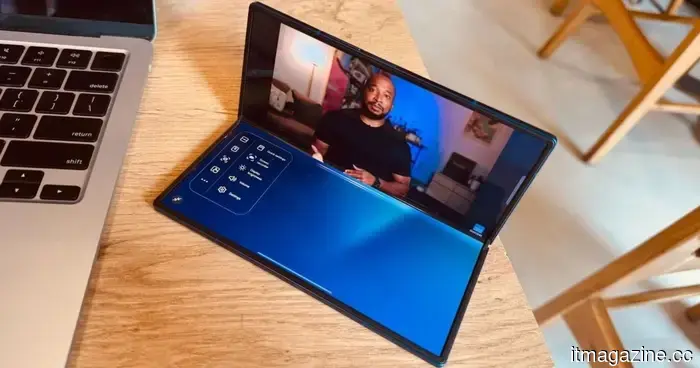 The powerful stylus may make a comeback in the upcoming Samsung Galaxy foldable.
Following the discreet removal of the S Pen from last year's Galaxy Z Fold 7, Samsung seems poised to reintroduce it in a more prominent and striking design, coinciding with Apple’s entry into the foldable market with its first foldable iPhone.
The powerful stylus may make a comeback in the upcoming Samsung Galaxy foldable.
Following the discreet removal of the S Pen from last year's Galaxy Z Fold 7, Samsung seems poised to reintroduce it in a more prominent and striking design, coinciding with Apple’s entry into the foldable market with its first foldable iPhone.
 How AI is changing hospitality operations while maintaining the human touch.
Arran Campolucci-Bordi discusses how AI-powered systems are transforming hospitality operations by enhancing efficiency while maintaining a focus on human interaction.
How AI is changing hospitality operations while maintaining the human touch.
Arran Campolucci-Bordi discusses how AI-powered systems are transforming hospitality operations by enhancing efficiency while maintaining a focus on human interaction.
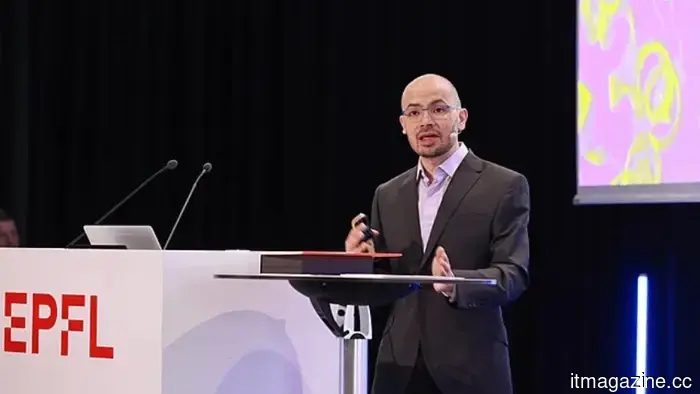 Demis Hassabis states that Google DeepMind needed to revert to its startup origins following the merger with Brain.
Hassabis mentions that after the Brain merger, Google DeepMind needed to reconnect with its startup origins and adopt a more resourceful approach, managing Isomorphic Labs as a secondary role from 10 PM.
Demis Hassabis states that Google DeepMind needed to revert to its startup origins following the merger with Brain.
Hassabis mentions that after the Brain merger, Google DeepMind needed to reconnect with its startup origins and adopt a more resourceful approach, managing Isomorphic Labs as a secondary role from 10 PM.
Google Cloud strengthens its AI infrastructure collaboration with Intel, focusing on Xeon and specialized chips.
Google Cloud is broadening its multi-year AI infrastructure collaboration with Intel, pledging support for Xeon 6 CPUs and jointly developing custom Infrastructure Processing Units.