

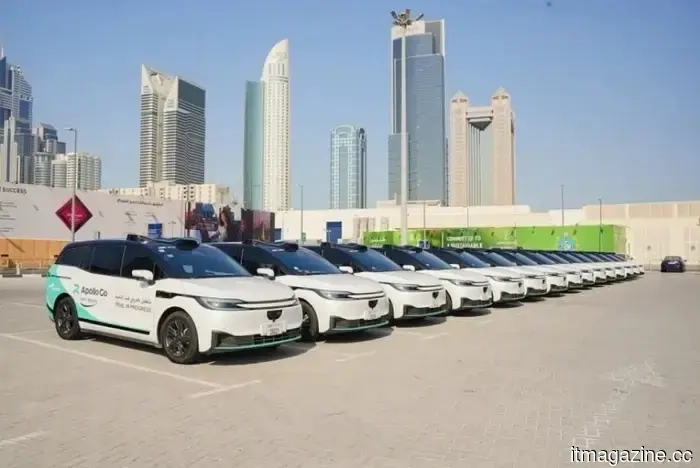
A malfunction in the Apollo Go Robotaxi service in Wuhan, China, has caused significant traffic delays and raised safety issues.
On Wednesday, the Traffic Management Bureau of the Wuhan Municipal Public Security Bureau released a police report indicating that at 20:57 on March 31, several Apollo Go autonomous taxis abruptly stopped on main roads and elevated expressways in Wuhan, leading to significant traffic congestion. Fortunately, there were no reports of injuries or fatalities. An initial investigation suggests that the incident was attributed to a system malfunction.
According to on-site witnesses and passengers, during the malfunction, nearly dozens of Apollo Go vehicles came to a complete stop on the road. Some vehicles blocked fast lanes or halted in the middle of elevated highways, with their hazard lights activated but unable to proceed. Several passengers found themselves trapped inside, with the longest wait extending nearly two hours. During this time, the in-vehicle SOS buttons were ineffective, customer service lines were overwhelmed, and some passengers resorted to calling the police for assistance. The immobilized vehicles resulted in multiple rear-end collisions, further complicating the traffic situation.
In response to the incident, Wuhan’s traffic police and transportation officials quickly implemented emergency measures, sending officers and rescue teams to the location. Working alongside Apollo Go personnel, they helped evacuate passengers from each vehicle and removed the malfunctioning cars. By the early hours of April 1, all stranded passengers had been safely evacuated, and traffic conditions began to improve.
Apollo Go, a ride-hailing service platform owned by Baidu, operates using Level 4 (L4) autonomous driving technology and has previously functioned commercially in cities like Wuhan. This system failure has highlighted potential safety risks associated with the large-scale implementation of autonomous driving technology.
Industry analysts speculate that the malfunction could have been caused by irregularities in cloud communication or weaknesses in system algorithms, leading vehicles to engage a “safe stop” mechanism. However, this mechanism may not have sufficiently considered the consequences of widespread failures on public traffic.
The definitive cause of the incident is under further investigation. Apollo Go has announced a temporary halt to its operations in Wuhan and is gradually resuming services, although no detailed information has been provided regarding the technical malfunction.
This event has renewed public concerns about the safety of autonomous driving. Experts are urging the industry to enhance system redundancy designs, improve emergency response protocols, and strengthen regulatory frameworks for incident reporting and accountability, to ensure a balanced approach between technological advancement and public safety.



Other articles
 SpaceX submits application for unprecedented $75 billion IPO amid rising conflicts of interest.
SpaceX has submitted a confidential application for an IPO that has the potential to generate $75 billion and value the company at $1.75 trillion, which would make Musk the world's first trillionaire. The connections with Trump, NASA, and the defense sector are extensive.
SpaceX submits application for unprecedented $75 billion IPO amid rising conflicts of interest.
SpaceX has submitted a confidential application for an IPO that has the potential to generate $75 billion and value the company at $1.75 trillion, which would make Musk the world's first trillionaire. The connections with Trump, NASA, and the defense sector are extensive.
 Legora has just reached $100 million in revenue, a milestone achieved in 18 months.
Swedish legal AI company Legora reports that it has surpassed $100 million in annual recurring revenue, rising from $1 million just 18 months ago, as it competes with Harvey for leadership in law-firm AI.
Legora has just reached $100 million in revenue, a milestone achieved in 18 months.
Swedish legal AI company Legora reports that it has surpassed $100 million in annual recurring revenue, rising from $1 million just 18 months ago, as it competes with Harvey for leadership in law-firm AI.
 I'm tired of the chaotic internet, but I have finally discovered a cleanup tool that makes it more understandable.
Textise is a straightforward web tool that transforms messy webpages into clean, text-only formats, allowing for quicker and distraction-free online reading.
I'm tired of the chaotic internet, but I have finally discovered a cleanup tool that makes it more understandable.
Textise is a straightforward web tool that transforms messy webpages into clean, text-only formats, allowing for quicker and distraction-free online reading.
 Legora has just reached $100 million in revenue, achieving this milestone in 18 months.
Swedish legal AI startup Legora reports that it has surpassed $100 million in annual recurring revenue, a significant increase from $1 million just 18 months prior, as it vies with Harvey for leadership in law-firm AI.
Legora has just reached $100 million in revenue, achieving this milestone in 18 months.
Swedish legal AI startup Legora reports that it has surpassed $100 million in annual recurring revenue, a significant increase from $1 million just 18 months prior, as it vies with Harvey for leadership in law-firm AI.
 Swiss finance minister brings criminal charges regarding abuse generated by Grok on X.
Karin Keller-Sutter, the former president of Switzerland, has initiated defamation proceedings after Grok was activated to produce sexist insults regarding her on X. This case may establish the first legal precedent concerning the liability of AI platforms.
Swiss finance minister brings criminal charges regarding abuse generated by Grok on X.
Karin Keller-Sutter, the former president of Switzerland, has initiated defamation proceedings after Grok was activated to produce sexist insults regarding her on X. This case may establish the first legal precedent concerning the liability of AI platforms.
 SpaceX submits application for a record $75 billion initial public offering as various conflicts of interest increase.
SpaceX has submitted a confidential application for an IPO that could generate $75 billion, valuing the company at $1.75 trillion and potentially making Musk the first trillionaire. The connections with Trump, NASA, and the defense sector are significant.
SpaceX submits application for a record $75 billion initial public offering as various conflicts of interest increase.
SpaceX has submitted a confidential application for an IPO that could generate $75 billion, valuing the company at $1.75 trillion and potentially making Musk the first trillionaire. The connections with Trump, NASA, and the defense sector are significant.
A malfunction in the Apollo Go Robotaxi service in Wuhan, China, has caused significant traffic delays and raised safety issues.
On Wednesday, the Traffic Management Bureau of the Wuhan Municipal Public Security Bureau released a police report indicating that starting at 20:57 on March 31,