

Spotify reports that AI-generated content is overwhelming your music feed and has introduced a tool for artists to manage it.
What began as a commitment to openness is becoming a potential risk. Spotify has announced that a surge of low-quality AI-generated content is filling users' music feeds, prompting the introduction of a new feature to mitigate this issue. The company is currently testing a function that allows artists to review songs before they are published on their profiles.
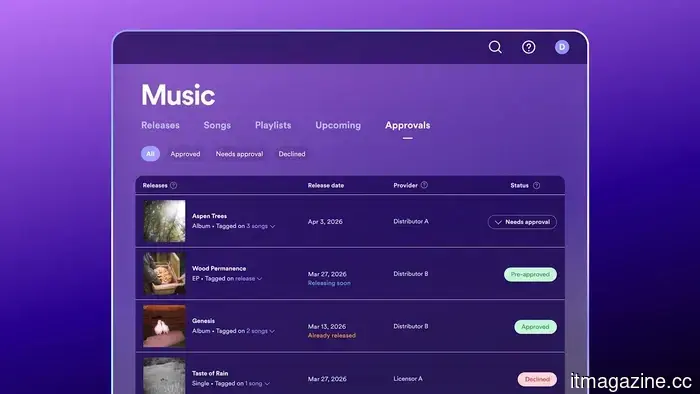
Named Artist Profile Protection, this tool is currently in beta and introduces a verification step in a system that has been easily manipulated in the past. It enables artists to approve or reject releases associated with their identity prior to their official launch, effectively blocking a frequent method used by spam uploads and incorrectly labeled tracks.
The urgency of this situation is escalating rapidly. As music creation becomes less expensive and quicker, an increasing amount of content is incorrectly linked to the wrong profiles, whether intentionally or accidentally.
This problem has already manifested in real-world scenarios. A recent case in the US involved a guilty plea related to AI-generated tracks and bot-driven streaming that resulted in fraudulent earnings, highlighting how automated content can be misused on a large scale.
Introducing a new approval layer for releases
This update adds a crucial verification step. When a release featuring an artist credit is submitted, it will no longer be automatically published. Instead, the artist will be notified and will have the opportunity to determine if it should appear on their page.
If the artist approves it, the release will proceed as usual and will contribute to their statistics and recommendations. If the artist denies or overlooks it, the release will remain off their profile, even if it is still accessible elsewhere.
Spotify claims this feature is a first among streaming services. Additionally, it has introduced an artist key, a unique identifier that trusted partners can use to ensure that legitimate releases navigate the system without needing manual approval.
There is a tradeoff to consider. Artists who opt into this feature must stay vigilant with incoming releases or risk delaying their own projects.
Reasons behind the need for this change due to AI music fraud
This update comes as the use of open distribution shifts from merely cluttering platforms to posing significant financial risks. Tools that accelerate music production have also enabled an increase in low-effort content flooding these platforms.
In the US fraud case, the use of automated listening alongside synthetic tracks resulted in real financial gains. This situation reveals vulnerabilities in how earnings and crediting are managed.
The ramifications extend beyond disorganized profiles. Incorrectly credited releases can distort listener analytics, disrupt discovery algorithms, and misappropriate revenue from the rightful creators.
Spotify
Spotify has relied on open distribution to assist artists in reaching a wider audience. However, this openness has allowed opportunistic individuals to exploit the system, with automation significantly amplifying the scale of the issue.
What artists should anticipate next
Artist Profile Protection is optional and currently only available to a select beta group, meaning access is not uniform. Spotify has stated it will refine the feature before broader rollout, although no timeline has been provided. Apple Music has recently implemented a tagging system that allows labels to mark content as being AI-generated.
The effectiveness of this system also hinges on the vigilance of artists. They must promptly identify problematic submissions, as it does not prevent unauthorized uploads from appearing on other platforms.
Nonetheless, this change is significant. Control is now being exerted earlier in the process, prior to a release having the ability to impact statistics or connect with fans.
If this rollout expands quickly, it could become a standard precaution, particularly beneficial for artists with common names. For a platform designed for discovery, it is becoming increasingly challenging to trust what is being played.

Other articles
 RWS introduces Language Weaver Pro.
RWS and Cohere have unveiled Language Weaver Pro, an enterprise translation model with 100 billion parameters that the company asserts surpasses DeepL and Gemini.
RWS introduces Language Weaver Pro.
RWS and Cohere have unveiled Language Weaver Pro, an enterprise translation model with 100 billion parameters that the company asserts surpasses DeepL and Gemini.
 Origin secures $30 million in Series A+ funding.
Origin has secured $30 million in a Series A+ funding round led by Notion Capital to enhance its AI platform, which provides multinationals with insights into benefits expenditures.
Origin secures $30 million in Series A+ funding.
Origin has secured $30 million in a Series A+ funding round led by Notion Capital to enhance its AI platform, which provides multinationals with insights into benefits expenditures.
 Spotify reports that AI-generated content is overwhelming your music feed, and has introduced a tool for artists to manage this.
Spotify is experimenting with a new feature that allows artists to approve their songs prior to release, in response to the rise of AI-generated spam and fraud that reveal how effortlessly counterfeit tracks can take over profiles and impact earnings.
Spotify reports that AI-generated content is overwhelming your music feed, and has introduced a tool for artists to manage this.
Spotify is experimenting with a new feature that allows artists to approve their songs prior to release, in response to the rise of AI-generated spam and fraud that reveal how effortlessly counterfeit tracks can take over profiles and impact earnings.
 This AI analyzes your driving behaviors to determine if they indicate a risk of accidents.
This AI model examines eye tracking, heart rate, and personality characteristics to identify high-risk drivers before they start driving, which could transform the way fleets evaluate candidates and enhance safety measures.
This AI analyzes your driving behaviors to determine if they indicate a risk of accidents.
This AI model examines eye tracking, heart rate, and personality characteristics to identify high-risk drivers before they start driving, which could transform the way fleets evaluate candidates and enhance safety measures.
 PAVE Space secures $40 million to develop orbital transfer vehicles.
The Swiss startup PAVE Space has secured $40 million in funding to develop orbital transfer vehicles capable of relocating satellites to any orbit within a 24-hour timeframe.
PAVE Space secures $40 million to develop orbital transfer vehicles.
The Swiss startup PAVE Space has secured $40 million in funding to develop orbital transfer vehicles capable of relocating satellites to any orbit within a 24-hour timeframe.
 PAVE Space secures $40 million to develop orbital transfer vehicles.
Swiss startup PAVE Space has secured $40 million to develop orbital transfer vehicles capable of relocating satellites to any orbit within 24 hours.
PAVE Space secures $40 million to develop orbital transfer vehicles.
Swiss startup PAVE Space has secured $40 million to develop orbital transfer vehicles capable of relocating satellites to any orbit within 24 hours.
Spotify reports that AI-generated content is overwhelming your music feed and has introduced a tool for artists to manage it.
Spotify is experimenting with a new feature that allows artists to authorize their songs prior to release, as the emergence of AI-generated spam and fraud highlights the ease with which counterfeit tracks can take over profiles and disrupt revenue distributions.