
OpenAI Sora has disappeared. The artists are continuing their work.
In September of last year, when OpenAI subtly launched the Sora 2 app to the public, the conversation surrounding it was anything but subdued. Observers who had spent months viewing the model's preview clips—the golden retriever leaping through autumn leaves, the almost lifelike street scene in Tokyo—quickly asserted that a significant change had occurred. Not gradually, but radically. The idea that technology could generate moving images from a simple sentence was seen as the onset of the end for certain types of human employment.
Actors, animators, and cinematographers found their honed skills, cultivated over years, suddenly deemed precarious. Statements surfaced from Hollywood unions, and illustrators shared open letters. The term "replacement" appeared so frequently in headlines that it started to resemble more of a weather forecast delivered with casual certainty than a mere prediction.
On March 24, 2026, OpenAI announced the discontinuation of Sora. The app had been active for six months but had not displaced anyone.
This is significant not because Sora failed technically. The model, according to most, was genuinely remarkable: it could generate video that easily deceived a casual viewer, complemented by audio generation that enhanced the illusion. OpenAI described Sora 2 as potentially marking “the GPT-3.5 moment for video,” indicating a significant breakthrough. It reached one million downloads faster than ChatGPT had and briefly occupied the top spot in Apple’s App Store.
However, it struggled to encourage users to return. By January 2026, downloads plummeted by 45%. The social component OpenAI had aimed to establish—a TikTok-like feed of AI-generated content—never developed into a consistent routine for users.
This week, the company informed employees that shutting down Sora would free computational resources for its next generation of models. It mentioned that the research team would shift focus to "world simulation research" for robotics, indicating a move away from creativity toward practicality.
This transition is worth contemplating, as it contradicts the fundamental assumptions of the narrative claiming AI would replace artists. This narrative was based on a specific understanding of creative work: that the value audiences derive from art, film, and performance lies mainly in the final product—the imagery, the sounds, the stories—and that if a machine can generate a convincing reproduction, the human creators become unnecessary.
Sora was expected to serve as proof of this concept.
Instead, it highlighted an aspect of the discussion that replacement theorists often overlook. Audiences do not merely consume outputs; they connect with them based on their origins.
For example, a deepfake of a deceased civil rights leader performing a comedy routine is not the same cultural artifact as a biographical film about that leader, even if the former's pixel quality is technically superior.
When the families of Martin Luther King Jr. and Robin Williams publicly objected to AI videos featuring their likenesses on the Sora platform, they were not just making a theoretical ethical statement. They were expressing a sentiment that users also felt as they scrolled through yet another AI-generated clip: the context of creation is integral to what makes a creative work valuable.
OpenAI recognized this dynamic or at least perceived it, which is why it sought a deal with Disney so urgently.
The licensing agreement that covered over 200 characters from Disney, Marvel, Pixar, and Star Wars was not merely a commercial transaction. It was an effort to gain cultural credibility, attempting to align AI-generated videos with something audiences were already connected to.
This deal was announced in December 2025 but was revoked this week, with Disney clarifying that no monetary exchange took place.
The trends in this narrative are clear. OpenAI sought to cultivate an audience for AI creativity by first showcasing impressive outputs, then by making them customizable (the “cameo” feature, where users could upload their likenesses for others to generate deepfakes, was the app’s main attraction), and finally by linking it to established intellectual properties with existing fan bases.
None of these efforts resulted in sustained engagement. The application that was meant to displace creative professionals failed to capture the attention of its intended audience.
This does not imply that AI video generation is without impact on the creative sectors. The technology exists; it will be utilized, and some of that usage will replace the work previously performed by humans.
These are significant concerns, and the unions and guilds advocating for protections are justified. However, the dominant assertion during Sora’s launch—that AI was approaching a point where human creativity would become obsolete, rendering actors and artists structurally irrelevant—has encountered a fundamental truth in the evolution of cultural technology: people do not simply seek content.
They desire content created by someone.
The rise of streaming was predicted to eliminate cinema. It made theatrical releases more selective, yet did not diminish the craving for films viewed on a large screen alongside others, made by a director whose previous works audiences were familiar with.
Other articles
 ChatGPT can now provide real-time weather information using AccuWeather.
ChatGPT now offers real-time weather assistance via a new AccuWeather app, allowing users to view forecasts, alerts, and live weather updates right within their conversations.
ChatGPT can now provide real-time weather information using AccuWeather.
ChatGPT now offers real-time weather assistance via a new AccuWeather app, allowing users to view forecasts, alerts, and live weather updates right within their conversations.
 Your finance team continues to pursue outstanding invoices - here’s the actual expense.
Manual accounts payable costs between $15 and $40 for each invoice. BILL streamlines the entire process, from capture to payment, for over 400,000 businesses. You can try it for free or access the complimentary Spend & Expense plan.
Your finance team continues to pursue outstanding invoices - here’s the actual expense.
Manual accounts payable costs between $15 and $40 for each invoice. BILL streamlines the entire process, from capture to payment, for over 400,000 businesses. You can try it for free or access the complimentary Spend & Expense plan.
 Meadow is a square phone that eliminates distracting apps, and I really want one.
Meadow is a secondary device priced at $399 that provides access to your phone number, maps, music, and camera, while excluding social media, work emails, and notifications.
Meadow is a square phone that eliminates distracting apps, and I really want one.
Meadow is a secondary device priced at $399 that provides access to your phone number, maps, music, and camera, while excluding social media, work emails, and notifications.
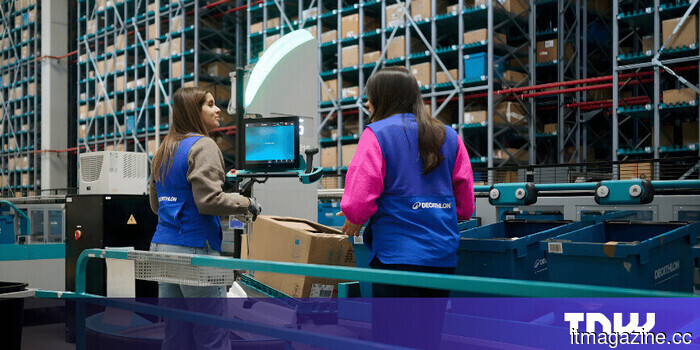 Decathlon increases warehouse productivity by two times with Exotec robots at seven locations in Europe | TNW
Decathlon has automated seven of its European warehouses using Exotec's Skypod robots, resulting in a doubling of order output in Portugal and a 90% reduction in the walking distance for pickers.
Decathlon increases warehouse productivity by two times with Exotec robots at seven locations in Europe | TNW
Decathlon has automated seven of its European warehouses using Exotec's Skypod robots, resulting in a doubling of order output in Portugal and a 90% reduction in the walking distance for pickers.
 Granola secures $125 million in funding at a valuation of $1.5 billion to transform meetings into enterprise AI insights | TNW
The London-based AI meeting application Granola secured $125 million in Series C funding, achieving a valuation of $1.5 billion. The funding round was led by Index Ventures and Kleiner Perkins.
Granola secures $125 million in funding at a valuation of $1.5 billion to transform meetings into enterprise AI insights | TNW
The London-based AI meeting application Granola secured $125 million in Series C funding, achieving a valuation of $1.5 billion. The funding round was led by Index Ventures and Kleiner Perkins.
 Granola secures $125 million with a valuation of $1.5 billion to transform meetings using enterprise AI technology | TNW
The London-based AI meeting application Granola secured $125 million in Series C funding, achieving a valuation of $1.5 billion. The funding round was led by Index Ventures and Kleiner Perkins.
Granola secures $125 million with a valuation of $1.5 billion to transform meetings using enterprise AI technology | TNW
The London-based AI meeting application Granola secured $125 million in Series C funding, achieving a valuation of $1.5 billion. The funding round was led by Index Ventures and Kleiner Perkins.
OpenAI Sora has disappeared. The artists are continuing their work.
OpenAI's AI video application aimed to revolutionize creative tasks. However, six months after the release of Sora 2, it struggled to retain users.