
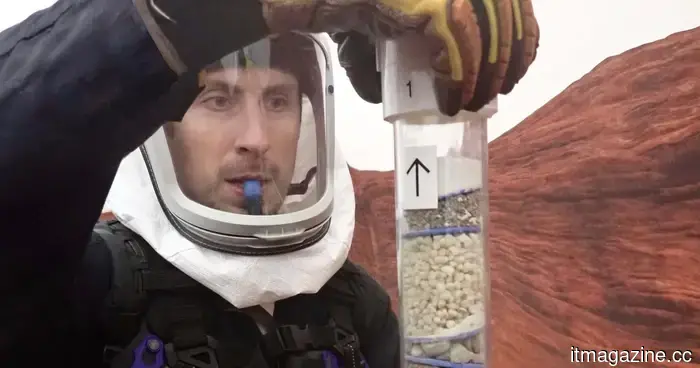
Take a look inside NASA's Mars habitat where individuals prepare for living on the red planet.
NASA has provided a glimpse inside its Mars simulation habitat, where four volunteers have now spent 150 days cut off from the outside world.
By residing in the 1,700-square-foot Mars Dune Alpha habitat at the Johnson Space Center in Houston, Ross Elder, Ellen Ellis, Matthew Montgomery, and James Spicer are assisting NASA in preparing for long-term missions aimed at sending humans deep into space.
This week, the space agency released several images featuring the volunteers, who entered the habitat on October 19 of last year.
CHAPEA has reached the 150-day milestone! 🎉 From harvesting crops to tracking their physical and mental stress levels, the crew of @NASA's yearlong Mars simulation is enabling us to better understand how humans will live and operate in deep space. Swipe to catch a glimpse inside their… pic.twitter.com/Yk4z94WiYu— NASA’s Johnson Space Center (@NASA_Johnson) March 18, 2026
Montgomery and Elder are depicted conducting scientific research, as well as playing table tennis with Ellis at what appears to be a normal dining table. The fourth member, Montgomery, is not featured in the pictures, but we can assume he’s doing well (he likely took the photos!).
NASA is meticulously observing how the volunteers respond physically and mentally to prolonged confinement.
During their stay in the Mars habitat, they will face challenges such as resource shortages, alongside maintenance tasks and daily activities like crop management.
"Since the crew is mimicking life on the surface of Mars, which is about 250 million miles away, communication with Earth can experience delays of around 22 minutes each way and might even be entirely obstructed," Elder explained before entering the habitat. "As a result, we might not be able to rely on input from Mission Control in Houston during critical emergencies. Thus, it’s essential for the crew to depend on teamwork, skills, decision-making, and quick action to ensure the mission's safety and success."
The facility includes approximately nine rooms, a shared bathroom, and a communal area for meals and social interactions. Each participant also has their own private bedroom.
Additionally, there is an adjacent area designed to simulate the Martian terrain, where volunteers can practice “Mars walks.”
Elder, Ellis, Montgomery, and Spicer are set to exit the habitat on October 31 of this year, allowing NASA more time to comprehend what is necessary for survival millions of miles from Earth.
NASA aims to send the first humans to Mars in the 2030s, although this monumental journey may not occur until much later. For now, the closest anyone will get to the red planet will be through controlled simulations like the one at the Johnson Space Center.
Other articles
 The surge in interest for AI is driving up the prices of used MacBooks, indicating what may be on the horizon.
The demand for AI is increasing the prices of pre-owned MacBooks, as individuals are purchasing secondary devices to utilize tools such as OpenClaw.
The surge in interest for AI is driving up the prices of used MacBooks, indicating what may be on the horizon.
The demand for AI is increasing the prices of pre-owned MacBooks, as individuals are purchasing secondary devices to utilize tools such as OpenClaw.
 Take a look inside NASA's Mars habitat where individuals prepare for living on the red planet.
NASA has provided a glimpse into its Mars simulation habitat, where four volunteers have been living in isolation for 150 days. Residing in the 1,700-square-foot Mars Dune Alpha habitat at the Johnson Space Center in Houston, Ross Elder, Ellen Ellis, Matthew Montgomery, and James Spicer are assisting NASA […]
Take a look inside NASA's Mars habitat where individuals prepare for living on the red planet.
NASA has provided a glimpse into its Mars simulation habitat, where four volunteers have been living in isolation for 150 days. Residing in the 1,700-square-foot Mars Dune Alpha habitat at the Johnson Space Center in Houston, Ross Elder, Ellen Ellis, Matthew Montgomery, and James Spicer are assisting NASA […]
 What criteria should I use to select scalable accounting software for expansion?
A useful guide for choosing financial management software that can grow alongside expanding businesses and operations with multiple entities.
What criteria should I use to select scalable accounting software for expansion?
A useful guide for choosing financial management software that can grow alongside expanding businesses and operations with multiple entities.
 Perplexity introduces Perplexity Health, an AI tool designed to convert your disorganized medical data into valuable health insights.
Perplexity Health brings together your lab results, prescriptions, and wearable data in a single location, providing health insights supported by credible medical sources.
Perplexity introduces Perplexity Health, an AI tool designed to convert your disorganized medical data into valuable health insights.
Perplexity Health brings together your lab results, prescriptions, and wearable data in a single location, providing health insights supported by credible medical sources.
 ChatGPT may soon develop into a super app featuring the Atlas browser and integrated Codex.
The speculated superapp plans from OpenAI might combine ChatGPT, Codex, and the Atlas browser into one platform, streamlining user interaction with AI tools.
ChatGPT may soon develop into a super app featuring the Atlas browser and integrated Codex.
The speculated superapp plans from OpenAI might combine ChatGPT, Codex, and the Atlas browser into one platform, streamlining user interaction with AI tools.
 What should I consider when selecting scalable accounting software to support growth?
A useful guide for choosing financial management software that can grow alongside expanding businesses and manage multi-entity operations.
What should I consider when selecting scalable accounting software to support growth?
A useful guide for choosing financial management software that can grow alongside expanding businesses and manage multi-entity operations.
Take a look inside NASA's Mars habitat where individuals prepare for living on the red planet.
NASA has provided a glimpse into its Mars simulation habitat, where four volunteers have been isolated from the outside world for 150 days. Residing in the 1,700-square-foot Mars Dune Alpha habitat at the Johnson Space Center in Houston, Ross Elder, Ellen Ellis, Matthew Montgomery, and James Spicer are contributing to NASA's [...]