
NASA reveals amazing images of Mars to celebrate the orbiter's 20th anniversary.
NASA launched the Mars Reconnaissance Orbiter (MRO) in August 2005, and it entered the orbit of Mars on March 10, 2006, where it remains operational to this day.
The data transmitted back to Earth by the MRO has provided unprecedented insights into Mars and has significantly enhanced scientists' understanding of this intriguing planet over the years.
One notable finding is evidence suggesting that liquid water may exist seasonally on contemporary Mars. The orbiter’s highly advanced HiRISE camera not only uncovered details about Mars’ geology and climate but also contributed to evaluating the planet's capacity to support microbial life.
The reliable spacecraft also collects information on the planet's temperatures and minerals, and it can delve beneath the surface using its radar technology.
While its scientific contributions are crucial and thrilling, the orbiter is famously recognized for capturing stunning images from an altitude of approximately 155–196 miles (250–316 km).
To commemorate its 20th anniversary on Tuesday, NASA released some of these remarkable images on X:
"For two decades, our Mars Reconnaissance Orbiter has been on a quest for clues of ancient water. It has returned not just beautiful photographs, but valuable information that will assist future astronauts when they land on Mars. What's your favorite?" pic.twitter.com/mc4wHYjqm5— NASA (@NASA) March 10, 2026
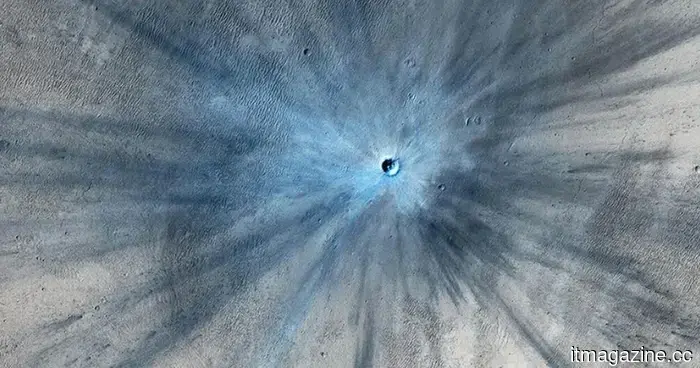
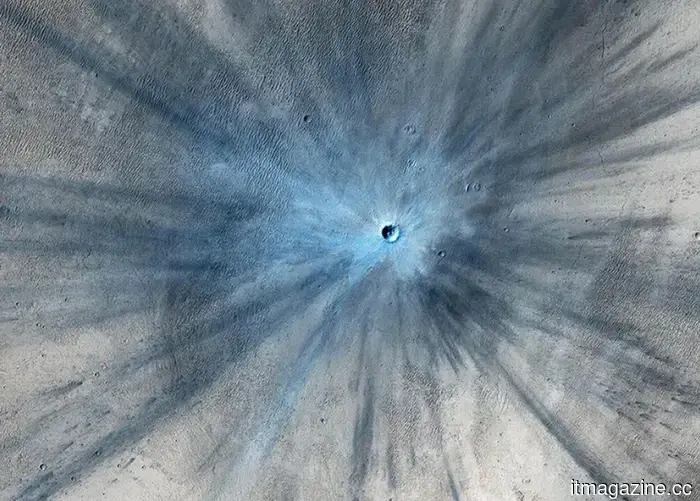
One of the images displays a crater on Mars measuring roughly 100 feet (30 meters) in diameter, encircled by a vast blast area. The impact that formed this crater expelled debris as far as 9.3 miles (15 km). Blue tones have been enhanced to highlight the details.
NASA/JPL-Caltech/Univ. of Arizona
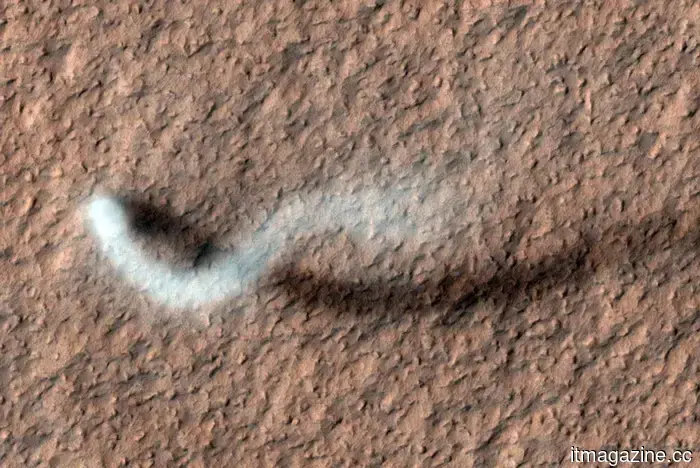
Another image, captured serendipitously, features a massive dust devil sweeping across the Martian landscape. Taken from an altitude of 185 miles (297 kilometers), the shadow cast by the whirlwind indicates it rose more than half a mile (800 meters) high, comparable to the height of the Burj Khalifa, the tallest building in the world located in the United Arab Emirates.
NASA/JPL-Caltech/Univ. of Arizona
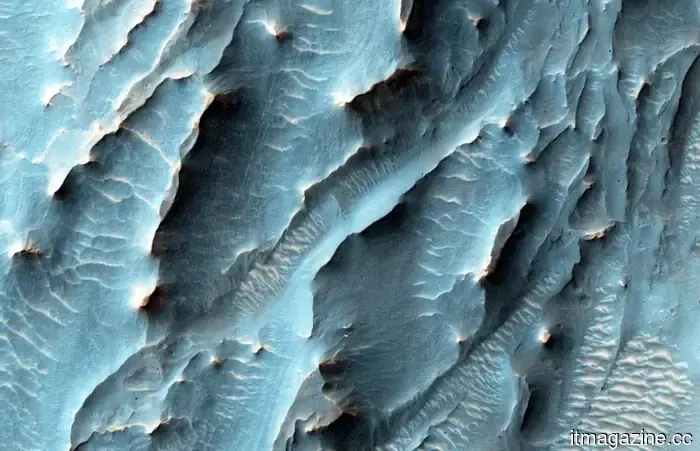
The next image illustrates an area with distinctive textures located on the floor of Gale Crater, where NASA’s Curiosity rover landed in 2012. Blue hues have been added for improved visibility.
The rover continues to operate in that region today (the MRO has even photographed it!), as it gradually ascends the base of Mount Sharp (Aeolis Mons), the prominent mountain at the center of the crater. Notably, the MRO also acts as an essential communications link, relaying information from the Curiosity and Perseverance rovers back to Earth.
NASA/JPL-Caltech/Univ. of Arizona
Again, blue tones have been applied to the following image to enhance features like the peaks of dunes and ripples. Similar to Earth, many of these formations evolve over time due to constant Martian winds shifting the sand and reshaping the terrain.
NASA/JPL-Caltech/Univ. of Arizona
NASA intends to keep the MRO operational as long as the spacecraft is in good health and has sufficient fuel, with expectations for continued operation into the late 2020s and perhaps beyond.
This means we can anticipate many more astonishing images from the experienced Mars orbiter.

Other articles
 The compact gaming laptop powered by ASUS' Strix Halo has finally arrived in the US.
ASUS has officially released the 14-inch TUF Gaming A14 in the US, featuring AMD's robust Strix Halo processor in a compact gaming laptop.
The compact gaming laptop powered by ASUS' Strix Halo has finally arrived in the US.
ASUS has officially released the 14-inch TUF Gaming A14 in the US, featuring AMD's robust Strix Halo processor in a compact gaming laptop.
 ASUS' compact gaming laptop, equipped with the powerful Strix Halo, has officially arrived in the US.
ASUS has officially released the 14-inch TUF Gaming A14 in the US, featuring AMD's robust Strix Halo processor in a compact gaming laptop design.
ASUS' compact gaming laptop, equipped with the powerful Strix Halo, has officially arrived in the US.
ASUS has officially released the 14-inch TUF Gaming A14 in the US, featuring AMD's robust Strix Halo processor in a compact gaming laptop design.
 The DJI Power 2000 is priced at $799, positioning it as one of the best value power stations available at the moment.
Portable power stations have seen a surge in popularity recently, yet many of the intriguing options are either too small to be truly functional or priced excessively high. The DJI Power 2000 stands out in a different league: it features a capacity of 2048Wh with LFP technology, offers a continuous output of 3000W, and can recharge from 0 to 80% in just 55 minutes, [...]
The DJI Power 2000 is priced at $799, positioning it as one of the best value power stations available at the moment.
Portable power stations have seen a surge in popularity recently, yet many of the intriguing options are either too small to be truly functional or priced excessively high. The DJI Power 2000 stands out in a different league: it features a capacity of 2048Wh with LFP technology, offers a continuous output of 3000W, and can recharge from 0 to 80% in just 55 minutes, [...]
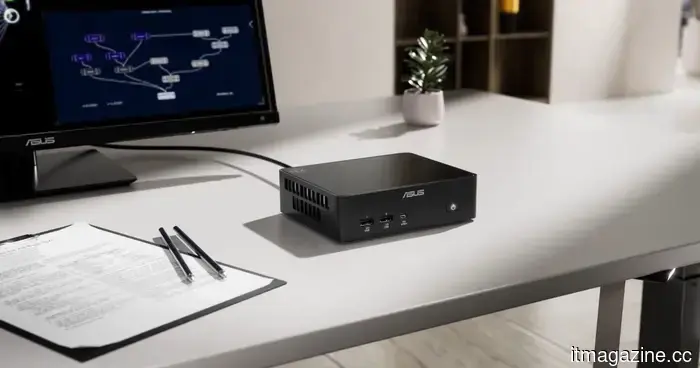 You can now purchase the ASUS NUC 16 Pro mini PC, although it is a mid-range model.
The Asus NUC 16 Pro mini PC, featuring Intel Panther Lake processors and supporting up to 128GB of RAM, has started to show up for sale on the internet.
You can now purchase the ASUS NUC 16 Pro mini PC, although it is a mid-range model.
The Asus NUC 16 Pro mini PC, featuring Intel Panther Lake processors and supporting up to 128GB of RAM, has started to show up for sale on the internet.
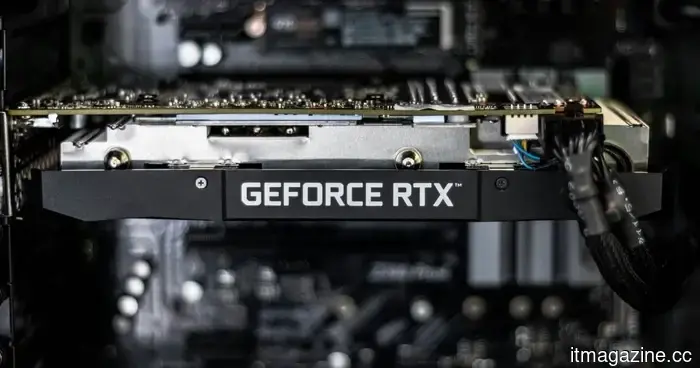 Nvidia leaks suggest that a 9GB version of the GeForce RTX 5050 is imminent.
A recent leak indicates that Nvidia could launch a GeForce RTX 5050 model featuring 9GB of GDDR7 memory, while still keeping the power requirement at 130W.
Nvidia leaks suggest that a 9GB version of the GeForce RTX 5050 is imminent.
A recent leak indicates that Nvidia could launch a GeForce RTX 5050 model featuring 9GB of GDDR7 memory, while still keeping the power requirement at 130W.
 Nvidia leaks suggest that a 9GB version of the GeForce RTX 5050 is imminent.
A recent leak indicates that Nvidia might launch a GeForce RTX 5050 model featuring 9GB of GDDR7 memory, all while keeping the power requirement at 130W.
Nvidia leaks suggest that a 9GB version of the GeForce RTX 5050 is imminent.
A recent leak indicates that Nvidia might launch a GeForce RTX 5050 model featuring 9GB of GDDR7 memory, all while keeping the power requirement at 130W.
NASA reveals amazing images of Mars to celebrate the orbiter's 20th anniversary.
NASA launched the Mars Reconnaissance Orbiter in August 2005, and it entered the orbit of the red planet on March 10 of the following year, where it still operates today. The data sent back to Earth by the MRO has provided unprecedented detail of Mars and, over the years, has assisted scientists in learning more about […]