

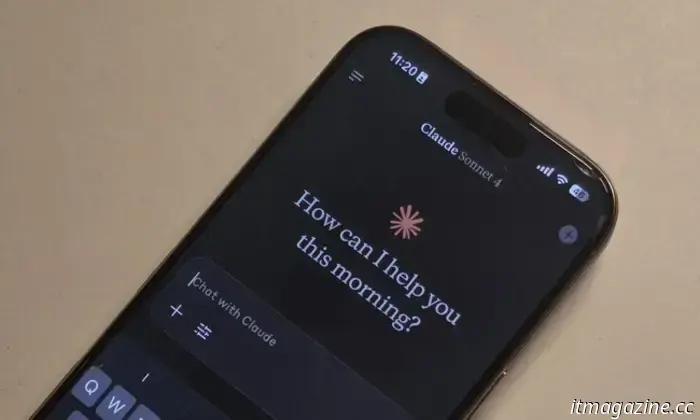
Anthropic's Cowork transforms Claude into your active digital partner.
Automate tedious tasks without needing to write any code.
Anthropic has introduced a new tool that makes Claude Code's advanced features accessible to users with less technical knowledge, allowing them to carry out various tasks without writing a single line of code. Named Cowork, this tool can access folders on a user's computer, enabling the reading, modifying, or deleting of files on their behalf.
Claude Cowork can also initiate new projects utilizing information from the folder, facilitating tasks like generating reports from a user's notes. Anthropic claims that the tool can assist in organizing old receipts and creating an expense-tracking spreadsheet, as well as tidying up a cluttered downloads folder.
Cowork can leverage Claude’s existing connectors, allowing it to generate documents, presentations, or other projects using data from third-party applications. Moreover, it integrates with the Claude in Chrome extension to perform actions that require internet access.
Anthropic describes Cowork as being “designed to simplify the use of Claude for new tasks.” The company emphasizes that users aren't required to continuously provide context or manually adjust output to the correct format, and they can queue multiple tasks for Claude to handle simultaneously. The aim is for the experience to resemble collaborating with a teammate rather than engaging in ongoing back-and-forth exchanges with a chatbot.
The risks of enhanced access
The company acknowledges that Cowork's capability to access local files carries potential risks. To counter privacy issues, it states that the tool can only read or modify files that users explicitly allow access to. However, since Cowork can delete local files if directed to do so, Anthropic recommends that users provide clear prompts to minimize the chances of unintended actions.
It also cautions against the possibility of prompt-injection attacks, which could pose significant issues if Cowork has access to sensitive files. While Anthropic claims it has implemented safeguards to reduce such threats, it admits that defenses against prompt injection are “still a work in progress.”
Cowork is currently being rolled out as a research preview for Claude Max subscribers on macOS. Users on other plans or platforms can join a waitlist for future access.
Pranob is an experienced technology journalist with over eight years of experience in consumer technology reporting. His work has...
Anthropic’s Claude will soon assist you in interpreting your Apple Watch health data.
The AI assistant will evaluate your wearable metrics and provide clearer health insights.
Anthropic has ventured into the healthcare AI domain with the introduction of Claude for Healthcare, a new collection of tools aimed at providers, payers, and patients. Following the example set by OpenAI's ChatGPT Health, Claude for Healthcare seeks to safely integrate AI into medical contexts, helping users access and comprehend their health information more effectively.
To support this initiative, Anthropic is rolling out new integrations that enable users to connect their health data to Claude. In the U.S., subscribers on the Claude Pro and Max plans can securely allow the AI assistant to access lab results and health records, unlocking features that render that data actionable.
Researchers in China unveil a high-voltage sodium-sulfur battery that could rival lithium batteries.
A group of researchers in China has unveiled a groundbreaking design for a sodium-sulfur battery that could transform energy storage calculations. By leveraging the very chemistry that has traditionally posed challenges for engineers, they have created a cell that is remarkably inexpensive to produce while still delivering significant energy output.
The design, currently undergoing laboratory tests, employs low-cost materials: sulfur, sodium, aluminum, and a chlorine-based electrolyte. In initial experiments, the battery achieved energy densities exceeding 2,000 watt-hours per kilogram - a figure that surpasses today’s sodium-ion batteries and even competes with premium lithium cells.
This artificial skin could provide ‘human-like’ sensitivity to robots.
Enhancing robots' sense of touch.
While robots are increasingly proficient at seeing, hearing, and moving, touch has consistently been a missing element. At CES 2026, Ensuring Technology unveiled a new type of artificial skin that could finally impart robots with something resembling human-like sensitivity, enabling them to feel their environment rather than merely colliding with it.
The company’s latest tactile sensing technology aims to help robots comprehend pressure, texture, and contact in ways that extend beyond basic touch sensors. Central to this announcement are two products named Tacta and HexSkin, both targeting a longstanding issue in the field of robotics.



Other articles
 Google Withdraws AI Health Summaries After Revelations of Risky Medical Mistakes
In response to safety issues, Google has removed specific AI-generated health summaries and is reevaluating how its search AI manages delicate medical subjects.
Google Withdraws AI Health Summaries After Revelations of Risky Medical Mistakes
In response to safety issues, Google has removed specific AI-generated health summaries and is reevaluating how its search AI manages delicate medical subjects.
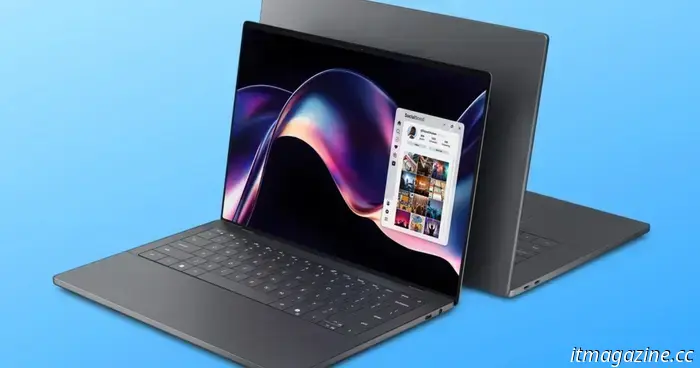 Your initial NVIDIA N1X laptop might be from Dell.
A Dell-tested NVIDIA N1X laptop has recently appeared in a new test record. This strongly suggests that Nvidia is moving forward with its laptop processor plans, although the details regarding Windows drivers and the timing of the launch are still uncertain.
Your initial NVIDIA N1X laptop might be from Dell.
A Dell-tested NVIDIA N1X laptop has recently appeared in a new test record. This strongly suggests that Nvidia is moving forward with its laptop processor plans, although the details regarding Windows drivers and the timing of the launch are still uncertain.
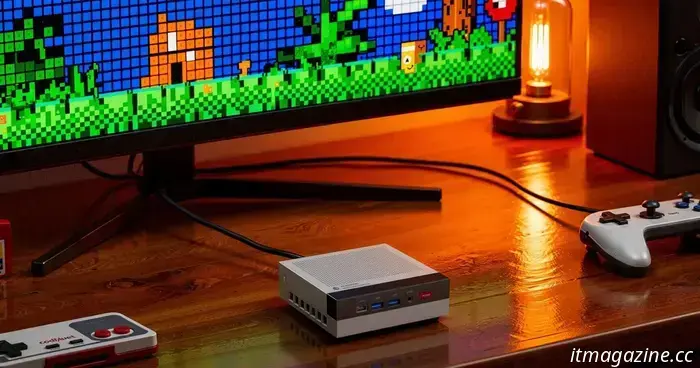 Your upcoming retro mini PC might resemble a classic PlayStation.
Acemagic's newest retro mini PC takes inspiration from the design of the Dreamcast and PS1, and integrates it with AMD's Gorgon Point platform. It appears to be suited for a TV stand, though the pricing and release date remain unspecified.
Your upcoming retro mini PC might resemble a classic PlayStation.
Acemagic's newest retro mini PC takes inspiration from the design of the Dreamcast and PS1, and integrates it with AMD's Gorgon Point platform. It appears to be suited for a TV stand, though the pricing and release date remain unspecified.
 SpaceX's Crew-11 is seen in a video as they get ready to head back home ahead of schedule.
SpaceX's Crew-11 is heading back from the International Space Station (ISS) earlier than planned because of a medical issue involving one of its astronauts. This marks the first instance in which NASA has opted to return a crew member prematurely due to a health concern. The Crew-11 team includes Americans Michael Fincke and Zena Cardman, along with [...]
SpaceX's Crew-11 is seen in a video as they get ready to head back home ahead of schedule.
SpaceX's Crew-11 is heading back from the International Space Station (ISS) earlier than planned because of a medical issue involving one of its astronauts. This marks the first instance in which NASA has opted to return a crew member prematurely due to a health concern. The Crew-11 team includes Americans Michael Fincke and Zena Cardman, along with [...]
 You could acquire a wearable from OpenAI, and it's more than just earbuds.
Smart Pikachu asserts that OpenAI is developing a wearable device called Sweetpea, designed to be worn behind the ear and featuring detachable components. An image resembling a schematic suggests it could combine listening capabilities with sensing technology.
You could acquire a wearable from OpenAI, and it's more than just earbuds.
Smart Pikachu asserts that OpenAI is developing a wearable device called Sweetpea, designed to be worn behind the ear and featuring detachable components. An image resembling a schematic suggests it could combine listening capabilities with sensing technology.
Anthropic's Cowork transforms Claude into your active digital partner.
Anthropic's newest tool enables Claude to access local files to assist you with routine tasks.