

New York will begin regulating social media in a manner similar to cigarettes by implementing warning labels.
New York to Mandate Mental Health Warning Labels on Addictive Social Media Features
New York has taken a significant stride in regulating the tech industry by mandating social media companies to implement warning labels on their platforms. The new legislation focuses on the features that keep users engaged for extended periods—such as infinite scrolling, auto-playing videos, and addictive algorithms—aimed at protecting younger users from the negative mental health impacts these features may induce. Governor Kathy Hochul endorsed the law on Friday, describing it as a crucial safeguard for children in an increasingly digital age.
New York’s Initiative Against “Addictive Feeds”
The regulations particularly target what the state identifies as "addictive feeds," including the endless scrolling on TikTok, the auto-playing clips on YouTube, and the AI-generated feeds on Instagram designed to enhance user engagement. According to the law, platforms utilizing these features must display overt, hard-to-miss warning labels. These notifications will alert users—especially teens and children—about the mental health risks, such as anxiety and depression, associated with excessive screen time.
Governor Hochul likened these digital warnings to the labels found on cigarette packages or plastic bags. She argues that if society alerts individuals about the physical dangers of tobacco or suffocation risks from packaging, the same should apply to the psychological hazards of social media. This shift places the onus on the platforms rather than on parents, demanding clarity regarding how their designs influence mental well-being.
Enforcement Mechanisms and a Global Movement
This legislation carries weighty ramifications, as the New York Attorney General is now empowered to pursue companies failing to comply, with penalties of up to $5,000 for each violation. Although the law specifically pertains to users within New York, it signals to the tech industry that the era of “self-regulation” is effectively coming to an end.
New York joins a growing number of jurisdictions adopting tougher measures toward technology. California and Minnesota have already enacted similar laws, and Australia recently made headlines by prohibiting social media access for children under 16. It appears we are at a pivotal moment, with a global consensus emerging that the current design of these platforms is not merely “engaging,” but potentially harmful.
Implications for Daily Use
For families, this could transform the experience of social media. The labels aim to serve as a “speed bump,” prompting users and parents to reconsider before becoming engrossed in lengthy scrolling sessions. The hope is that by approaching these features as a public health concern, we can foster healthier digital habits.
The timing is also crucial, as major tech companies face significant lawsuits from school districts regarding student mental health crises. Additionally, the U.S. Surgeon General has advocated for such labels, and New York is now the first to implement that suggestion as law.
As other states monitor the situation, we may witness a future where social media operates quite differently across the nation. Companies might ultimately be compelled to eliminate these addictive design elements, or else contend with a fragmented array of laws that hinder uniform operation across all regions.
Moinak Pal has been involved in the technology field, reporting on both consumer technology and automotive advancements.
Say goodbye to old DMs: X introduces Chat with encryption and more
From disappearing messages to large file transfers, here’s what to expect.
What’s happening? X announced this week the rollout of Chat via its official channel, marking the complete replacement of its traditional DM system with a new, encrypted communication layer. The platform has unveiled new functionalities: voice and video calls, message editing and deletion, file sharing, end-to-end encryption, and disappearing messages. Users will need to create a four-digit passcode to access Chat, enhancing security when using the new features.
It’s not just you. X is down again. [Update: It’s back online]
Here we go again. It appears that users in the U.S. are experiencing issues more than other parts of the world.
Update: The recent X outage affecting U.S. users seems to have been resolved. Reports of service-related issues on Downdetector.com have decreased from nearly twenty thousand to just over a hundred as of 10:50 am PT. The official X Developer Platform Status page currently indicates that all services are functioning normally, with no reported incidents in the past 24 hours. The original story follows: Just days after a Cloudflare disruption affected X along with many other websites, the platform is facing another service outage. At the time of writing, numerous users reported the app and website are not functioning properly.
X reveals your “location,” which could alter the feed
The platform’s new location labels aim for increased transparency, yet reactions indicate a mixed reception.
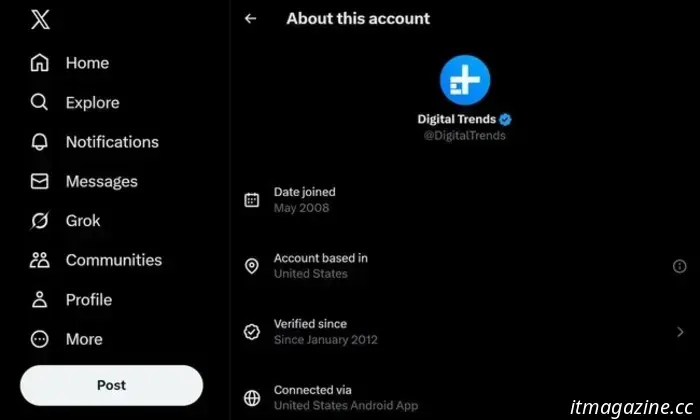
What’s happening? X is implementing a new “About This Account” feature that adds a publicly visible “Based in” label to user profiles. Early testers have observed the update appearing on various accounts, marking the platform’s first significant move toward location transparency on a large scale. Although X had previously hinted at testing credibility




Other articles
 "Cyber Storage": creating a universal storage system for block, file, object, and backup
Against the backdrop of growing demand for flexible and cost-efficient data storage systems, CyberProtect is offering customers "Cyber Storage", which combines block, file, and object access in a single scalable platform. The product enables the creation of a fault-tolerant infrastructure on standard servers, integrates with backup solutions, and offers built-in mechanisms to protect data from ransomware. Details are in an IT-World article.
"Cyber Storage": creating a universal storage system for block, file, object, and backup
Against the backdrop of growing demand for flexible and cost-efficient data storage systems, CyberProtect is offering customers "Cyber Storage", which combines block, file, and object access in a single scalable platform. The product enables the creation of a fault-tolerant infrastructure on standard servers, integrates with backup solutions, and offers built-in mechanisms to protect data from ransomware. Details are in an IT-World article.
 The Logitech PRO X 60 is currently available for almost 50% off at a price of $89.99.
If you're looking for a compact gaming keyboard that won’t cost a fortune, this is a solid offer for a genuine wireless choice. The Logitech PRO X 60 LIGHTSPEED is now priced at $89.99, down from $179.99, giving you a savings of $90. That’s the kind of discount that transforms a “nice-to-have” upgrade into a sensible decision, particularly if you’ve been considering […]
The Logitech PRO X 60 is currently available for almost 50% off at a price of $89.99.
If you're looking for a compact gaming keyboard that won’t cost a fortune, this is a solid offer for a genuine wireless choice. The Logitech PRO X 60 LIGHTSPEED is now priced at $89.99, down from $179.99, giving you a savings of $90. That’s the kind of discount that transforms a “nice-to-have” upgrade into a sensible decision, particularly if you’ve been considering […]
 The release window for Ted Lasso season 4 has been announced, but the wait will be prolonged.
Production for Ted Lasso season 4 has officially resumed, and a release is anticipated in mid-2026. The downside is that it requires waiting through a full football season to reach that point.
The release window for Ted Lasso season 4 has been announced, but the wait will be prolonged.
Production for Ted Lasso season 4 has officially resumed, and a release is anticipated in mid-2026. The downside is that it requires waiting through a full football season to reach that point.
 Get great savings on a 27-inch 4K gaming monitor that can switch to 320Hz at 1080p resolution.
If you've been looking for a "buy it now" deal on a high-quality gaming monitor, this one is definitely worth considering. The Acer Predator XB273K is now priced at $289.99 (originally $699.99), giving you a savings of $410 (approximately 59% off). That’s a significant discount for a 27-inch 4K IPS screen, particularly since this model is designed for two distinct [...]
Get great savings on a 27-inch 4K gaming monitor that can switch to 320Hz at 1080p resolution.
If you've been looking for a "buy it now" deal on a high-quality gaming monitor, this one is definitely worth considering. The Acer Predator XB273K is now priced at $289.99 (originally $699.99), giving you a savings of $410 (approximately 59% off). That’s a significant discount for a 27-inch 4K IPS screen, particularly since this model is designed for two distinct [...]
 The major home theater trend of 2026 is set to address this frustrating A/V issue.
Here are our predictions for home theaters in 2026, featuring a wireless year along with advancements in soundbars and projectors.
The major home theater trend of 2026 is set to address this frustrating A/V issue.
Here are our predictions for home theaters in 2026, featuring a wireless year along with advancements in soundbars and projectors.
New York will begin regulating social media in a manner similar to cigarettes by implementing warning labels.
A recently enacted law in New York requires mental health warning labels on addictive features of social media, enabling state enforcement and highlighting the increasing worldwide worry regarding the online safety of young people.