
Alibaba unveils Wan3.0, its 30-second video format, just days after securing $10 billion in funding.
Alibaba has introduced Wan3.0, the latest iteration of its video generation model, just days after raising approximately $10.2 billion through a share placement in Hong Kong, with all proceeds allocated to AI initiatives. The timing is deliberate, as the company has spent the past two weeks convincing investors that its capital expenditures are yielding visible benefits.
The model has been available in public beta since early August via Alibaba Cloud’s Model Studio and the Qwen Cloud platform, meaning Monday’s launch is an expansion of accessibility rather than a debut. It enters a space where Chinese laboratories have quietly established a strong presence while Western focus has remained on chatbots.
Wan3.0 is capable of producing clips of up to 30 seconds in a single pass, which is double the 15-second limit of its predecessor, Wan2.7, and can reach resolutions of up to 1080p. According to Alibaba, the model maintains character details, props, spatial layouts, and motion graphics consistently throughout the video while rendering faces with synchronized micro-expressions and multilingual voice output.
A key feature is its ability to accept a variety of input types. In addition to text, images, audio, and video, Wan3.0 can process web pages and documents, including PDFs and PowerPoint files, allowing users to input a slide deck or spreadsheet and receive a video that reflects the structure of the original material.
This positions the product primarily for marketing and corporate communications teams rather than filmmakers, although Alibaba also lists applications such as short dramas, social media content, and simulation training for autonomous vehicles and robotics. Essentially, it functions as a business tool disguised as a creative one.
The pricing structure reflects this approach. Wan3.0 is priced at $0.05 per second for 480p, $0.10 for 720p, and $0.20 for 1080p, amounting to $12 per minute for the highest quality, compared to $0.40 per second for the standard tier of Google's Veo 3.1.
Positioning itself against competitors is a familiar tactic, but the cost comparisons are not entirely straightforward. Several competitors that currently rank higher than Alibaba’s previous model on independent charts are also priced lower per minute than Wan3.0 at 1080p, and Wan3.0 itself has not yet been independently assessed, leaving its quality claims unverified for now.
There is also pricing pressure from lower-tier market entrants, with an Indian startup recently launching a video model at just half a cent per second, betting that most commercial video does not require top-tier quality.
Access to Wan3.0 is currently limited rather than fully open. The beta is available through Model Studio and Qwen Cloud on an application basis, full API access is being gradually rolled out, and a consumer-facing site at wan.video is anticipated as a members-only platform, indicating that Alibaba is controlling demand while it assesses the computational costs of service.
It is important to note that the model's weights are closed. Alibaba initially built much of its reputation by open-sourcing the Wan series, with Wan2.2 in July 2025 being the last video flagship released this way. This shift coincides with its decision to begin charging the heaviest users of its open Qwen models.
The business rationale for these developments was evident in the latest financial results. Cloud and AI revenue surged 45% to 48.44 billion yuan in the June quarter, with AI model services alone generating over 16 billion yuan in annual recurring revenue, which is the growth trajectory intended to be supported by the share sale.
However, the costs associated with achieving this growth are also apparent, with quarterly net profit plummeting 75% as capital expenditures rose by 75% to 67.68 billion yuan. Alibaba committed 380 billion yuan to AI infrastructure over three years in early 2025 and has been reported to be considering an increase to 480 billion.
Whether Wan3.0 will validate this investment is a question that remains unanswered this week. Running video models is costly, buyers often switch based on pricing, and the leaderboards that could clarify this situation have not yet evaluated the new model.
Other articles
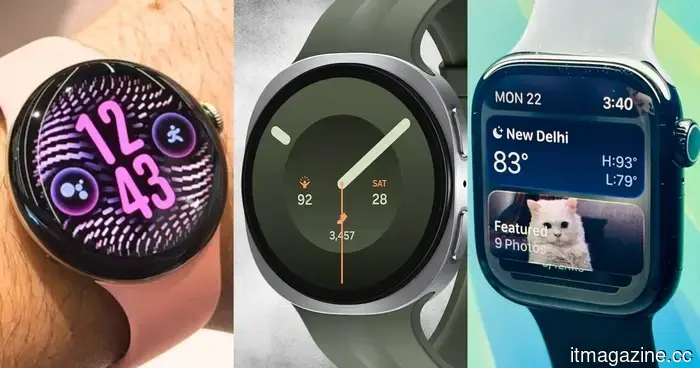 Pixel Watch 5 vs. Galaxy Watch 9 vs. Apple Watch Series 11: There are various ways to prioritize your health.
Although Google has not fully kept pace with its rivals in the smartwatch sector, especially regarding health monitoring capabilities, the Pixel Watch 5 represents its most significant effort to bridge that divide. With functionalities like Insulin Resistance Trends and Breathing Emergency Detection, Google is making a substantial effort in a field where […]
Pixel Watch 5 vs. Galaxy Watch 9 vs. Apple Watch Series 11: There are various ways to prioritize your health.
Although Google has not fully kept pace with its rivals in the smartwatch sector, especially regarding health monitoring capabilities, the Pixel Watch 5 represents its most significant effort to bridge that divide. With functionalities like Insulin Resistance Trends and Breathing Emergency Detection, Google is making a substantial effort in a field where […]
 Hugging Face is considering a sale with a valuation of $13 billion, which is almost three times higher than its previous valuation.
Hugging Face has engaged bankers to consider a sale priced at $13 billion or higher, which is almost three times its valuation of $4.5 billion in 2023.
Hugging Face is considering a sale with a valuation of $13 billion, which is almost three times higher than its previous valuation.
Hugging Face has engaged bankers to consider a sale priced at $13 billion or higher, which is almost three times its valuation of $4.5 billion in 2023.
 A new iMac is expected to be released before the end of 2026, but do not anticipate anything beyond the M6 chip.
The upcoming iMac from Apple is anticipated to be released by the end of the year featuring an M6 chip, but those hoping for an OLED display, a bigger screen, or a significant redesign might need to wait considerably longer.
A new iMac is expected to be released before the end of 2026, but do not anticipate anything beyond the M6 chip.
The upcoming iMac from Apple is anticipated to be released by the end of the year featuring an M6 chip, but those hoping for an OLED display, a bigger screen, or a significant redesign might need to wait considerably longer.
 Nvidia is negotiating to support Perplexity at a valuation exceeding $30 billion.
Nvidia has explored the possibility of investing in Perplexity with a valuation exceeding $30 billion, and has also considered a technology licensing agreement in conjunction with this investment.
Nvidia is negotiating to support Perplexity at a valuation exceeding $30 billion.
Nvidia has explored the possibility of investing in Perplexity with a valuation exceeding $30 billion, and has also considered a technology licensing agreement in conjunction with this investment.
 XPENG's robotics division has secured over $900 million in funding in preparation for its humanoid production phase.
XPENG announced that its robotics division has secured more than $900 million, just months ahead of the mass production launch of its IRON humanoid.
XPENG's robotics division has secured over $900 million in funding in preparation for its humanoid production phase.
XPENG announced that its robotics division has secured more than $900 million, just months ahead of the mass production launch of its IRON humanoid.
 New Zealand has joined the worldwide effort to prevent those under the age of 16 from using social media.
New Zealand plans to introduce legislation that will prohibit individuals under the age of 16 from using social media. However, two coalition partners are against the proposal, and there will be no vote on it before the elections in November.
New Zealand has joined the worldwide effort to prevent those under the age of 16 from using social media.
New Zealand plans to introduce legislation that will prohibit individuals under the age of 16 from using social media. However, two coalition partners are against the proposal, and there will be no vote on it before the elections in November.
Alibaba unveils Wan3.0, its 30-second video format, just days after securing $10 billion in funding.
Alibaba's Wan3.0 creates 30-second 1080p videos from PDFs and slides, offers lower prices than Veo, and comes with closed weights.