
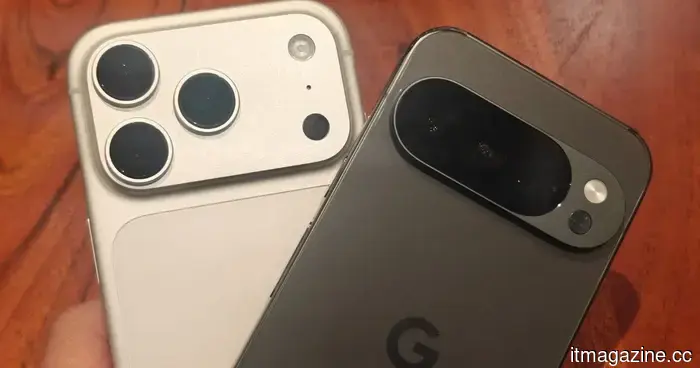
The $1,500 flagship could be nearer than you realize.
In July, a Google executive addressed the ongoing memory crisis, emphasizing a drastic increase in RAM prices that surged over four times from 2025 to 2026. Prices jumped from $2.80 in 2025 to approximately $12 in 2026, as noted in the same report. Calculating for a 16GB memory package, the cost to companies reportedly escalated from $45 to $192.
This isn’t a mere rounding issue; it signifies a fundamental shift impacting the entire industry. Google is not the only company discussing the memory crisis; Nothing's CEO has also commented on it, and brands like Motorola, OnePlus, and Xiaomi have made price adjustments throughout their product lines.
Nadeem Sarwar / DigitalTrends
Flagship smartphones are poised to become extraordinarily expensive.
The impact isn't confined to the entry-level market; it’s apparent at the premium end of the smartphone sector. Given that these devices utilize the highest quality DRAM and NAND configurations, production costs have been consistently increasing since early 2026.
As rumors suggest that the next generation of flagship phones will see price increases, are we heading towards a situation where a top-tier model with 256GB of storage could reach around $1,500? Let’s examine the current starting prices for flagship smartphones.
Moinak Pal/Digital Trends
Device | USA (256GB) | USA (512GB) | India (256GB)
--- | --- | --- | ---
Vivo X300 Ultra | N/A | N/A | N/A
OPPO Find X9 Ultra | N/A | N/A | N/A
Google Pixel 10 Pro XL | $1,199 | ~$1,349 | ₹1,24,999 (~$1,313)
Samsung Galaxy S26 Ultra | $1,299.99 | $1,499.99 | ₹1,39,999 (~$1,470)
iPhone 17 Pro Max | $1,199 | $1,399 | ₹1,49,900 (~$1,574)
To purchase an iPhone 17 Pro Max in the U.S., you'll need to spend $1,199, with potential for a lower price during sales. Other flagships, like the Galaxy S26 Ultra and Pixel 10 Pro XL, start at $1,299.99 and $1,199, respectively. While these appear somewhat standard, is there reason for concern?
Beyond the several prior price hikes, let’s focus on what’s ahead.
Vikhyaat Vivek / Digital Trends
Upcoming flagship devices could redefine pricing standards.
Multiple sources are suggesting a forthcoming price increase for the iPhone 18 Pro Max. Initial rumors hinted at a hike of about $200, but recent reports suggest a rise in the range of $250 to $300 for Apple’s next flagship. Performing the calculation with the current iPhone 17 Pro Max price of $1,199 indicates that the base iPhone 18 Pro Max could range from $1,449 to $1,499.
Whether Apple will mitigate the projected 20 to 25% price increase with enhanced base storage remains to be seen. Nonetheless, a $1,500 starting price seems increasingly plausible.
Shimul Sood / Digital Trends
Device | Current-gen price (USA) | Rumored price (USA) | Effective Increase (Rumored)
--- | --- | --- | ---
iPhone 18 Pro | $1,099 | $1,349–$1,399 | +$250–300
iPhone 18 Pro Max | $1,199 | $1,449–$1,499 | +$250–300
Google Pixel 11 Pro XL | $1,199 | $1,299 | +$100
Samsung Galaxy S27 Ultra | $1,299.99 | $1,399–$1,499 | +$100–200
Apple isn't the only manufacturer experiencing the effects of the memory shortage. The Pixel 11 Pro XL is anticipated to be priced at $1,299 upon its August 2026 release, up from $1,199. Samsung’s Galaxy S27 Ultra is also expected to exceed $1,300, with some reports revealing it might surpass $1,400. Can you see the trend emerging in the smartphone industry?
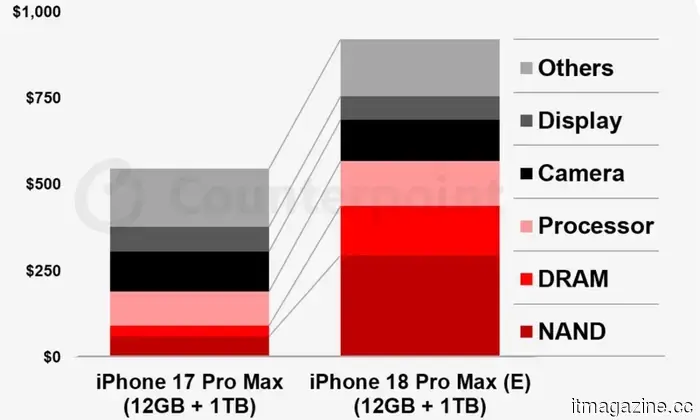
The rise in component costs from the iPhone 17 Pro Max to the rumored iPhone 18 Pro Max highlights this shift, as noted by Counterpoint Research.
Elimination of free storage upgrades and 36-month financing options signifies these changes.
With the availability of consumer-grade memory and storage continuing to dwindle, brands will likely begin scaling back on introductory promotions. For instance, Samsung did not announce any free-storage upgrades for the Galaxy S26 Ultra or its latest Galaxy Z foldable lineup.
Without these benefits, prices have nowhere to conceal themselves. What you see at launch increasingly





Other articles
The $1,500 flagship could be nearer than you realize.
The base-model flagship devices remain priced at approximately $1,200, but increasing memory costs and diminishing benefits indicate that this price point may not be sustainable for much longer.