
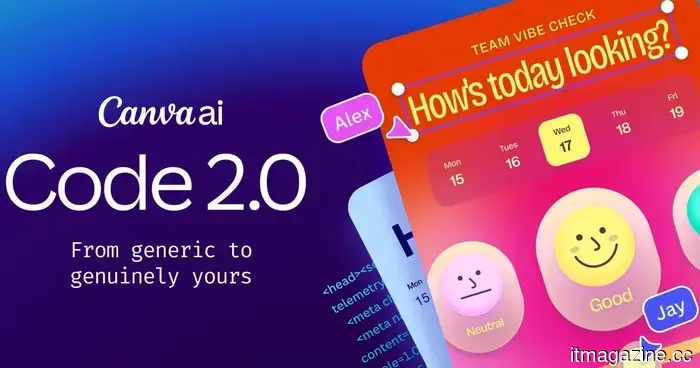
Canva Code 2.0 has significantly simplified vibe coding, making it less daunting for all.
Digital Trends may receive a commission when you purchase through links on our site. Why trust us?
Coding was traditionally limited to developers who dedicated years to mastering complex programming languages. However, this has changed gradually with vibe coding, allowing users to create apps and websites using straightforward, plain-language prompts.
The challenge is that many of these tools can still seem daunting for everyday users, as a certain understanding of coding is often necessary to implement any significant adjustments. Without that knowledge, projects can end up looking quite similar.
Canva aims to address this issue. The company is launching Canva Code 2.0 to its entire user base, which integrates AI-driven coding with its design tools, providing a user-friendly method for customizing apps and websites.
What can you create with it?
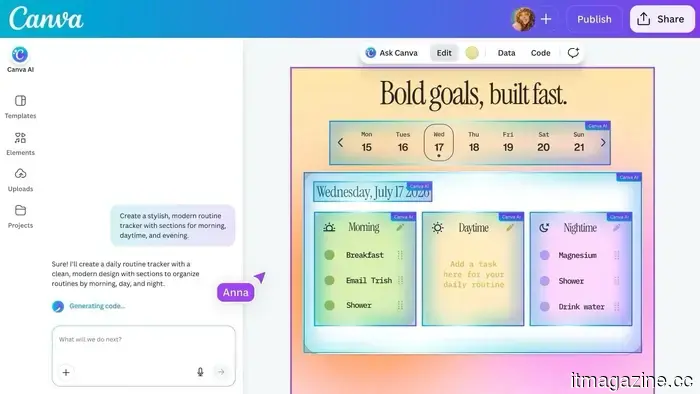
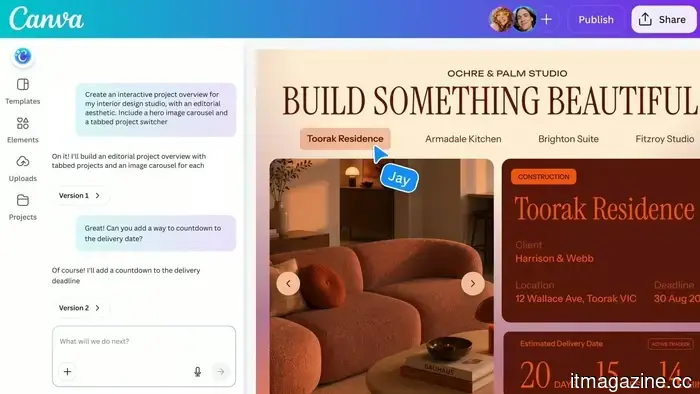
You can begin with a simple prompt, choose from over 50 new templates, or import your existing HTML from previous projects. Once you have a starting point, you can design directly within your other Canva projects, including pages, whiteboards, or presentations.
The best part is that you’re not limited to the output generated by the AI. You can incorporate your own images, adjust colors and fonts using the familiar toolbar, or click on any section to rewrite the text as you prefer. If you prefer to communicate your edits verbally, Canva AI can assist with that as well.
Why is this important?
Most vibe coding tools typically produce a working prototype that resembles what everyone else is creating. However, Canva Code distinguishes itself by being integrated directly into the editor where your brand kit resides, ensuring your creations reflect your unique style.
You can collaborate with your team in real-time, add comments directly in the editor, and easily share your final product wherever it needs to go. You can secure a custom domain through Canva, opt for a free one, or keep your work private within your organization.
With Canva Code 2.0, you can use vibe coding alongside Canva's design tools to develop something unique for your brand, a capability that many vibe coding tools lack. For creators who prioritize both aesthetics and functionality, this represents a significant advantage.
Rachit is an experienced tech journalist with over ten years of experience in the consumer technology field.
South Korea aims to provide every citizen with free and unlimited access to its own AI chatbot, shifting the technology closer to a public utility rather than just another premium subscription service.
On July 13, the Ministry of Science and ICT announced the AI for Everyone initiative. Private companies will construct the platform using locally developed models, while a different AI agent will assist individuals in navigating government services, fulfilling a more practical role than merely generating emails or resolving disputes that individuals would rather not investigate themselves.
Since the emergence of AI chatbots, lawmakers and experts have expressed concern about humans forming emotional attachments to these AI systems. There have been numerous instances where excessive dependence on AI companions or partners has led to medical emergencies, loss of lives, and multiple lawsuits against companies like OpenAI and Meta.
Russian state-sponsored hackers have been exploiting a persistent vulnerability in critical infrastructure networks for over a decade, often targeting poorly configured and outdated routers still exposed to the internet.
In a joint cybersecurity advisory, the NSA, CISA, FBI, and international partners have alerted that hackers associated with Center 16 of Russia’s Federal Security Service are continuing to exploit vulnerable networking equipment. Sectors such as energy, healthcare, and government are facing the greatest risks.


Other articles
 DeepSeek's IPO is approaching as it aims for a valuation of $71 billion.
A DeepSeek IPO could be possible as early as this year. The Chinese AI lab is seeking a new funding round at a valuation of $71 billion, an increase from $50 billion just six weeks prior.
DeepSeek's IPO is approaching as it aims for a valuation of $71 billion.
A DeepSeek IPO could be possible as early as this year. The Chinese AI lab is seeking a new funding round at a valuation of $71 billion, an increase from $50 billion just six weeks prior.
 Proposal for a social media curfew for older teenagers in the UK
Starting in spring 2027, the UK's social media curfew will deactivate apps overnight for users aged 16 and 17, as well as restrict infinite scrolling by default.
Proposal for a social media curfew for older teenagers in the UK
Starting in spring 2027, the UK's social media curfew will deactivate apps overnight for users aged 16 and 17, as well as restrict infinite scrolling by default.
 Motorola's latest flagship challenger offers the speed and magnetic charging that more expensive Android devices often lack.
The Motorola Edge 70 Max features Snapdragon 8 Gen 5 performance, an enormous 7,100mAh battery, and magnetic charging, all at a cost significantly less than many high-end flagship models.
Motorola's latest flagship challenger offers the speed and magnetic charging that more expensive Android devices often lack.
The Motorola Edge 70 Max features Snapdragon 8 Gen 5 performance, an enormous 7,100mAh battery, and magnetic charging, all at a cost significantly less than many high-end flagship models.
 Google Gemini lawsuit: publishers file suit regarding AI training.
Publishers and author Scott Turow have initiated a lawsuit against Google Gemini, alleging that the company trained its AI using millions of copyrighted books without obtaining permission.
Google Gemini lawsuit: publishers file suit regarding AI training.
Publishers and author Scott Turow have initiated a lawsuit against Google Gemini, alleging that the company trained its AI using millions of copyrighted books without obtaining permission.
 Alibaba's stock rises 4% following the approval of Qwen to operate Apple Intelligence in China.
The Cyberspace Administration has authorized Apple AI services in conjunction with Huawei. A startup backed by Khosla has compressed Qwen from 54GB to less than 4GB for on-device operation.
Alibaba's stock rises 4% following the approval of Qwen to operate Apple Intelligence in China.
The Cyberspace Administration has authorized Apple AI services in conjunction with Huawei. A startup backed by Khosla has compressed Qwen from 54GB to less than 4GB for on-device operation.
 Velocity secures $38 million in Series A funding for stablecoin transactions.
London-based fintech Velocity has secured $38 million in a Series A funding round, with Dragonfly and FirstMark as the leading investors, to provide enterprises with stablecoin treasury and settlement solutions.
Velocity secures $38 million in Series A funding for stablecoin transactions.
London-based fintech Velocity has secured $38 million in a Series A funding round, with Dragonfly and FirstMark as the leading investors, to provide enterprises with stablecoin treasury and settlement solutions.
Canva Code 2.0 has significantly simplified vibe coding, making it less daunting for all.
Canva Code 2.0 has arrived, enabling anyone to create apps, websites, and interactive experiences using simple language, all within the familiar Canva editor.