
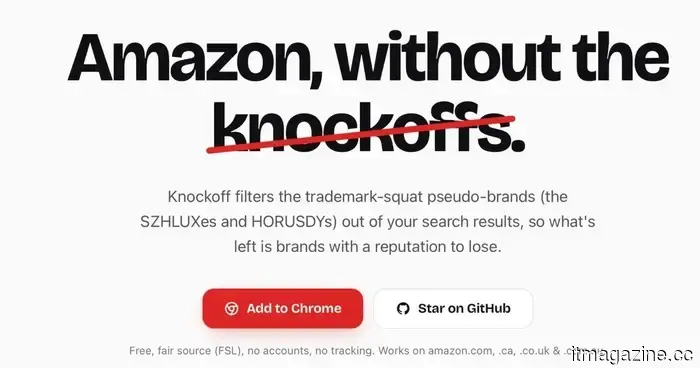
Amazon is cluttered with imitators and questionable brands. This Chrome extension helps you steer clear of them.
**Knockoff**
Shopping on Amazon used to be straightforward. You would search for an item, compare a few well-known brands, and make your purchase. Nowadays, it often feels like you’re scrolling through an endless list of names that seem to appear randomly. This is the issue that Knockoff aims to address.
Developed by Josh Pigford, the Chrome extension doesn’t claim to reveal counterfeit items or magically identify quality products. Instead, it addresses a perhaps more frustrating problem: the inundation of unknown, mass-produced brands that clutter Amazon search results.
**Farewell to Alphabet Soup**
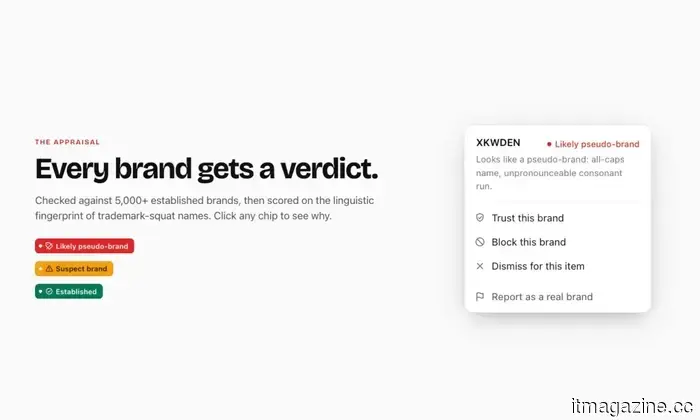
The concept is refreshingly simple. Knockoff spots unknown brands and allows you to take action. You can choose to label them, dim them so they become less noticeable, or remove them completely. If you have confidence in a specific brand, you can whitelist it. Conversely, if there’s a brand you never wish to see again, you can block it with a click.
Knockoff is now available! Filter out the questionable brands on Amazon. Apologies to brands like WNPETHOME, EHEYCIGA, YXYL, LU&MN, JOYIN, TOMY, GODONLIF, YOOJEE, LINGTENG, LANEIGE, VISCOO, BIODANCE, COOFANDY, BALENNZ, TOSY, and LUENX. [https://t.co/9mLk0EAsfG](https://t.co/9mLk0EAsfG) [https://t.co/K07lMkepOW](https://t.co/K07lMkepOW) — Josh Pigford (@Shpigford) July 7, 2026
The extension allows you to set its filtration intensity. A relaxed setting minimizes intervention, while a stricter approach hides more brands. It functions like a spam filter, but for shopping. Pigford initially floated the idea on X, questioning whether users would actually utilize an extension that dims or hides what he referred to as “crap, mass-produced, fake brands” on Amazon. The enthusiastic response led to the extension’s launch.
**Finding the Needle in Amazon’s Haystack**
It’s important to note that Knockoff doesn’t label every unfamiliar brand as selling counterfeit products. Many new companies offer completely legitimate items, and some may grow to become well-known. However, the extension recognizes a rising annoyance among online shoppers: finding products has turned into a daunting task. Instead of comparing a few recognizable choices, consumers often encounter a multitude of listings from unfamiliar brands, most featuring very similar product images, titles, and descriptions. Knockoff doesn’t dictate your purchasing decisions; it simply streamlines the browsing experience by reducing clutter.
Whether this enhancement improves the Amazon shopping experience ultimately depends on your shopping style. If you enjoy searching for hidden treasures, you might prefer seeing all listings untouched. But if you’ve ever wondered why your search results are filled with seemingly randomly generated names, this extension could be a refreshing solution. Sometimes, enhancing the shopping experience isn’t about adding another recommendation tool, but rather about knowing when to obscure some distractions instead.
**Shimul** is a contributor at Digital Trends, bringing over five years of experience in the tech industry.
---
**AI Agent Allegedly Conducted Full Ransomware Attack Independently**
AI didn't merely write malware; it seems to have taken charge of the operation.
Cybersecurity researchers report documenting what could be the first ransomware attack largely executed by an autonomous AI agent, signaling a major evolution in the nature of cyberattacks. According to cloud security company Sysdig, they uncovered a ransomware operation named JadePuffer, which appears to have utilized a large language model (LLM) agent to carry out almost all phases of the attack without ongoing human supervision. If validated, this event indicates that AI is advancing from merely writing malicious code to actively planning, adapting, and executing cyberattacks in real-time.
**The Washington Post's 1976 Predictions for 2026 Prove Surprisingly Accurate**
Fifty years ago, when floppy disks were cutting-edge and the personal computer revolution was just beginning, The Washington Post undertook a remarkably ambitious task: predicting what life in 2026 would resemble. Some of those forecasts feel like science fiction, while others now seem remarkably commonplace as they have become integral to daily life.
In a retrospective for the 250th anniversary of America, the newspaper revisited science editor Thomas O'Toole's 1976 article "Inventing the Future," contrasting its predictions with today’s technological landscape. The findings reveal that while pinpointing specific timelines is nearly impossible, recognizing long-term scientific trends can be quite accurate.
**Australian Government Cautions Doctors on AI Scribing Tools Amid Privacy Concerns**
The Australian government is advising healthcare professionals to be cautious when using AI-driven medical scribing tools as regulators assess the need for enhanced safeguards around one of healthcare's most rapidly




Other articles
 Toyota relocates Tacoma production to Texas; Trump takes credit.
Toyota's $3.6 billion expansion in Texas will shift a portion of Tacoma production away from Mexico. While Trump attributes this change to tariffs, Toyota does not agree and confirms that it will not be exiting Mexico.
Toyota relocates Tacoma production to Texas; Trump takes credit.
Toyota's $3.6 billion expansion in Texas will shift a portion of Tacoma production away from Mexico. While Trump attributes this change to tariffs, Toyota does not agree and confirms that it will not be exiting Mexico.
 Microsoft replaces OpenAI's technology with its own AI in certain applications.
Microsoft is shifting certain app features to its own MAI models rather than relying on OpenAI and Anthropic, reducing its dependence on external partners.
Microsoft replaces OpenAI's technology with its own AI in certain applications.
Microsoft is shifting certain app features to its own MAI models rather than relying on OpenAI and Anthropic, reducing its dependence on external partners.
 New Zealand dismisses the idea of a VPN ban following privacy concerns.
New Zealand has rejected intentions to prohibit VPNs in relation to its social media ban for individuals under 16, following strong privacy concerns, as age-verification regulations continue to move closer to encryption issues.
New Zealand dismisses the idea of a VPN ban following privacy concerns.
New Zealand has rejected intentions to prohibit VPNs in relation to its social media ban for individuals under 16, following strong privacy concerns, as age-verification regulations continue to move closer to encryption issues.
 Apple may have discovered an innovative method to enhance the battery life of the iPhone Air 2.
The upcoming slim iPhone from Apple might finally achieve a balance between style, battery life, and improved cameras while remaining thin.
Apple may have discovered an innovative method to enhance the battery life of the iPhone Air 2.
The upcoming slim iPhone from Apple might finally achieve a balance between style, battery life, and improved cameras while remaining thin.
 Claude Cowork is now available on web and mobile platforms.
Anthropic's Claude Cowork is now available on both web and mobile platforms, allowing tasks to continue even when your laptop is closed, as AI agents expand their presence throughout the office.
Claude Cowork is now available on web and mobile platforms.
Anthropic's Claude Cowork is now available on both web and mobile platforms, allowing tasks to continue even when your laptop is closed, as AI agents expand their presence throughout the office.
 OpenAI is looking to hire an investment banker for its AI division.
OpenAI is offering a $205K position for a "subject matter expert" to educate its AI on the foundational tasks of Wall Street, as it competes with Anthropic for profitable finance sector profits.
OpenAI is looking to hire an investment banker for its AI division.
OpenAI is offering a $205K position for a "subject matter expert" to educate its AI on the foundational tasks of Wall Street, as it competes with Anthropic for profitable finance sector profits.
Amazon is cluttered with imitators and questionable brands. This Chrome extension helps you steer clear of them.
Knockoff allows you to reduce visibility or conceal unknown Amazon brands, making the shopping experience feel a bit less daunting.