
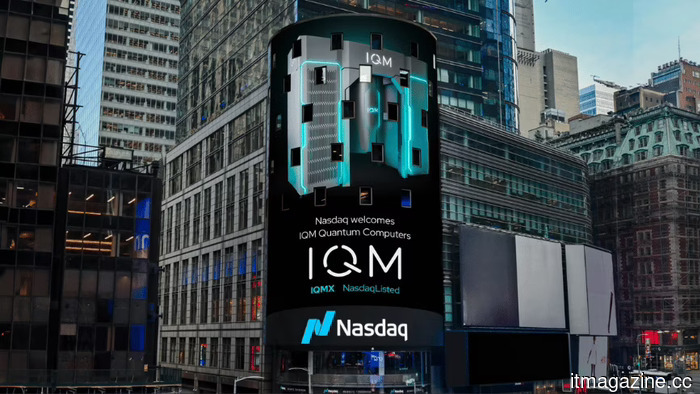
IQM debuts on Nasdaq: the first publicly traded quantum company in Europe.
Europe has just listed its first quantum computing company on a major American stock exchange, doing so while remaining in its home country. IQM, a Finnish manufacturer of quantum machines, began trading on Nasdaq this week, marking a significant milestone and a reality check.
IQM started trading on the Nasdaq Global Select Market on July 2 under the ticker “IQMX,” as confirmed by the company. It achieved this not through a traditional IPO but by merging with a US shell company, resulting in a pro forma cash reserve of €337 million.
This milestone is noteworthy; IQM is the first European quantum company to list on a major US exchange. The company claims to have sold 23 full-stack quantum computers globally — more than any of its competitors. Its clients include Italy’s CINECA, Germany’s Leibniz Supercomputing Centre, and the US Department of Energy’s Oak Ridge National Laboratory.
A Finnish company that remained in Finland
What stands out is what IQM did not do. Traditionally, ambitious European deep-tech firms have chosen to reincorporate in Delaware, relocate to the US, and list there exclusively. However, IQM chose to stay put.
Founded in 2018 as a spinout from Aalto University, IQM retains two-thirds of its 420 employees in Espoo, close to Helsinki, while also maintaining a significant presence in Munich. The company listed on Nasdaq Helsinki the day after its New York debut, allowing state fund Tesi and local pension insurers to remain shareholders. BlackRock also invested prior to the debut.
“IQM’s Nasdaq debut is a landmark for European deep tech,” stated Tom Henriksson, an early investor at OpenOcean. He argued that it demonstrates that European companies can access significant US capital without having to relocate their core research and development or ambitions.
A pioneer with actual revenue
IQM distinguishes itself from others in a field filled with companies operating at a loss. It reported €31 million in revenue for 2025 and has an order backlog exceeding €67 million, which are substantial figures within the quantum sector. In contrast, Honeywell-backed Quantinuum filed for a traditional IPO at a valuation of up to $20 billion despite minimal sales, while US-listed IonQ and Rigetti continue to be unprofitable.
Chairman Sierk Poetting described the listing as “not a change of direction, but… an acceleration.” CEO Jan Goetz referred to it as an inflection point, noting that organizations are transitioning from exploration to implementation and that IQM is entering the market “from a position of strength.”
Concerns from investors
However, investor confidence appeared more cautious. IQM’s shares spent much of their first day trading below the offering price. TechCrunch attributed this lukewarm reception to a notable disclaimer in the company’s prospectus: that “large-scale commercial traction of quantum computing technology may never occur.”
This caution applies to the entire industry. Quantum machines are currently useful for specific simulation and optimization tasks. However, the "quantum advantage" expected to revolutionize areas such as drug discovery, finance, and encryption lacks a clear timeline for its arrival, with even the developers of these computers unable to predict when it might happen.
Investments continue to flow into the sector. Governments on both sides of the Atlantic are increasing their funding, and Europe is striving to keep up. French competitor Pasqal is also preparing for its own listing. For now, IQM has established a presence: a European deep-tech champion can be publicly traded in New York while still calling Helsinki home. Whether US investors will continue to support it remains to be seen.
Otros artículos
 GoDaddy advierte que la represión de sitios falsos en India podría salir mal.
GoDaddy está impugnando una orden de un tribunal de Delhi sobre sitios web falsos, advirtiendo que eliminar la privacidad de dominio por defecto podría exponer a millones de propietarios legítimos.
GoDaddy advierte que la represión de sitios falsos en India podría salir mal.
GoDaddy está impugnando una orden de un tribunal de Delhi sobre sitios web falsos, advirtiendo que eliminar la privacidad de dominio por defecto podría exponer a millones de propietarios legítimos.
 El agente de IA realiza el primer ataque de ransomware de extremo a extremo.
Sysdig dice que capturó el primer ataque de ransomware llevado a cabo completamente por un agente de IA. Entró, borró una base de datos y dejó un rescate que la víctima no puede pagar.
El agente de IA realiza el primer ataque de ransomware de extremo a extremo.
Sysdig dice que capturó el primer ataque de ransomware llevado a cabo completamente por un agente de IA. Entró, borró una base de datos y dejó un rescate que la víctima no puede pagar.
 Pronto podrás usar WhatsApp en tu iPad sin tocar tu iPhone.
Los usuarios de iPad ahora pueden usar WhatsApp como un dispositivo principal independiente sin necesidad de un iPhone.
LALIGA de España bloquea más de 500,000 sitios web
Un estudio de OONI encuentra que los bloqueos de IP anti-piratería de LALIGA en España eliminaron más de 500,000 sitios legítimos, desde Amnistía hasta Greenpeace, e interceptaron tráfico.
Pronto podrás usar WhatsApp en tu iPad sin tocar tu iPhone.
Los usuarios de iPad ahora pueden usar WhatsApp como un dispositivo principal independiente sin necesidad de un iPhone.
LALIGA de España bloquea más de 500,000 sitios web
Un estudio de OONI encuentra que los bloqueos de IP anti-piratería de LALIGA en España eliminaron más de 500,000 sitios legítimos, desde Amnistía hasta Greenpeace, e interceptaron tráfico.
 El banco Erebor de Palmer Luckey busca una valoración de 8 mil millones de dólares.
Erebor, el banco respaldado por Thiel fundado por Palmer Luckey de Anduril, está en conversaciones para recaudar a una valoración de más de $8 mil millones después de que los depósitos casi se cuadruplicaran a $4 mil millones.
El banco Erebor de Palmer Luckey busca una valoración de 8 mil millones de dólares.
Erebor, el banco respaldado por Thiel fundado por Palmer Luckey de Anduril, está en conversaciones para recaudar a una valoración de más de $8 mil millones después de que los depósitos casi se cuadruplicaran a $4 mil millones.
IQM debuts on Nasdaq: the first publicly traded quantum company in Europe.
Finland's IQM started trading on Nasdaq as the first European quantum firm on a significant US exchange, retaining its headquarters in Helsinki along with a cash reserve of €337M.