

As AI-generated voices become increasingly difficult to distinguish, ElevenLabs implements Google's SynthID to assist you in identifying the fakes.
Unsplash
There was a time when identifying AI-generated content was almost like a challenge. Images featured extra fingers, chatbots communicated with the enthusiasm of inexperienced interns, and synthetic voices had a distinctly robotic tone. Those times are quickly fading away.
Nowadays, AI voices can laugh, whisper, pause naturally, and even convey emotions convincingly enough to deceive many listeners. This is exciting for creators but is also leading to a growing trust issue. If you can’t determine whether a clip is real or generated by AI, how can you discern what is trustworthy?
Concealing the truth to reveal it later
This is the problem that ElevenLabs is attempting to address. The company has announced its plan to integrate Google DeepMind’s SynthID watermarking technology into AI-generated speech, starting with text-to-speech audio produced by free users and then expanding to all audio generations in the coming weeks.
Google
The concept is quite clever. Instead of adding metadata that could easily vanish when a file is edited or shared, SynthID embeds a silent digital watermark directly within the audio. Although inaudible, ElevenLabs claims that the watermark endures common edits such as trimming, compression, alterations in speed, file conversions, and even metadata removal. In conjunction with the watermarking feature, ElevenLabs is also rolling out a free Audio Detector that allows anyone to verify if a recording was made using its platform.
Trust might emerge as AI's most valuable characteristic
The timing is fitting. AI-generated audio is becoming harder to tell apart from real recordings, and deepfake scams are increasingly more sophisticated. While ElevenLabs already monitors content internally and forbids deceptive uses of its platform, the addition of a persistent watermark provides another layer of accountability that remains intact even after a file leaves its servers. Furthermore, persistent watermarks could assist creators in asserting ownership of AI-generated works, maintaining content credentials, and simplifying the tracking of copyrighted material across platforms such as YouTube, Instagram, and TikTok.
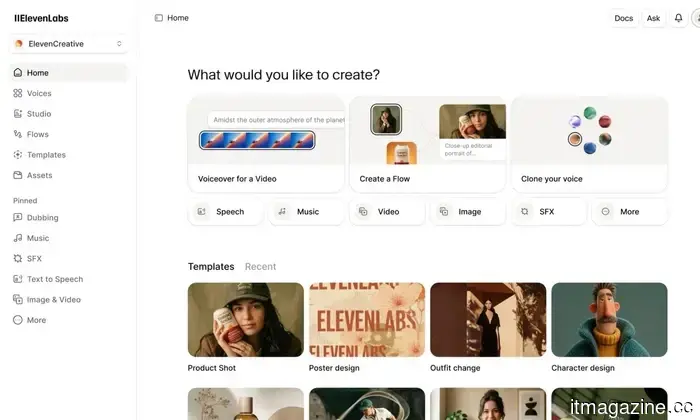
ElevenLabs
Of course, watermarking alone won't bring an end to malicious deepfakes immediately. Bad actors will continue to seek ways to circumvent detection systems. However, as AI-generated audio becomes nearly indistinguishable from human speech, invisible provenance may prove just as crucial as the technology that creates the voices. The future of AI is not solely about making synthetic voices more human-like; it also hinges on ensuring that people are aware when they aren't.
Shimul is a contributor at Digital Trends, bringing over five years of experience in the tech field.
Stanford scientists have developed an AI capable of creating healthier, greener burgers
The new system balances nutrition, taste, cost, and environmental impact to come up with better recipes.
Artificial intelligence has already contributed to code writing, drug discovery, and video generation. Now, it aims to enhance burger creation. Researchers from Stanford University have introduced BurgerAI, a new AI system that crafts burger recipes by harmonizing taste, nutrition, sustainability, and cost. What’s surprising? In blind taste tests, some diners rated AI-generated burgers just as highly as, and in some cases even better than, a popular fast-food burger. BurgerAI is designed to create original recipes rather than replicate existing ones.
Read more
OpenAI unveils its most advanced GPT-5.6 model, but access is currently restricted
GPT-5.6 features enhanced reasoning, autonomy, and cybersecurity capabilities, yet its availability is presently limited to government-approved customers.
OpenAI has officially announced GPT-5.6, its most advanced lineup of AI models to date. However, there’s a catch: unless you're one of a select group of approved clients, you won’t have the opportunity to test it anytime soon. Instead of a wide release, the company is beginning with a tightly controlled preview while navigating a new U.S. government review process.
GPT-5.6 is available, but only a limited number of users can access it.
Read more
Bacteria might hold the key to keeping your computers cool
Scientists have discovered that bacteria can cultivate thermal materials that outperform current cooling technologies.
Your PC and laptop become increasingly hotter each year, especially as AI tools and demanding software push them to their limits. Heat poses a significant performance bottleneck, which has led people to implement extreme solutions, such as attaching an actual ice machine to an RTX GPU. A new study suggests a significantly less drastic solution involving bacteria (via TechXplore). Researchers have developed a method to cultivate thermal interface materials, the substances that exist between a chip and its cooling system to facilitate faster heat dissipation. This process involves feeding bacteria sugar and metal ions, allowing the microbes to naturally produce the material instead of relying on conventional chemical manufacturing.
Read more





Other articles
 As AI voices become increasingly difficult to detect, ElevenLabs is incorporating Google's SynthID to assist you in identifying the fakes.
Voices generated by AI are becoming extremely difficult to detect. ElevenLabs is now incorporating invisible watermarks into its audio, allowing you to recognize when you're hearing AI-generated content.
As AI voices become increasingly difficult to detect, ElevenLabs is incorporating Google's SynthID to assist you in identifying the fakes.
Voices generated by AI are becoming extremely difficult to detect. ElevenLabs is now incorporating invisible watermarks into its audio, allowing you to recognize when you're hearing AI-generated content.
 Meaning of Snapchat Planets: Arrangement, Rankings, and Functioning of the Friend Solar System
Snapchat Planets transforms your friendship rankings into a miniature social solar system, with being Mercury as the top tier and Neptune possibly feeling a bit disappointing.
Meaning of Snapchat Planets: Arrangement, Rankings, and Functioning of the Friend Solar System
Snapchat Planets transforms your friendship rankings into a miniature social solar system, with being Mercury as the top tier and Neptune possibly feeling a bit disappointing.
 OpenAI presents ChatGPT advertisements at Cannes amid a drop in CPM.
OpenAI made its first appearance at the Cannes Lions with a large number of advertisers, yet its ad pricing fell from $60 to $25 CPM within a matter of weeks. Is it possible for ChatGPT to achieve $100 billion in advertising revenue by 2030?
OpenAI presents ChatGPT advertisements at Cannes amid a drop in CPM.
OpenAI made its first appearance at the Cannes Lions with a large number of advertisers, yet its ad pricing fell from $60 to $25 CPM within a matter of weeks. Is it possible for ChatGPT to achieve $100 billion in advertising revenue by 2030?
 We finally caught a glimpse of Android 17's gaming technique that resembles a Nintendo DS.
Android 17’s foldable gaming mode divides the screen into areas for gameplay and a virtual controller, enhancing the experience of folding phones to resemble compact gaming handhelds.
We finally caught a glimpse of Android 17's gaming technique that resembles a Nintendo DS.
Android 17’s foldable gaming mode divides the screen into areas for gameplay and a virtual controller, enhancing the experience of folding phones to resemble compact gaming handhelds.
 Your Windows 10 computer has received an additional year of security updates. Here's how to obtain it at no cost.
Millions of Windows 10 PCs that are unable to run Windows 11 have received some relief, as Microsoft has extended its free security update program until October 2027.
Your Windows 10 computer has received an additional year of security updates. Here's how to obtain it at no cost.
Millions of Windows 10 PCs that are unable to run Windows 11 have received some relief, as Microsoft has extended its free security update program until October 2027.
 I discovered two budget charger deals for Prime Day that don’t seem like the usual cable-drawer clutter.
These Anker and Belkin charger deals for Prime Day are affordable, functional, and from brands I would trust more than taking chances with random wall chargers.
I discovered two budget charger deals for Prime Day that don’t seem like the usual cable-drawer clutter.
These Anker and Belkin charger deals for Prime Day are affordable, functional, and from brands I would trust more than taking chances with random wall chargers.
As AI-generated voices become increasingly difficult to distinguish, ElevenLabs implements Google's SynthID to assist you in identifying the fakes.
AI-generated voices are becoming increasingly difficult to distinguish. ElevenLabs is now incorporating invisible watermarks into its audio, enabling you to recognize when you're hearing AI-generated content.