
Lightsails have encountered another obstacle on their journey toward interstellar travel.
The most intriguing concept for interstellar travel might be undermined by the very light that propels it.
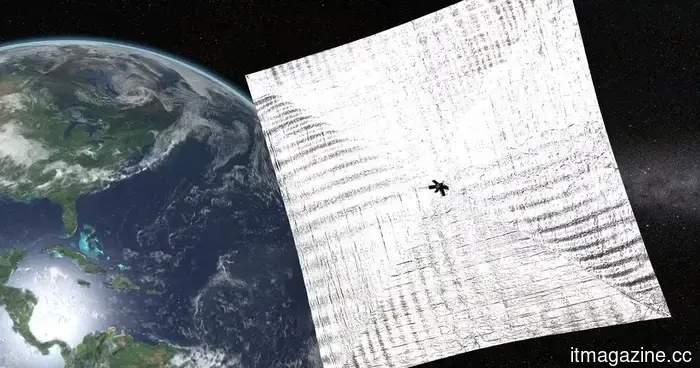
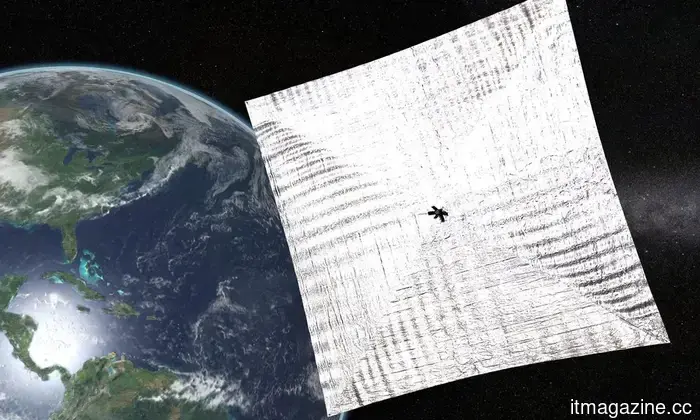
When deployed, the solar sails of LightSail could potentially be seen by those on the ground.
Laser-driven lightsails are among the most exciting solutions for space exploration. While they may lack the fantastical appeal of a warp drive, their feasibility has now come into question. With lightsails, a spacecraft can unfurl a thin reflective sail and harness the push of a powerful laser, eliminating the need for fuel.
The technology appears straightforward and elegant, yet it presents complications beyond initial expectations. A new preprint from researchers Chao Shen and Jiaze Li at the Harbin Institute of Technology indicates that relativistic lightsails could encounter a concealed propulsion issue upon reaching extremely high speeds.
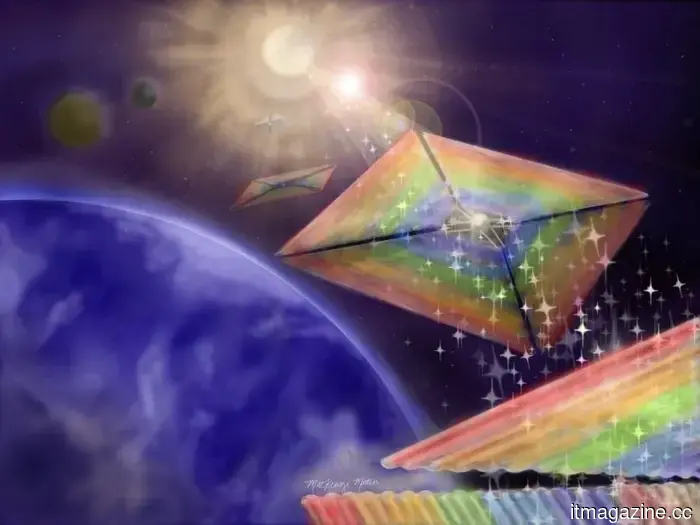
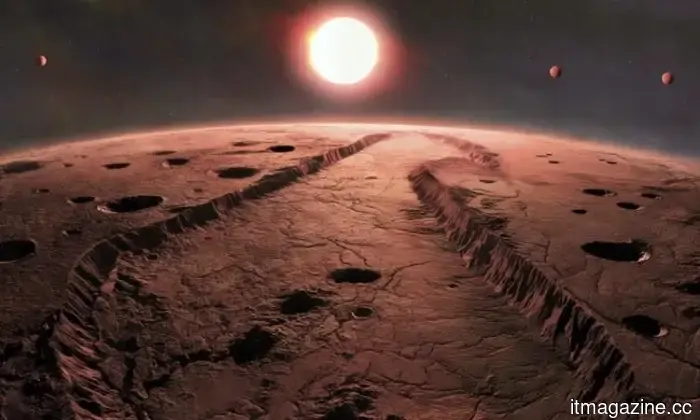
Diffractive solar sails, illustrated in a concept image, could facilitate missions to challenging destinations, such as orbits over the Sun’s poles. NASA
The issue with light itself
The study categorizes lightsail propulsion into three photon-driven forces: incident light, specular reflection, and diffuse scattering. Incident light refers to the direct force from incoming photons. Specular reflection occurs when photons bounce off the sail cleanly, while diffuse scattering pertains to light that is absorbed and then reemitted in less orderly directions. At lower velocities, all three types of interactions contribute to the sail's propulsion.
The complication arises when a lightsail spacecraft approaches relativistic speeds. As the sail moves away from the laser, Doppler effects diminish the frequency of incoming light. Consequently, the thrust from all three components declines as the sail accelerates. An unusual phenomenon occurs when the sail reaches approximately 75% of the speed of light; diffuse scattering may transition from a minor aide to a genuine drag force. Although the laser's net force still drives the spacecraft forward, overall efficiency decreases.
The lightsail dream is not yet over
This doesn’t imply that the lightsail idea should be abandoned. The study is theoretical, presented as a preprint, primarily concentrating on radiative dynamics. It does not take into account various other issues engineers would need to address, such as interstellar dust, gas drag, beam stability, or the sail's ability to endure a powerful laser without warping or melting.
Interstellar lightsails already pose a multitude of engineering challenges. Gaining insights into how light interacts at extreme speeds offers mission designers an additional constraint to consider. Advanced materials and photonic structures may still provide support. However, for the time being, our endeavors in interstellar travel still require significant refinement.
The galaxy holds an exoplanet-sized enigma, and NASA's EVE mission aims to solve it.
This planet-hunting mission seeks to discover young planets before they mature.
Humanity's exploration of space has spawned more questions than answers, particularly regarding planetary sizes. Astronomers have identified numerous rocky super-Earths and numerous puffier sub-Neptunes, yet far fewer planets approximately 1.8 times the size of Earth exist. This gap is termed the radius valley, and a proposed mission known as the Early eVolution Explorer, or EVE, aims to understand its existence. NASA’s simple strategy involves examining planets while they are still in their infancy. The mission concept, outlined in a recent arXiv preprint and reported by Phys.org, would target newly formed star clusters to observe small planets before they undergo billions of years of evolution.
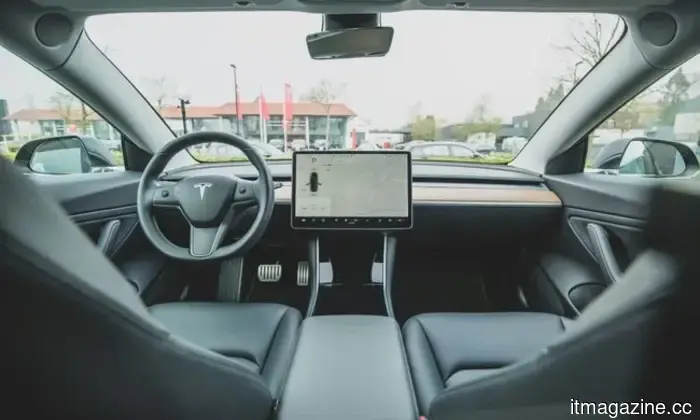
We recently received promising signals that a merger between Tesla and SpaceX could be on the horizon.
For years, the notion of merging Tesla and SpaceX has straddled the line between ambitious business theory and fanciful speculation. The two companies already share foundational elements, leadership influence, engineering talent, and long-term objectives. However, discussions on this topic have often felt more like an intriguing thought exercise than a feasible outcome. Recently, a significant figure at SpaceX provided new momentum to the conversation.
In a recent interview with CNBC, SpaceX President and COO Gwynne Shotwell was questioned about the possibility of fostering closer connections between Tesla and SpaceX. Her response was not a definitive rejection. Rather, she implied that consolidating the two companies could simplify processes for Musk. While this may seem like a casual remark, it carries weight coming from Shotwell, who has been with SpaceX since its inception and remains one of its most consequential executives.
Astronauts reportedly took precautions after maintenance on a leaky Russian ISS module ignited safety concerns.
The ISS coincidentally faced a stressful situation with renewed leaks.
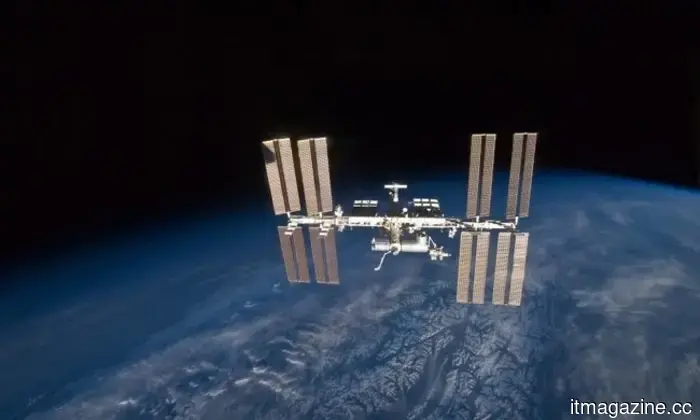
Astronauts aboard the International Space Station took precautionary measures after maintenance on the Russian Zvezda service module raised fresh concerns about air leaks in the orbiting laboratory.
Reports indicate that the Zvezda module has faced persistent air leak issues over the years. Following repair work and pressure tests related to the leak investigation, astronauts were instructed to take shelter in safer sections of the ISS while engineers monitored the station’s safety and pressure stability.

Other articles
 Your Ryzen CPU previously encrypted your RAM, but a firmware update discreetly disabled that feature.
AMD quietly turned off TSME memory encryption on consumer Ryzen processors through a firmware update. This feature remains active on Pro CPUs. AMD has not provided an explanation for this change.
Your Ryzen CPU previously encrypted your RAM, but a firmware update discreetly disabled that feature.
AMD quietly turned off TSME memory encryption on consumer Ryzen processors through a firmware update. This feature remains active on Pro CPUs. AMD has not provided an explanation for this change.
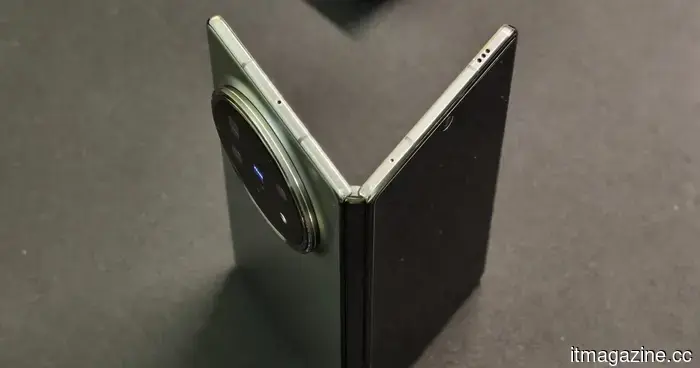 This forthcoming foldable device is elevating zoom capture to extraordinary heights, surpassing both Apple and Samsung.
The upcoming Vivo X Fold 6 is anticipated to prioritize camera capabilities, featuring a 200MP main sensor and support for a ZEISS 200mm teleconverter.
This forthcoming foldable device is elevating zoom capture to extraordinary heights, surpassing both Apple and Samsung.
The upcoming Vivo X Fold 6 is anticipated to prioritize camera capabilities, featuring a 200MP main sensor and support for a ZEISS 200mm teleconverter.
 YouTube's AI content cleanup is penalizing creators who never appeared on camera.
YouTube has shut down 16 channels that amassed 4.7 billion views and is experimenting with viewer surveys to identify low-quality AI content. However, creators without a visible presence argue that the crackdown also affects them unfairly.
YouTube's AI content cleanup is penalizing creators who never appeared on camera.
YouTube has shut down 16 channels that amassed 4.7 billion views and is experimenting with viewer surveys to identify low-quality AI content. However, creators without a visible presence argue that the crackdown also affects them unfairly.
 A single click on a Microsoft link could have emptied your inbox. Here's how SearchLeak functioned.
Varonis linked three vulnerabilities in Microsoft 365 Copilot Enterprise Search to create a one-click method for data theft that evaded phishing filters and CSP safeguards.
A single click on a Microsoft link could have emptied your inbox. Here's how SearchLeak functioned.
Varonis linked three vulnerabilities in Microsoft 365 Copilot Enterprise Search to create a one-click method for data theft that evaded phishing filters and CSP safeguards.
 Airalo and the Emergence of eSIM Travel: A More Intelligent Method to Remain Connected While Traveling Abroad
International travel relies on connectivity more than it ever has. Whether it's finding your way in new cities, handling bookings, or keeping in contact with family back home, dependable mobile data is crucial. Here's how Airalo is assisting travelers in staying connected in over 200 countries and regions using the convenience of eSIM technology.
Airalo and the Emergence of eSIM Travel: A More Intelligent Method to Remain Connected While Traveling Abroad
International travel relies on connectivity more than it ever has. Whether it's finding your way in new cities, handling bookings, or keeping in contact with family back home, dependable mobile data is crucial. Here's how Airalo is assisting travelers in staying connected in over 200 countries and regions using the convenience of eSIM technology.
 YouTube's AI content cleanup is penalizing human creators who have never revealed their identities.
YouTube has terminated 16 channels that collectively had 4.7 billion views and is experimenting with viewer surveys to identify low-quality AI content. However, faceless creators argue that this enforcement also punishes them.
YouTube's AI content cleanup is penalizing human creators who have never revealed their identities.
YouTube has terminated 16 channels that collectively had 4.7 billion views and is experimenting with viewer surveys to identify low-quality AI content. However, faceless creators argue that this enforcement also punishes them.
Lightsails have encountered another obstacle on their journey toward interstellar travel.
A recent study indicates that laser-powered interstellar lightsails could encounter an unnoticed efficiency issue as the light used to propel them begins to act in a less favorable manner.