

Your smart home concludes at the back door — wireless robotic lawn mowers aim to transform that.
Take a moment to reflect on the number of automated devices in your home. Your robotic vacuum takes care of the floors. Your thermostat adjusts the temperature before you even arrive. The doorbell camera recognizes visitors as they approach.
Now, step outside. You’ll discover that your lawn still requires you to pull out a gas mower every Saturday. While indoor smart home technology has advanced significantly, going outdoors presents a more complex situation. This disconnect has consistently posed a challenge for the smart home sector.
Reasons for the lag in outdoor automation
There are valid reasons why outdoor automation has taken longer to develop. Inside the home, the environment is predictable: walls, flat surfaces, and stable furniture. A robotic vacuum can easily map the living room and begin cleaning. Outside, the scenario is different. The terrain varies. Grass grows unevenly. There are trees, slopes, flower beds, patio furniture that moves every weekend, hoses left on the lawn, and toys scattered about. All of this is compounded by unpredictable weather. Unlike a room, a yard often lacks clear edges, such as walls or fences.
This last point is a key factor contributing to the challenges faced by early robotic lawn mowers. Most models required homeowners to install a boundary wire to outline the yard's perimeter. This involved burying or staking a physical wire into the ground to indicate where the mower should stop. While this approach was functional, it was cumbersome to set up and prone to damage, creating a significant obstacle to achieving the seamless experience users expect from indoor smart home devices.
As an alternative to boundary wires, some users opted to install an RTK base station, which required mounting an antenna and utilizing GPS to guide the mower. Although this addressed the boundary wire installation issues, it could suffer from poor performance in densely vegetated areas or around fences and buildings.
Innovative solutions transforming the landscape
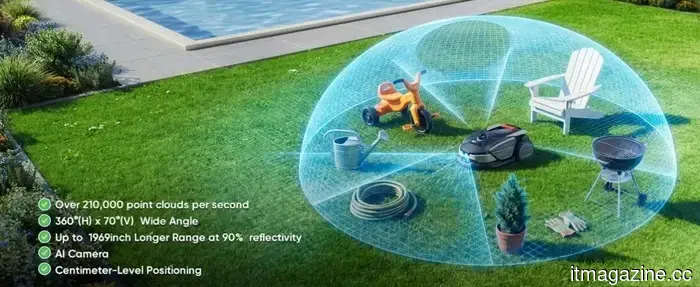
Recognizing these challenges, manufacturers have introduced a new generation of robotic mowers. One such example is the Sunseeker S4. It stands out among its peers as it does not require a boundary wire or an RTK base station antenna. Setting up the S4 resembles the installation of a new robotic vacuum—without the need for trench-digging or mounting antennas as seen in earlier systems. The S4 utilizes its onboard sensors to analyze the lawn directly. Its AllSense™ Vision AI and 3D LiDAR collaborate to create a real-time map of the mower's environment, enabling it to detect typical backyard obstacles and navigate cluttered spaces.
However, these advancements come with some limitations. Notably, the S4 is not suitable for St. Augustine or Zoysia lawns. Other constraints are relatively minimal. The Sunseeker S4 can manage yards up to 0.25 acres, handle slopes of up to 42% (22°), and manage as many as 100 zones across five maps, allowing one unit to operate effectively in both front and back yards. Many suburban lawns fit within these parameters. For complete compatibility, pricing, and availability details, please refer to Sunseeker's official communications.
Experiencing the Sunseeker Tech
Setting up the S4 is done via an app, where you can create mowing zones and schedule mowing times. Compared to previous iterations, the setup process is much shorter and simpler—no trench digging, no boundary wire staking, and no need for an RTK antenna installation.
Once operational, the S4 uses its LiDAR and Vision AI to identify and maneuver safely around common outdoor items, such as toys, pets, furniture, and garden features. It follows a regular schedule for mowing, which is beneficial for the grass, as frequent light cuts promote healthier growth compared to the "scalp-and-recover" approach often used when mowers are brought out only on weekends.
This overall experience highlights the evolution of this category. Users can set up the system, monitor it through the app as desired, and otherwise forget about the mowing task.
The relationship with robotic vacuums
The comparison is hard to miss. A decade ago, robotic vacuum cleaners were groundbreaking yet initially impractical. Early versions often awkwardly bounced off everything in their path, more of a novelty than a labor-saving tool. However, over time, they improved. Setup processes became simpler. Object detection evolved significantly. Accurate mapping became a possibility. Ultimately, robotic vacuums shifted from being mere curiosities to viable substitutes for traditional vacuum cleaners.
Robotic lawn mowers appear to be approaching a similar tipping point. The AI lawn mower category has transitioned from cumbersome, installation-heavy devices to practical outdoor smart home tools. The Sunseeker S4 exemplifies this transformation. A 3D LiDAR robotic mower that doesn’t necessitate boundary installation and can effectively navigate a “real” yard represents a new breed of product markedly different from those in the market five years ago.
Are robotic mowers ready for widespread use?
The new approaches adopted by robotic mower manufacturers signal positive trends for smart home users

Other articles
 AI requires discernment rather than merely a job description: Michael Ronis discusses the future of hiring.
AI is capable of sifting through a thousand resumes in a matter of hours, yet it lacks the ability to assess rapport, cultural alignment, or career aspirations. According to recruiter Michael Ronis, the key issue isn't if AI will take over human roles, but rather in which areas humans need to intervene.
ShinyHunters compromised over 100 companies via an unpatched zero-day vulnerability in Oracle PeopleSoft.
ShinyHunters took advantage of CVE-2026-35273 (CVSS 9.8) to compromise over 100 organizations utilizing Oracle PeopleSoft, with two-thirds of them being universities. There is currently no available patch.
AI requires discernment rather than merely a job description: Michael Ronis discusses the future of hiring.
AI is capable of sifting through a thousand resumes in a matter of hours, yet it lacks the ability to assess rapport, cultural alignment, or career aspirations. According to recruiter Michael Ronis, the key issue isn't if AI will take over human roles, but rather in which areas humans need to intervene.
ShinyHunters compromised over 100 companies via an unpatched zero-day vulnerability in Oracle PeopleSoft.
ShinyHunters took advantage of CVE-2026-35273 (CVSS 9.8) to compromise over 100 organizations utilizing Oracle PeopleSoft, with two-thirds of them being universities. There is currently no available patch.
 Bluesky introduces group chats and shifts focus to communities as growth levels off at 44.8 million users.
Bluesky has introduced group chats for as many as 50 individuals and is developing communities similar to those found on Reddit. This shift occurs amid a slowdown in user growth and as X discontinues its own community features.
Bluesky introduces group chats and shifts focus to communities as growth levels off at 44.8 million users.
Bluesky has introduced group chats for as many as 50 individuals and is developing communities similar to those found on Reddit. This shift occurs amid a slowdown in user growth and as X discontinues its own community features.
 Anthropic is investing $150 million to place 1,000 AI fellows in nonprofit organizations, with no degree necessary.
Anthropic's Claude Corps is set to place 1,000 fellows at nonprofit organizations for a year, offering each a salary of $85,000. Applications are currently being accepted, and a college degree is not necessary. The inaugural cohort will begin in October.
ShinyHunters compromised over 100 companies by exploiting a zero-day vulnerability in Oracle PeopleSoft that had not been patched.
ShinyHunters took advantage of CVE-2026-35273 (CVSS 9.8) to compromise over 100 organizations utilizing Oracle PeopleSoft. Among them, two-thirds are educational institutions. A patch is not available at this time.
Anthropic is investing $150 million to place 1,000 AI fellows in nonprofit organizations, with no degree necessary.
Anthropic's Claude Corps is set to place 1,000 fellows at nonprofit organizations for a year, offering each a salary of $85,000. Applications are currently being accepted, and a college degree is not necessary. The inaugural cohort will begin in October.
ShinyHunters compromised over 100 companies by exploiting a zero-day vulnerability in Oracle PeopleSoft that had not been patched.
ShinyHunters took advantage of CVE-2026-35273 (CVSS 9.8) to compromise over 100 organizations utilizing Oracle PeopleSoft. Among them, two-thirds are educational institutions. A patch is not available at this time.
 Graduation Gift Guide 2026: Best Portable Chargers for Recent Graduates
As the Class of 2026 approaches graduation, portable power is shifting from being a mere backup option to a necessity. Whether for daily travels or job searches, here are six exceptional portable chargers that students and recent graduates can rely on to keep their devices charged throughout the day.
Graduation Gift Guide 2026: Best Portable Chargers for Recent Graduates
As the Class of 2026 approaches graduation, portable power is shifting from being a mere backup option to a necessity. Whether for daily travels or job searches, here are six exceptional portable chargers that students and recent graduates can rely on to keep their devices charged throughout the day.
Your smart home concludes at the back door — wireless robotic lawn mowers aim to transform that.
Pause for a moment to consider how many aspects of your home have become automated. Your robotic vacuum takes care of the floors. The thermostat adjusts the temperature before you even get home. The doorbell camera identifies those who come to your door. Now, step outside. You will see that your lawn is still waiting for you to take […]