
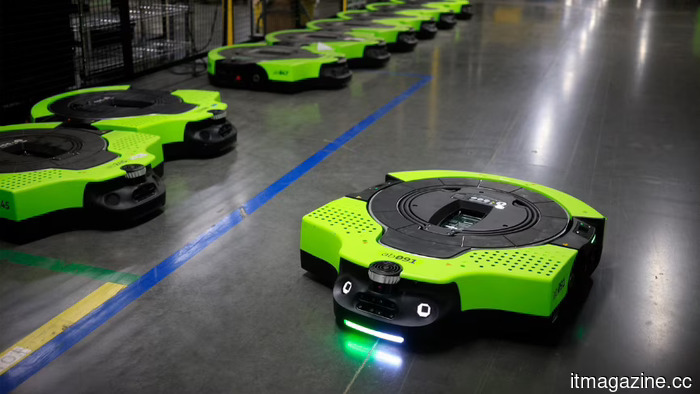
Amazon's latest robot, Proteus, understands simple language commands and is set to arrive in Europe in 2027.
Amazon's new warehouse robot is designed to respond to spoken commands. During the "Delivering the Future" event at the Dartford fulfilment center near London on June 4, Amazon introduced the next-generation Proteus, which accepts plain language instructions without the need for technical commands or a programming interface. The company also announced a plan to invest over €10 billion (approximately $11.6 billion) in its European fulfilment network in the coming years.
The main change is the user interface. "You instruct it on what needs to be accomplished. It determines the priority, route, and timing," explained Scott Dresser, vice president of Amazon Robotics, describing the robot as a helper for material handling.
In contrast to the current Proteus, which operates only in dock areas at 25 US locations to move carts weighing close to 400 kg, the new version is intended to function throughout a fulfilment or delivery site, assisting with the transport of containers as they arrive and moving them between workstations.
The new Proteus is not yet available for shipping. It is currently being tested in Amazon’s labs, with plans for European deployment in the first half of 2027.
This timeline coincides with the expansion of two other systems in the region: STARK, a collaborative tote-handling robot that was first piloted in Barcelona and is set to reach 15 European locations by 2027, and Vulcan, Amazon’s initial robot equipped with touch capabilities, which has relocated from Spokane, Washington, to Hamburg, Germany.
The investment represents a larger commitment. Amazon positioned the advancements in robotics as a component of its strategy to invest over €10 billion in modernizing European fulfilment, promising to increase its European fulfilment-centre workforce by 25,000 in the coming years.
This headcount increase addresses concerns about automation and job loss, as the company claims that robotics has generated new job categories in reliability, maintenance, and engineering.
The introduction of the robots is accompanied by a push for faster delivery. Amazon announced plans to open over 25 sub-same-day delivery sites across Europe this year, including locations in the UK and Germany, and to expand its Amazon Now service, which offers ultra-quick essentials delivery, to Manchester and Birmingham.
Additionally, same-day fresh grocery delivery is now available in more than 2,300 cities in the US and parts of Tokyo, with further expansions anticipated. The next-gen assistant, Alexa+, is expected to launch in 10 more countries in 2027.
This investment is part of a much larger financial commitment. In February, Amazon predicted a more than 50% increase in capital expenditure to $200 billion for the year, as it joins others in a major infrastructure expansion driven by AI.
In this context, the €10 billion earmarked for European fulfilment is a regional component rather than the main focus, but it symbolizes a tangible aspect: a robot that by 2027, workers in Dartford or Hamburg should be able to command with simple instructions. The true test will be whether it functions as seamlessly on the warehouse floor as it does in a controlled lab environment during the 2027 rollout.
Other articles
 SoftBank's PayPay ventures into the insurance sector with a 70.2% stake in T&D Life.
PayPay, supported by SoftBank, will acquire a 70.2% ownership in T&D Financial Life for roughly ¥134.3 billion (about $840 million), marking its entry into Japan's life insurance sector.
SoftBank's PayPay ventures into the insurance sector with a 70.2% stake in T&D Life.
PayPay, supported by SoftBank, will acquire a 70.2% ownership in T&D Financial Life for roughly ¥134.3 billion (about $840 million), marking its entry into Japan's life insurance sector.
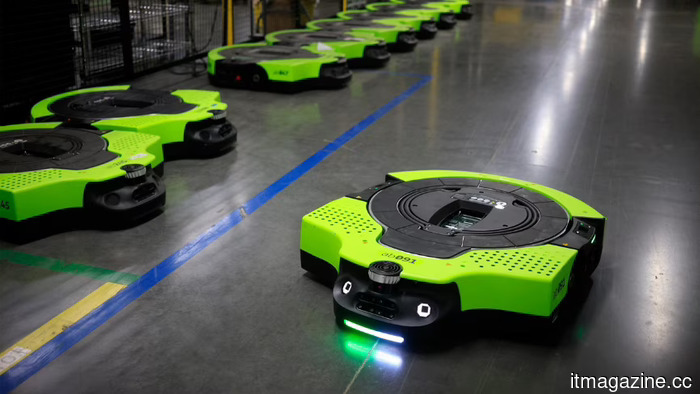 Amazon's latest robot, Proteus, understands simple language commands and is set to arrive in Europe in 2027.
Amazon introduced an advanced Proteus robot that responds to verbal commands, as part of a €10 billion (approximately $11.6 billion) investment in European fulfillment.
Amazon's latest Proteus robot responds to straightforward verbal commands and is set to arrive in Europe in 2027.
Amazon introduced a next-generation Proteus robot capable of responding to verbal commands, which is part of a €10 billion (approximately $11.6 billion) investment in European fulfillment.
Amazon's latest robot, Proteus, understands simple language commands and is set to arrive in Europe in 2027.
Amazon introduced an advanced Proteus robot that responds to verbal commands, as part of a €10 billion (approximately $11.6 billion) investment in European fulfillment.
Amazon's latest Proteus robot responds to straightforward verbal commands and is set to arrive in Europe in 2027.
Amazon introduced a next-generation Proteus robot capable of responding to verbal commands, which is part of a €10 billion (approximately $11.6 billion) investment in European fulfillment.
 Quantinuum sets its IPO valuation at $1.68 billion, establishing a new benchmark for the quantum industry.
Quantinuum set the price of its IPO at $60 to generate $1.68 billion, exceeding the expected range, which results in a valuation of $15.6 billion, marking the largest listing in the quantum-computing sector to date.
Quantinuum sets its IPO valuation at $1.68 billion, establishing a new benchmark for the quantum industry.
Quantinuum set the price of its IPO at $60 to generate $1.68 billion, exceeding the expected range, which results in a valuation of $15.6 billion, marking the largest listing in the quantum-computing sector to date.
 KPMG places Claude at the forefront of its 276,000 employees as part of its partnership with Anthropic.
KPMG is integrating Anthropic’s Claude into its Digital Gateway platform and providing access to all 276,000+ employees, with a specific emphasis on private equity.
KPMG places Claude at the forefront of its 276,000 employees as part of its partnership with Anthropic.
KPMG is integrating Anthropic’s Claude into its Digital Gateway platform and providing access to all 276,000+ employees, with a specific emphasis on private equity.
Amazon's latest robot, Proteus, understands simple language commands and is set to arrive in Europe in 2027.
Amazon revealed a next-generation Proteus robot that responds to voice commands, as part of a €10 billion (~$11.6 billion) investment in European fulfillment.