
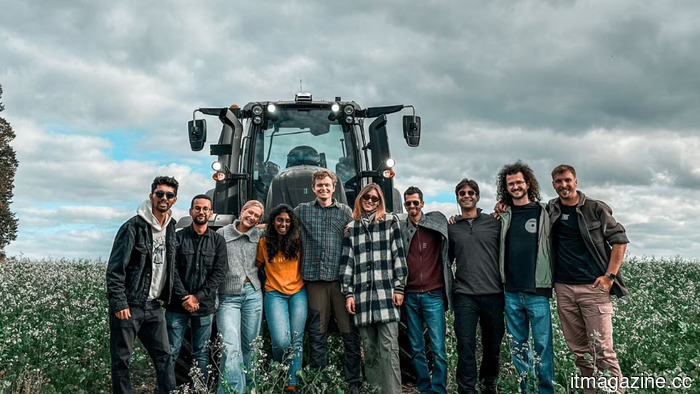
PerPlant secures €1M to equip tractors with AI cameras, managing 200,000 hectares in the process.
The Copenhagen-based agtech firm has already mapped nine times more European farmland than all Danish agricultural drones combined. Two prominent Nordic investors are now targeting the U.S. market.
The concept of PerPlant is simple for farmers to understand: a box is mounted on the tractor’s roof, a camera monitors the field, and AI determines which plants are sprayed. This week, the startup announced it has secured €1 million (DKK 7.6 million) in a funding round led by Jytte Rosenmaj, chair of the carbon-credit platform Agreena, and Kræn Østergaard Nielsen, former CEO of Danish retailer Coop Danmark and currently an active AI investor.
This investment is complemented by non-dilutive funding from Denmark’s EIFO, the European Space Agency, and Innovation Fund Denmark.
According to PerPlant, their technology promises a 90% reduction in herbicide usage for an average Danish farmer with about 200 hectares of land, along with a 30% decrease in fertilizer use. The investor group's materials suggest this could translate to savings of approximately DKK 269,000 annually per farm, enabling a return on investment within a single growing season.
More compelling is the dataset: PerPlant claims its cameras have surveyed over 200,000 hectares of European farmland, which they say is nine times the collective coverage of all agricultural drones in Denmark and constitutes the largest precision-farming dataset in the Nordics.
While satellite imagery typically has a resolution of ten to thirty meters, PerPlant’s on-tractor sensors achieve a resolution of two to ten centimeters. The company argues this precision enables audit-grade documentation, which banks, insurers, and EU authorities can utilize to verify where and what was sprayed.
This documentation is crucial commercially, as European farmers face regulatory pressures to reduce chemical usage and must demonstrate compliance. The EU's Farm to Fork strategy aims to halve pesticide use by 2030, with subsidy systems increasingly linked to verifiable environmental performance.
Precision-spraying companies are aware of this landscape. Earlier this year, Dutch startup BBLeap raised €5 million for a nozzle system that takes a different approach to achieving similar results. While they are not yet direct competitors at scale, they are targeting the same issue.
PerPlant was established in 2022 by CEO Rasmus Emil Hansen and CTO Sumod Nandanwar, who connected through Antler’s Nordic entrepreneur program. The foundational technology was initially created at KTH in Stockholm, based on research into edge processing and sensor systems enabling real-time inference without cloud data transmission.
The company now employs fifteen people and operates commercial deployments across twelve countries, including Denmark, the UK, the Netherlands, Belgium, Norway, Poland, Latvia, Estonia, Lithuania, Spain, Ireland, and Chile. Its existing supporters include Antler and The Footprint Firm, while this funding round brings Rosenmaj and Østergaard Nielsen on board as direct investors.
Looking ahead, the company has its sights set on the United States. Hansen articulated PerPlant’s offering in distinctly bureaucratic terms: “When our AI travels over the field, it documents field variation, every single plant, and groundwater-sensitive areas. This reduces bureaucracy for the farmer and ensures we can precisely stop spraying over sensitive groundwater zones.”
This more practical pitch may resonate better with North American farmers, who may be familiar with EU policy arguments. If the company’s claims prove valid in practice, the technology could appeal not only for the chemicals it avoids using but also for the paperwork it simplifies.
Other articles
 Reasons for the increasing adoption of AI in EU businesses and the ongoing challenges in keeping pace.
The adoption of AI in EU enterprises reached 20% in 2025. However, this headline masks a more significant issue that predates the AI Act.
Reasons for the increasing adoption of AI in EU businesses and the ongoing challenges in keeping pace.
The adoption of AI in EU enterprises reached 20% in 2025. However, this headline masks a more significant issue that predates the AI Act.
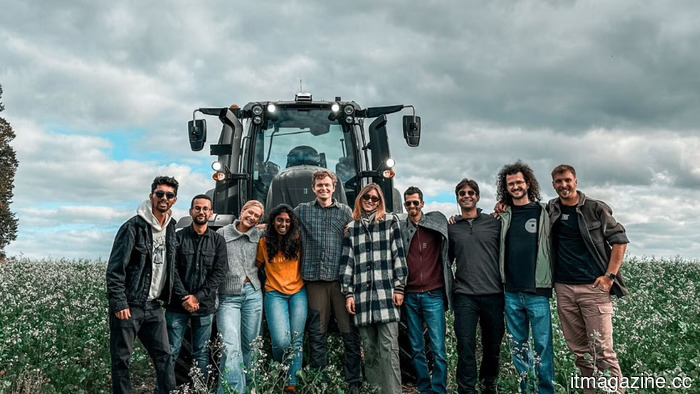 PerPlant secures €1M to implement AI cameras on tractors, with 200,000 hectares already secured.
Copenhagen-based agtech company PerPlant has secured €1M to expand its tractor-mounted AI precision-spraying technology. New investors include Agreena’s Jytte Rosenmaj and Coop’s Kræn Østergaard Nielsen.
PerPlant secures €1M to implement AI cameras on tractors, with 200,000 hectares already secured.
Copenhagen-based agtech company PerPlant has secured €1M to expand its tractor-mounted AI precision-spraying technology. New investors include Agreena’s Jytte Rosenmaj and Coop’s Kræn Østergaard Nielsen.
 India’s aspirations in AI depend on transforming 200 million workers into 350 million.
Sandip Patel from IBM India believes that by 2030, India has the potential to become the global hub for AI skills. However, the calculations are more complex than the initial figure implies.
India’s aspirations in AI depend on transforming 200 million workers into 350 million.
Sandip Patel from IBM India believes that by 2030, India has the potential to become the global hub for AI skills. However, the calculations are more complex than the initial figure implies.
 UK venture funding increased to $10.5 billion in the first four months of 2026, driven by three major funding rounds.
According to GlobalData, UK firms secured $10.5 billion in venture capital during the initial four months of 2026, with over 40% of that amount originating from only three funding rounds.
UK venture funding increased to $10.5 billion in the first four months of 2026, driven by three major funding rounds.
According to GlobalData, UK firms secured $10.5 billion in venture capital during the initial four months of 2026, with over 40% of that amount originating from only three funding rounds.
 Microsoft's subtle Claude Code retreat and the true expense of enterprise AI
Microsoft is reducing Claude Code licenses within its main product teams. The motivation isn't strategic; it's financial. Has the AI coding experiment come to an end?
Microsoft's subtle Claude Code retreat and the true expense of enterprise AI
Microsoft is reducing Claude Code licenses within its main product teams. The motivation isn't strategic; it's financial. Has the AI coding experiment come to an end?
 On the Vatican stage, Chris Olah from Anthropic states that AI cannot be guided solely by AI laboratories.
During the launch of Pope Leo XIV's first encyclical at the Vatican, Anthropic co-founder Chris Olah stated that AI cannot be directed solely by leading research labs.
On the Vatican stage, Chris Olah from Anthropic states that AI cannot be guided solely by AI laboratories.
During the launch of Pope Leo XIV's first encyclical at the Vatican, Anthropic co-founder Chris Olah stated that AI cannot be directed solely by leading research labs.
PerPlant secures €1M to equip tractors with AI cameras, managing 200,000 hectares in the process.
Copenhagen-based agtech company PerPlant has secured €1M to expand its AI precision-spraying system attached to tractors. New investors include Jytte Rosenmaj from Agreena and Kræn Østergaard Nielsen from Coop.