
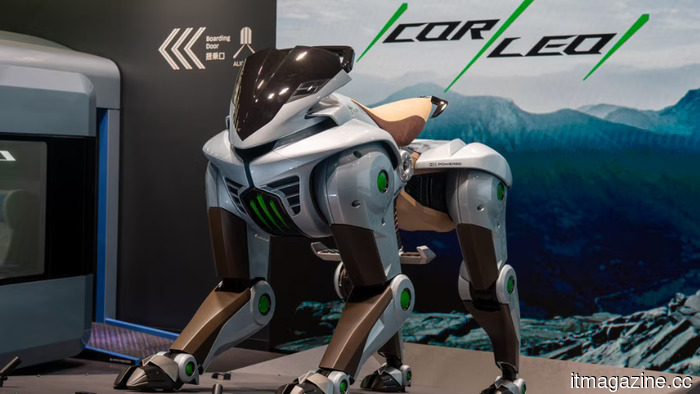
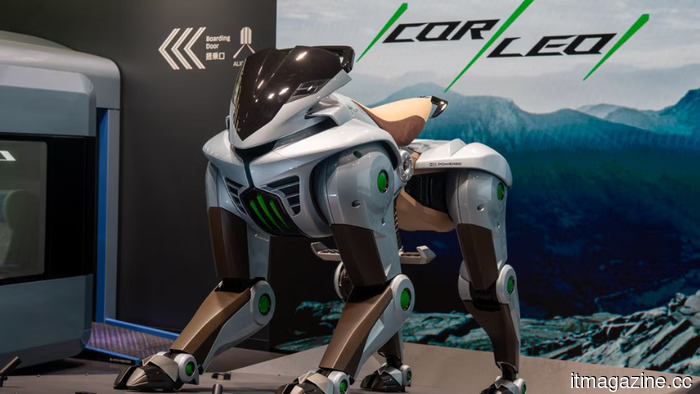
Kawasaki Heavy partners with Nvidia for physical AI, while the rideable robotic horse receives a foundational model.
Shares increased by 12% after the Japanese industrial company launched a development base in San Jose in collaboration with Nvidia, Analog Devices, Microsoft, and Fujitsu, showcasing its four-legged mobility concept, CORLEO, as the initial exhibit. On Friday, Kawasaki Heavy Industries announced its partnership with Nvidia and several other US and Japanese firms focused on physical AI for robotics, establishing a joint development center in San Jose, California. The stock of the 130-year-old industrial group rose by as much as 12% following the announcement, marking its largest gain since February 9. Other Japanese companies involved in physical AI also saw gains, with Fanuc rising by 8% and Yaskawa Electric gaining 5.9%.
The San Jose facility will unite Kawasaki, Nvidia, Analog Devices, Microsoft, and Fujitsu, initially targeting healthcare, nursing care, and mobility applications. The first product to be developed through this collaboration is CORLEO, a four-legged personal mobility robot designed for off-road environments. It is roughly the size of a large motorcycle, powered by a 150cc hydrogen engine that drives leg-mounted units, and is designed for the rider to straddle and steer using weight shifts.
Kawasaki has previously indicated its intention to showcase the vehicle at Expo 2030 in Riyadh and to launch it commercially by 2035. The collaboration will incorporate Nvidia’s simulation technologies into CORLEO’s development, along with efforts in medical robotics aimed at creating assistants for healthcare professionals. Nikkei reported the partnership prior to official confirmation, which Kawasaki subsequently verified on Friday morning Tokyo time.
Analysts from Morgan Stanley MUFG, including Takeshi Kitaura, noted in a pre-confirmation report that this collaboration “could accelerate its AI robotics development” if the information was accurate. The same report highlighted that Kawasaki plans to increase its investment for the fiscal year ending March 2027 by approximately ¥10 billion ($63 million), including expenditures related to robotics, signaling a proactive approach to AI adoption.
The broader context suggests that the Japanese industrial robotics sector is being restructured around partnerships with foundational model layers. Earlier this month, Fanuc partnered with Google to integrate Gemini Enterprise and the Intrinsic robotics platform into its 1.1 million installed industrial robots, resulting in record shares for Fanuc. Kawasaki’s agreement positions it similarly within the Nvidia framework.
Both of the largest hyperscaler-adjacent AI stacks now have anchor partnerships with established Japanese industrial robot manufacturers. The CORLEO showcase indicates that Kawasaki’s collaboration initially focuses on consumer-oriented and care-economy applications rather than the welding and pick-and-place sectors where Fanuc excels.
Japan faces demographic challenges that other OECD countries will confront in about two decades, and physical AI in elder care is a politically supported priority domestically. The investment perspective is clear: robotics has emerged as a leading Asian stock theme this year, and any credible partnership with Nvidia, Google, or other foundational model providers is viewed as a strategic opportunity for future growth.
Nvidia’s humanoid stack is already being tested in real logistics operations with Siemens in Germany, and its discussions with LG Electronics regarding robotics and AI data centers are well-known. The Kawasaki partnership introduces a significant player from Japan's heavy industry into this mix.
Whether CORLEO will transition from a concept to a viable product, or remain an expensive demonstration, is a question for the future. The robot currently exists as a hydrogen-powered concept that garnered around 1.2 billion social media impressions when unveiled at Expo 2025 in Osaka. The partnership with Nvidia provides a pathway to a simulation-trained control system that may bring it closer to functional hardware. The share rally on Friday indicates that investors are currently optimistic about this potential pathway.
Other articles
 The excitement surrounding Salesforce's Agentforce exceeds its actual delivery.
Salesforce secured 29,000 Agentforce agreements, yet its stock has decreased by 30% in 2026, and demonstration showcases continue to be unfinished projects.
The excitement surrounding Salesforce's Agentforce exceeds its actual delivery.
Salesforce secured 29,000 Agentforce agreements, yet its stock has decreased by 30% in 2026, and demonstration showcases continue to be unfinished projects.
 The majority of data breaches begin with a compromised password. Here’s how to address that issue.
Stolen credentials are responsible for 80% of breaches, yet many teams continue to exchange passwords via Slack. Proton Pass for Business offers encryption for just $1.99 per user per month.
The majority of data breaches begin with a compromised password. Here’s how to address that issue.
Stolen credentials are responsible for 80% of breaches, yet many teams continue to exchange passwords via Slack. Proton Pass for Business offers encryption for just $1.99 per user per month.
 The majority of data breaches begin with a compromised password. Here’s how to address this issue.
Stolen credentials account for 80% of security breaches, yet many teams continue to share passwords via Slack. Proton Pass for Business offers encryption for all data starting at $1.99 per user per month.
The majority of data breaches begin with a compromised password. Here’s how to address this issue.
Stolen credentials account for 80% of security breaches, yet many teams continue to share passwords via Slack. Proton Pass for Business offers encryption for all data starting at $1.99 per user per month.
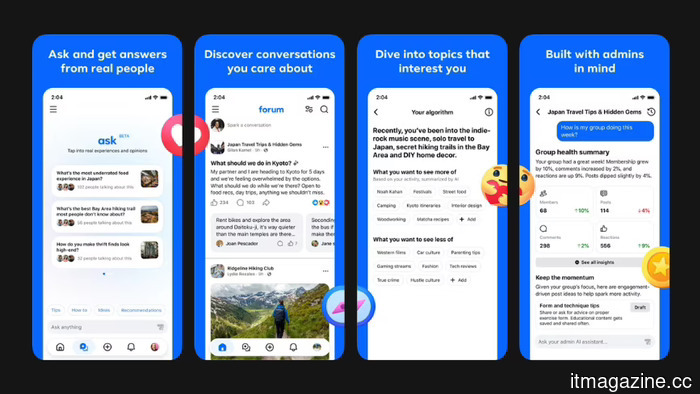 Forum is Meta's latest app for Facebook Groups, and it bears a strong resemblance to Reddit.
Meta has discreetly launched Forum, an independent app resembling Reddit that is based on Facebook Groups, featuring an AI "Ask" tab and an admin assistant.
Forum is Meta's latest app for Facebook Groups, and it bears a strong resemblance to Reddit.
Meta has discreetly launched Forum, an independent app resembling Reddit that is based on Facebook Groups, featuring an AI "Ask" tab and an admin assistant.
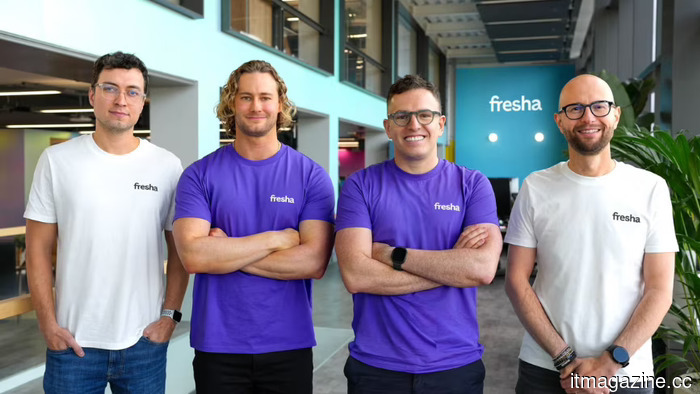 Fresha, based in London, achieves unicorn status following an $80 million funding round led by KKR.
Fresha, a beauty and wellness booking platform based in London, has secured $80 million from KKR, achieving a valuation of over $1 billion and gaining entry into the UK unicorn club.
Fresha, based in London, achieves unicorn status following an $80 million funding round led by KKR.
Fresha, a beauty and wellness booking platform based in London, has secured $80 million from KKR, achieving a valuation of over $1 billion and gaining entry into the UK unicorn club.
 The AI era didn’t eliminate trust in marketing; instead, it set a higher standard for achieving it.
Consumers have moved from looking for information to desiring certainty. An experienced marketer discusses why brands that fail to withstand the verification moment will be outperformed by those that succeed.
The AI era didn’t eliminate trust in marketing; instead, it set a higher standard for achieving it.
Consumers have moved from looking for information to desiring certainty. An experienced marketer discusses why brands that fail to withstand the verification moment will be outperformed by those that succeed.
Kawasaki Heavy partners with Nvidia for physical AI, while the rideable robotic horse receives a foundational model.
Kawasaki Heavy Industries surged 12% following the announcement of a physical-AI collaboration with Nvidia, Microsoft, Fujitsu, and Analog Devices, featuring its CORLEO robot as the highlight of the presentation.