
Google's Gemini may be implementing weekly limits, which will likely not please free users.
Google
Currently, almost every significant AI chatbot adheres to a similar strategy: attract users with a surprisingly capable free version, then gently encourage them towards a subscription as they become more dependent on it. In reality, for the majority of users, the free offerings are already sufficient. You can pose questions, create images, summarize documents, and even brainstorm ideas without frequently encountering a paywall. This is why a recently noticed alteration in Google’s Gemini app is particularly noteworthy.
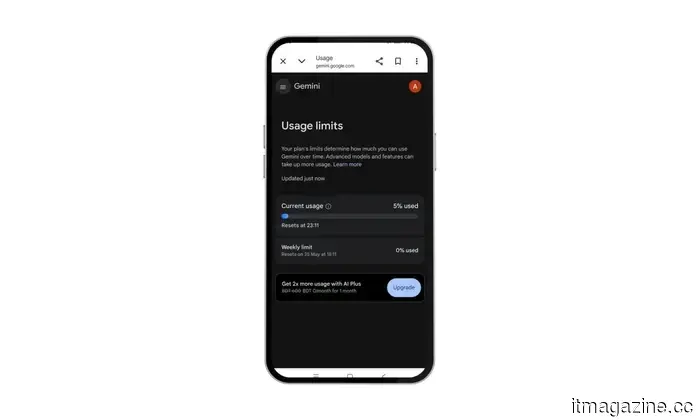
A user on X shared a screenshot indicating that Google might be testing stricter usage monitoring and potential weekly limits within Gemini. The screenshot features a new section stating, “Plan limits determine how much you can use Gemini over time.” This suggests that Google may be preparing to implement a more stringent system that tracks how often free users interact with Gemini, especially when utilizing more demanding AI models.
Ashutosh Shrivastava on X
The screenshot also shows a usage bar that indicates how much of the quota has already been utilized. In this case, the user reportedly consumed around 5% of the available allowance, with the limit resetting later in the day. While this may not seem worrisome yet, it points to Gemini becoming significantly more organized about the amount of free access users actually receive.
This was always on the horizon
Operating large AI models is extremely costly. Each prompt, generated image, or extended conversation incurs computing power expenses, and tech companies have spent the past few years training users to anticipate virtually unlimited AI for free. This initial phase was never meant to last indefinitely. Google, like almost every other AI company, ultimately seeks to have users pay for premium access. The challenge lies in determining how far it can push before users simply switch to alternatives. Unlike traditional software lock-ins, AI tools can be abandoned quite easily. If Gemini starts to feel restrictive, users can transition to ChatGPT, Claude, or another free option in a matter of minutes.
Google
That being said, it's essential not to jump to conclusions just yet. At present, this appears to be based on a single user report, and Google has not officially announced weekly limits for the free tier of Gemini. There is always the possibility that this is part of a small-scale trial or an experimental rollout that may never expand further. Nevertheless, Google has a long-standing practice of quietly testing features with a limited audience prior to broader implementation. Therefore, even if this is currently evident to only a select number of users, it would not be surprising to see stricter limits for Gemini gradually introduced to more people in the coming months. The bigger concern is whether users will accept it once it occurs. Users have become quite accustomed to considering AI chatbots as infinite digital assistants. If those assistants begin to state, “You’ve reached your limit for the week,” the dynamic between users and AI platforms may change significantly.
Shimul is a contributor at Digital Trends, bringing over five years of experience in the tech industry.
Scientists have just set a new wireless speed record that could influence the future of 6G technology
Researchers achieved 112Gbps over a 560GHz wireless connection, indicating the potential for faster backhaul before 6G networks reach consumer devices.
Scientists have advanced wireless speeds into realms that current mobile networks cannot reach. A team from Tokushima University demonstrated a 112Gbps wireless connection in the 560GHz band, utilizing soliton microcombs to produce a more stable terahertz signal for future 6G systems. The immediate benefit isn’t a faster mobile device; it’s the underlying infrastructure that manages traffic between network locations, which dictates whether the anticipated 6G speeds are realized or become hindered by congested network channels. This breakthrough in 6G speed is significant to monitor, even if consumers won’t observe it on specifications anytime soon.
Google Gemini’s new thinking level allows users to adjust cognitive processing
With Google I/O 2026 approaching, Google appears unable to prevent Gemini news from leaking early. New features seem to surface continually within the app, and now it appears Google is testing a way for users to control how much “thinking” Gemini does prior to delivering a response. According to a report from 9to5Google, some users have begun noticing a new “Thinking Level” option in the Gemini app. This feature seemingly appears within Gemini’s existing model selection, where users can already choose among options like Fast, Thinking, Pro, or Google AI Plus.
Japan has created robotic wolves to deter bear attacks, leading to a surge in sales
Orders for the “Monster Wolf” have reportedly increased threefold due to rising wildlife encounters.
Few headlines can simultaneously sound credible as both a robotics advancement and the premise of a low-budget sci-fi horror film. Japan deploying glowing robotic wolves to ward off bears is certainly one of them. The country's unusual robots are experiencing a significant increase in demand, as reported by AFP, in response to the growing occurrences of bear attacks and sightings throughout Japan. Japan’s robotic wolves





Other articles
 Samsung's Exynos 2800 chip may confine more AI tasks to upcoming Galaxy S smartphones.
Samsung's upcoming chip enhancement may enable future Galaxy smartphones to perform more AI tasks directly on the device, but it could also prevent older flagship models from accessing the most advanced Galaxy AI features.
Samsung's Exynos 2800 chip may confine more AI tasks to upcoming Galaxy S smartphones.
Samsung's upcoming chip enhancement may enable future Galaxy smartphones to perform more AI tasks directly on the device, but it could also prevent older flagship models from accessing the most advanced Galaxy AI features.
 Red Magic's newest gaming smartphone appears as though it has emerged from an esports laboratory.
Certain smartphones boast excellent cameras, while others prioritize an ultra-slim design. The latest offering from Red Magic seems ready to initiate a ranked match as soon as you pick it up. The Red Magic 11S Pro series has been officially unveiled in China, celebrating the brand’s eighth anniversary with two phones that are unmistakably geared towards gaming. The lineup [...]
Red Magic's newest gaming smartphone appears as though it has emerged from an esports laboratory.
Certain smartphones boast excellent cameras, while others prioritize an ultra-slim design. The latest offering from Red Magic seems ready to initiate a ranked match as soon as you pick it up. The Red Magic 11S Pro series has been officially unveiled in China, celebrating the brand’s eighth anniversary with two phones that are unmistakably geared towards gaming. The lineup [...]
 Google's Gemini may be implementing weekly restrictions, which free users are likely to dislike.
Google may be stealthily experimenting with tighter usage restrictions within Gemini, potentially altering the perception of “free” AI tools in the future. A recently discovered screenshot suggests a scenario where unrestricted access to chatbots could soon have conditions attached.
Google's Gemini may be implementing weekly restrictions, which free users are likely to dislike.
Google may be stealthily experimenting with tighter usage restrictions within Gemini, potentially altering the perception of “free” AI tools in the future. A recently discovered screenshot suggests a scenario where unrestricted access to chatbots could soon have conditions attached.
 Samsung's Exynos 2800 chipset may handle more AI tasks exclusively for upcoming Galaxy S smartphones.
The upcoming chip upgrade from Samsung could enable future Galaxy phones to perform more AI tasks directly on the device. However, it might also mean that the top Galaxy AI features are inaccessible for older flagship models.
Samsung's Exynos 2800 chipset may handle more AI tasks exclusively for upcoming Galaxy S smartphones.
The upcoming chip upgrade from Samsung could enable future Galaxy phones to perform more AI tasks directly on the device. However, it might also mean that the top Galaxy AI features are inaccessible for older flagship models.
 Microsoft is discontinuing the Together Mode in Teams to promote a more streamlined and straightforward option.
Microsoft Teams is discontinuing Together Mode and will introduce more straightforward meeting layouts aimed at enhancing the clarity of video calls, presentations, and screen sharing.
Microsoft is discontinuing the Together Mode in Teams to promote a more streamlined and straightforward option.
Microsoft Teams is discontinuing Together Mode and will introduce more straightforward meeting layouts aimed at enhancing the clarity of video calls, presentations, and screen sharing.
 The newest gaming phone from Red Magic appears as though it has emerged from an esports laboratory.
Certain smartphones feature impressive cameras, while others prioritize an ultra-slim design. The latest from Red Magic appears ready to initiate a competitive match the moment you interact with it. The Red Magic 11S Pro series has officially debuted in China, celebrating the brand's eighth anniversary with two devices that are distinctly aimed at gamers. The series […]
The newest gaming phone from Red Magic appears as though it has emerged from an esports laboratory.
Certain smartphones feature impressive cameras, while others prioritize an ultra-slim design. The latest from Red Magic appears ready to initiate a competitive match the moment you interact with it. The Red Magic 11S Pro series has officially debuted in China, celebrating the brand's eighth anniversary with two devices that are distinctly aimed at gamers. The series […]
Google's Gemini may be implementing weekly limits, which will likely not please free users.
Google might be subtly experimenting with more stringent usage limits within Gemini, which could alter the perception of how "free" AI tools truly are in the future. A recently discovered screenshot suggests a scenario where unrestricted access to chatbots may ultimately come with certain conditions.