
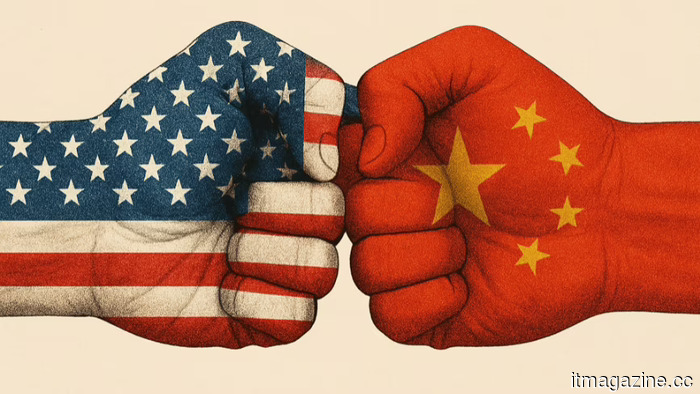
China intensifies its criticism of the US chip-equipment legislation as Trump arrives in Beijing.
On the eve of the Xi summit, Beijing’s foreign ministry criticized the MATCH Act, highlighting a 150-day alignment deadline for Japan and the Netherlands as a key aspect of the legislation. The Chinese government intensified its condemnation of US laws aimed at tightening control over semiconductor manufacturing equipment, coinciding with Donald Trump's arrival in Beijing for a state visit and his meeting with Xi Jinping.
According to the Chinese foreign ministry, the MATCH Act, currently progressing through Congress, exemplifies what spokesperson Lin Jian describes as Washington's "overextension of national security" and "malicious obstruction and suppression" of Chinese industry. The timing of these remarks is significant given that Trump and Xi are set to discuss trade, AI, export controls, Taiwan, and the conflict in Iran, with semiconductor equipment being among the most advanced topics.
The Multilateral Alignment of Technology Controls on Hardware Act, proposed by Representative Michael Baumgartner on April 2 and supported by Senators Pete Ricketts, Andy Kim, Jim Risch, and Chuck Schumer six days later, passed the House Foreign Affairs Committee on April 22. During that time, China's Ministry of Commerce cautioned that the bill could severely disrupt the global economic and trade order.
The legislation specifically identifies companies such as SMIC, Huawei, Hua Hong, CXMT, and YMTC as "covered facilities" and seeks to ban the export of deep-ultraviolet immersion lithography equipment from ASML to these firms. Additionally, it would prevent allied companies from servicing existing machines, which would gradually undermine Chinese manufacturing capacity since DUV systems require regular maintenance to maintain efficiency.
Perhaps most significantly, the bill would grant the Netherlands and Japan a 150-day period to align their export regulations with those of the US, or they would face unilateral enforcement through an expanded Foreign Direct Product Rule. ASML, the exclusive provider of the most advanced DUV systems, has already indicated that its revenue from China might drop to around 20% by 2026, down from 33% previously. If the MATCH Act is enacted, this decline could be even more pronounced. Applied Materials estimates potential losses of up to $710 million in revenue from China this fiscal year, while Lam Research foresees its China revenue dropping below 30%, down from 43% in the first quarter.
China has already established countermeasures, with the State Council issuing Order No. 834 in April, a supply-chain security regulation overseen by more than 15 agencies that permits legal action against companies perceived as detrimental to Chinese supply chains. Over the past 18 months, Beijing has fluctuated between restrictions on materials such as gallium, germanium, antimony, seven medium and heavy rare earths, and silver, sometimes suspending said restrictions but maintaining licensing requirements. Furthermore, it has mandated that domestic chipmakers source half of their new equipment from Chinese suppliers, jeopardizing an estimated $18 billion in annual American equipment sales.
The MATCH Act contrasts with the January decision by the executive branch, when the Trump administration altered its export-review policy for Nvidia's H200 and AMD's MI325X, shifting from a presumption of denial to a case-by-case approach—a relaxation advocated by Nvidia's CEO Jensen Huang, who has now been included in Trump's Beijing delegation after initially being excluded. While the White House loosened regulations on finished chips, Congress seeks to tighten controls on the manufacturing tools, based on the premise that lithography systems are more challenging to redirect compared to commodities.
Allied nations are still assessing the implications of the 150-day requirement. Japan, which imposed controls on 23 types of chip equipment in 2023, and the Netherlands, which has restricted ASML's EUV and certain DUV exports since 2024, will need to enhance these rules within five months, or face US enforcement against any firms utilizing American technology in their supply chains.
Discussions in the summit room are unlikely to stall the legislative process. The MATCH Act has progressed to the full House stage, and its bipartisan nature means it is one of the few significant China-policy initiatives advancing without substantial internal opposition. Beijing seems to believe that the summit provides an opportunity to establish the consequences of the legislation on record, while postponing any reaction until later. The Trump-Xi meeting is set to commence Thursday morning, Beijing time.
Other articles
 iOS 27 will integrate Siri into the Dynamic Island, but it's the enhancements to features that really excite me.
Apple intends to revamp Siri in iOS 27, with the most discussed alteration being its new location within the Dynamic Island. While the visual update is significant, it is the enhancements to the features that will truly make a difference.
iOS 27 will integrate Siri into the Dynamic Island, but it's the enhancements to features that really excite me.
Apple intends to revamp Siri in iOS 27, with the most discussed alteration being its new location within the Dynamic Island. While the visual update is significant, it is the enhancements to the features that will truly make a difference.
 Many startups don't actually struggle with burn issues; they struggle with decision-making.
Seventy percent of unsuccessful startups depleted their funds. The core problem isn't simply overspending; it's the lack of unified data and decisions made without clarity. Here’s how to address this.
Many startups don't actually struggle with burn issues; they struggle with decision-making.
Seventy percent of unsuccessful startups depleted their funds. The core problem isn't simply overspending; it's the lack of unified data and decisions made without clarity. Here’s how to address this.
 Employees at Meta are protesting the implementation of new mouse-tracking software just days ahead of widespread layoffs.
Employees at Meta handed out flyers at their US offices to protest the company's new mouse-tracking software, just days before the layoffs of around 8,000 employees set for May 20.
Mythos heads to Tokyo: Japanese banks to receive Anthropic’s AI for detecting vulnerabilities.
According to a source who spoke to Reuters, MUFG, Mizuho, and SMFG will be the inaugural Japanese institutions authorized to access Anthropic's limited Mythos AI model.
Employees at Meta are protesting the implementation of new mouse-tracking software just days ahead of widespread layoffs.
Employees at Meta handed out flyers at their US offices to protest the company's new mouse-tracking software, just days before the layoffs of around 8,000 employees set for May 20.
Mythos heads to Tokyo: Japanese banks to receive Anthropic’s AI for detecting vulnerabilities.
According to a source who spoke to Reuters, MUFG, Mizuho, and SMFG will be the inaugural Japanese institutions authorized to access Anthropic's limited Mythos AI model.
 Spain maintains its stance on regulations for social media and AI as the lobbying efforts from US tech companies increase.
Spain will proceed with its new regulations on social media and AI, despite heavy lobbying from American tech firms, stated digital transformation minister Óscar López.
Spain maintains its stance on regulations for social media and AI as the lobbying efforts from US tech companies increase.
Spain will proceed with its new regulations on social media and AI, despite heavy lobbying from American tech firms, stated digital transformation minister Óscar López.
 The majority of startups don't face an issue with burning cash; rather, they encounter a problem with decision-making.
Seventy percent of unsuccessful startups exhausted their funding. The core problem isn't simply high spending, but rather disorganized data and decisions made without proper insights. Here’s how to address this issue.
The majority of startups don't face an issue with burning cash; rather, they encounter a problem with decision-making.
Seventy percent of unsuccessful startups exhausted their funding. The core problem isn't simply high spending, but rather disorganized data and decisions made without proper insights. Here’s how to address this issue.
China intensifies its criticism of the US chip-equipment legislation as Trump arrives in Beijing.
Beijing intensified its criticism of the US MATCH Act, which aims to impose stricter export controls on chip equipment and obligate Japan and the Netherlands to meet a 150-day deadline.