
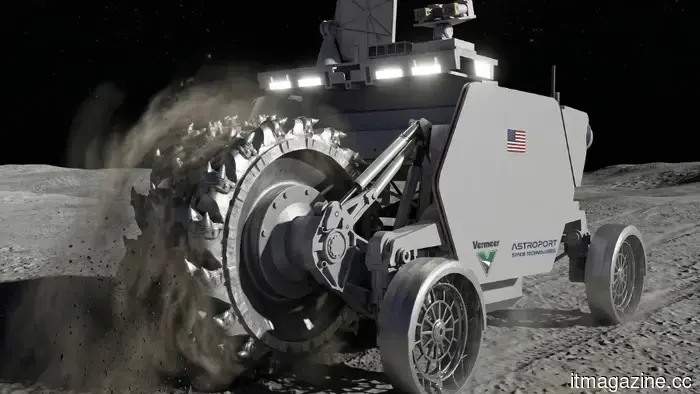
Astroport and Vermeer team up to create autonomous construction equipment for the Moon.
Astroport Space Technologies and Vermeer Corporation have announced a partnership aimed at modifying industrial surface mining equipment for autonomous construction on the Moon. Both companies view this collaboration as a way to provide the heavy machinery, or “Lunar Iron,” essential for establishing a permanent human presence on the lunar surface.
The announcement was made during the 20th International Conference on Engineering, Science, Construction and Operations in Challenging Environments (ASCE Earth & Space 2026) held in College Station, Texas. It focuses on the “lunarisation” of Vermeer’s surface mining machinery. The initiative will utilize Astroport’s Universal Tool Implement Payload Adapter, or UTIPA, which is a modular system consisting of interchangeable tools designed for robotic construction in the Moon's harsh environment. Starting with a surface mining application, the teams will modify heavy equipment that traditionally depends on mass and weight, adapting it for the Moon’s low gravity, extreme temperature fluctuations, and abrasive regolith.
Understanding "Lunar Iron"
The term "Lunar Iron" does not refer to iron ore but rather serves as the companies' shorthand for the kind of heavy construction machinery needed for lunar base development: excavators, trenchers, and surface miners capable of performing tasks such as digging foundations, grading roads, constructing landing pads, and preparing fortified sites for nuclear power systems and habitats. While this work is standard on Earth, on the Moon, where equipment must function autonomously in a vacuum and withstand over 300 degrees Celsius of temperature variation between day and night, it presents a significant engineering challenge that has not yet been overcome at operational scale.
“Vermeer has always focused on finding better ways to tackle tough tasks,” stated Jason Andringa, president and CEO of Vermeer Corporation. He emphasized that the company has spent over seventy years developing equipment for agriculture, natural resource management, and underground construction. “This partnership exemplifies our ongoing commitment to that vital work, applying our expertise in automation and heavy machinery to the lunar context.”
UTIPA: The Enabler
The key technical element of this partnership is Astroport’s UTIPA system. Instead of creating lunar construction machinery from the ground up, this method adapts proven industrial equipment through a modular payload interface. UTIPA allows standard connections between robotic platforms and interchangeable tool heads, enabling a single autonomous base unit to shift between tasks like surface mining, trenching, and grading.
This is critical because lunar construction encompasses various activities. Establishing a base necessitates site preparation, which involves excavating regolith to level the terrain; building roads to link landing zones to habitat areas; fabricating landing pads with sintered regolith; and trenching for power cables and thermal protection. A modular tool system reduces the number of machines that need to be launched from Earth, allowing each machine to serve multiple purposes during the construction process.
Prototype tests will be conducted at Vermeer’s headquarters in Pella, Iowa, where the company can utilize its existing heavy machinery testing facilities. The initial focus will be on adapting Vermeer’s high-torque cutting and trenching technologies, designed for continuous operation in hard ground and rock, to meet the demanding conditions found on the lunar surface.
The NASA Demand
The partnership aligns with NASA’s Moon Base program, which seeks to establish lunar infrastructure by 2030. The Artemis program has already completed its crewed lunar flyby and aims for lunar landings starting in 2028, with roughly annual missions thereafter. Permanent habitation will require precisely the kind of site preparation and civil engineering that Astroport and Vermeer are developing: excavated foundations, graded roads, sintered landing pads, and reinforced enclosures for fission power reactors.
Astroport has been strategically preparing for this opportunity. The company holds several NASA contracts for lunar construction technology, including STTR Phase II funding for its Brickbot regolith-processing demonstrator. In February 2026, Astroport and Venturi Astrolab successfully demonstrated an integrated excavator payload on Astrolab’s FLEX rover, moving an average of 94 kilograms of regolith simulant in just 3.5 minutes. Additionally, the company has collaborated with ispace to deliver scientific instruments for regolith research, and with Orbit Fab to develop in-situ resource utilization systems for converting regolith into water, oxygen, and metals.
Vermeer’s lunar experience is bolstered by its existing collaboration with Interlune, a Seattle-based startup focused on harvesting helium-3. Together, they presented a full-scale excavation prototype in May 2025 capable of processing 100 metric tonnes of regolith each hour. The Department of Energy has signed a purchase agreement with Interlune for lunar helium-3, with Vermeer planning to commence operations within four to six years.
The Larger Context
The Astroport-Vermeer partnership exists within a rapidly evolving lunar construction ecosystem. Interlune and Astrolab announced their own collaboration in March 2026, while Blue Origin, SpaceX, and various international agencies are developing lunar land
Other articles
 Don’t expect an affordable PlayStation 6 Lite anytime soon.
New speculation regarding the PlayStation 6 indicates that a genuine budget PS6 Lite is improbable, as handheld-style devices would result in excessive performance and development compromises. Instead, a simplified standard console seems to be a more viable option for Sony.
Don’t expect an affordable PlayStation 6 Lite anytime soon.
New speculation regarding the PlayStation 6 indicates that a genuine budget PS6 Lite is improbable, as handheld-style devices would result in excessive performance and development compromises. Instead, a simplified standard console seems to be a more viable option for Sony.
 HBO Max debuts in India through an exclusive partnership with JioHotstar, offering a subscription for ₹49 per month.
HBO Max debuts in India as a JioHotstar add-on for ₹49/month, offering shows like Euphoria, House of the Dragon, Friends, and The Big Bang Theory to over 100 million paid subscribers.
HBO Max debuts in India through an exclusive partnership with JioHotstar, offering a subscription for ₹49 per month.
HBO Max debuts in India as a JioHotstar add-on for ₹49/month, offering shows like Euphoria, House of the Dragon, Friends, and The Big Bang Theory to over 100 million paid subscribers.
 The Intel Nova Lake leak reveals intriguing details about the forthcoming Intel Core Ultra series 4 processors.
A recent leak from Fresh Nova has revealed three supposed die configurations for Intel's forthcoming Core Ultra Series 4 desktop processors, suggesting a potential division of the new lineup into different performance tiers.
The Intel Nova Lake leak reveals intriguing details about the forthcoming Intel Core Ultra series 4 processors.
A recent leak from Fresh Nova has revealed three supposed die configurations for Intel's forthcoming Core Ultra Series 4 desktop processors, suggesting a potential division of the new lineup into different performance tiers.
 More than a hundred Chrome extensions have been found causing significant issues. See if you're using any of them.
A recent report associates 108 Chrome extensions with identity theft, session hijacking, and misuse of browsers, suggesting that if you haven't reviewed your Chrome extensions recently, it's time to examine your seemingly harmless add-ons more closely.
More than a hundred Chrome extensions have been found causing significant issues. See if you're using any of them.
A recent report associates 108 Chrome extensions with identity theft, session hijacking, and misuse of browsers, suggesting that if you haven't reviewed your Chrome extensions recently, it's time to examine your seemingly harmless add-ons more closely.
 The pricing of Apple's iPhone 18 Pro may leave competitors struggling to keep up.
A recent rumor regarding the supply chain indicates that Apple is making significant efforts to prevent a substantial increase in the price of the iPhone 18 Pro, a decision that may add further strain on the already escalating prices of Android flagship devices.
The pricing of Apple's iPhone 18 Pro may leave competitors struggling to keep up.
A recent rumor regarding the supply chain indicates that Apple is making significant efforts to prevent a substantial increase in the price of the iPhone 18 Pro, a decision that may add further strain on the already escalating prices of Android flagship devices.
 Snap reduces its workforce by 1,000 positions, which amounts to 16%, as CEO Spiegel points to increased efficiency from AI.
Snap is reducing its workforce by 1,000 employees and eliminating 300 job openings, aiming for $500 million in annual savings, with CEO Evan Spiegel positioning AI as a route to achieving profitability.
Snap reduces its workforce by 1,000 positions, which amounts to 16%, as CEO Spiegel points to increased efficiency from AI.
Snap is reducing its workforce by 1,000 employees and eliminating 300 job openings, aiming for $500 million in annual savings, with CEO Evan Spiegel positioning AI as a route to achieving profitability.
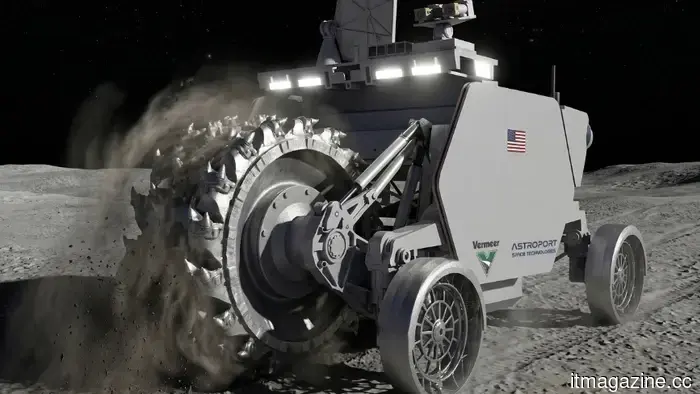
Astroport and Vermeer team up to create autonomous construction equipment for the Moon.
Astroport and Vermeer are modifying industrial surface mining machinery for lunar use, employing a modular tool adapter to construct roads, landing pads, and base infrastructure by the year 2030.