
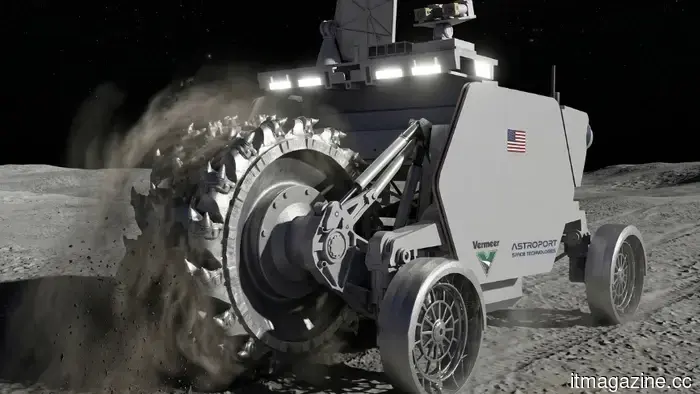
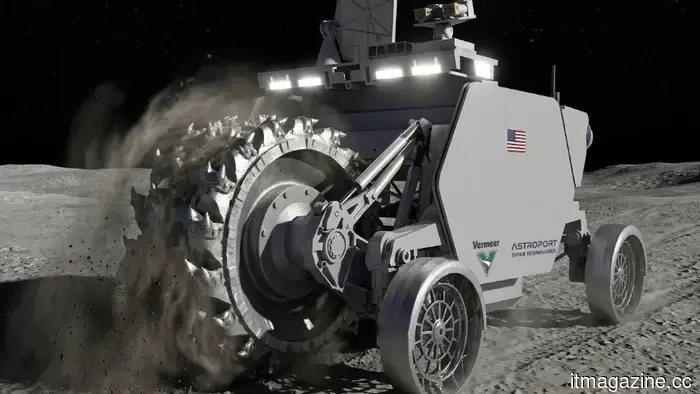
Astroport and Vermeer join forces to develop autonomous machinery for lunar construction.
Astroport Space Technologies and Vermeer Corporation have announced a partnership to modify industrial surface mining equipment for autonomous construction on the Moon. Both companies view this collaboration as essential in providing the heavy machinery, referred to as "Lunar Iron," necessary for establishing a permanent human presence on the lunar surface.
The announcement was made at the 20th International Conference on Engineering, Science, Construction and Operations in Challenging Environments (ASCE Earth & Space 2026) in College Station, Texas, and focuses on what the companies describe as the "lunarisation" of Vermeer’s surface mining machinery. The initiative will utilize Astroport’s Universal Tool Implement Payload Adapter (UTIPA), a modular system designed for robotic construction in the Moon’s harsh environment. Initially starting with a surface miner application, the teams will re-engineer heavy equipment that typically depends on mass and weight, instead modifying it to function in the Moon's low gravity, extreme temperature fluctuations, and abrasive regolith.
Understanding “Lunar Iron”
The phrase does not refer to iron ore but is a term the companies use to denote the category of heavy construction machinery necessary for lunar base development, including excavators, trenchers, and surface miners. These machines will be essential for tasks like digging foundations, grading roads, creating landing pads, and preparing hardened sites for nuclear power systems and habitats. While such activities are routine on Earth, they pose significant engineering challenges on the Moon, where machinery must operate autonomously in a vacuum, endure temperature changes exceeding 300 degrees Celsius between day and night, and function in a low-gravity environment that alters the performance of traditional construction equipment.
"Vermeer has always focused on finding improved methods for handling tough tasks," stated Jason Andringa, president and CEO of Vermeer Corporation. He pointed out that the company has dedicated over seventy years to developing equipment for sectors such as agriculture, natural resource management, and underground construction. “This collaboration exemplifies our ongoing commitment, leveraging our automation and heavy equipment expertise to adapt to the lunar setting."
UTIPA: The Functional Adapter
The core technological aspect of this collaboration is Astroport's UTIPA system. Instead of creating specialized lunar construction equipment from the ground up, this approach modifies existing industrial machinery using a modular payload interface. UTIPA enables a standardized connection between robotic platforms and interchangeable tool heads, allowing one autonomous base unit to perform various tasks like surface mining, trenching, and grading.
This flexibility is crucial since lunar construction encompasses several activities. Preparing a site necessitates excavating regolith to level the ground, constructing roads linking landing zones to habitats, fabricating landing pads from sintered regolith, and trenching for power cables and thermal protection. A modular tool system enables fewer machines to be launched from Earth, with each machine capable of fulfilling multiple functions throughout the construction process.
Prototype testing will occur at Vermeer’s facility in Pella, Iowa, utilizing the company’s existing heavy machinery testing infrastructure. The collaboration will initially concentrate on adapting Vermeer’s high-torque cutting and trenching technologies, designed for continuous operation in tough terrains, to meet the unique requirements of the lunar surface.
The NASA Demand
This partnership aligns with NASA’s Moon Base program, which aims to establish lunar infrastructure by 2030. The Artemis program has already completed a crewed lunar flyby mission and plans to initiate lunar landings in 2028, with missions expected to occur roughly annually thereafter. Permanent habitation will necessitate the kind of site preparation and civil engineering that Astroport and Vermeer are developing, including excavated foundations, graded roads, sintered landing pads, and robust enclosures for nuclear reactors.
Astroport has been diligently preparing for this moment, holding multiple NASA contracts for lunar construction technology, including STTR Phase II funding for its Brickbot regolith-processing prototype. In February 2026, the company, alongside Venturi Astrolab, successfully demonstrated an integrated excavator payload on Astrolab’s FLEX rover, moving an average of 94 kilograms of regolith simulant within 3.5 minutes. Astroport has also partnered with ispace for the delivery of scientific instruments for regolith research and with Orbit Fab to create in-situ resource utilization systems for converting regolith into water, oxygen, and metals.
Vermeer’s credentials in lunar operations arise from its collaboration with Interlune, a Seattle-based startup focused on helium-3 harvesting. Together, they presented a full-scale excavation prototype in May 2025, capable of processing 100 metric tonnes of regolith per hour. The Department of Energy has established a purchase agreement with Interlune for lunar helium-3, and Vermeer plans to commence operations within four to six years.
The Larger Context
The Astroport-Vermeer collaboration is part of a rapidly evolving lunar construction ecosystem. Interlune and Astrolab also revealed their partnership in March 2026, while Blue Origin, SpaceX, and several international organizations are developing lunar landers and habitation modules.
Other articles
 Anthropic, Google, and Microsoft offered bug bounties for AI agent vulnerabilities but chose to remain silent about the issues.
Researchers exploited prompt injection to take control of Claude, Gemini, and Copilot AI agents in order to obtain API keys and tokens. Each of the three companies offered bounties but did not make a public announcement.
Anthropic, Google, and Microsoft offered bug bounties for AI agent vulnerabilities but chose to remain silent about the issues.
Researchers exploited prompt injection to take control of Claude, Gemini, and Copilot AI agents in order to obtain API keys and tokens. Each of the three companies offered bounties but did not make a public announcement.
 HBO Max debuts in India through an exclusive partnership with JioHotstar, offering a subscription for ₹49 per month.
HBO Max debuts in India as a JioHotstar add-on for ₹49/month, offering shows like Euphoria, House of the Dragon, Friends, and The Big Bang Theory to over 100 million paid subscribers.
HBO Max debuts in India through an exclusive partnership with JioHotstar, offering a subscription for ₹49 per month.
HBO Max debuts in India as a JioHotstar add-on for ₹49/month, offering shows like Euphoria, House of the Dragon, Friends, and The Big Bang Theory to over 100 million paid subscribers.
 Anthropic has received investment proposals at a valuation of $800 billion.
Anthropic has attracted investment proposals valuing the company at $800 billion, which is double its valuation from February, with annualized revenue reaching $30 billion as discussions for an IPO commence with Goldman Sachs and JPMorgan.
Anthropic has received investment proposals at a valuation of $800 billion.
Anthropic has attracted investment proposals valuing the company at $800 billion, which is double its valuation from February, with annualized revenue reaching $30 billion as discussions for an IPO commence with Goldman Sachs and JPMorgan.
 Nissan has unveiled the Juke EV, and I sincerely hope this daring design remains.
Nissan has unveiled the third-generation Juke as an all-electric crossover for Europe, and its striking new design is undoubtedly the most captivating aspect of the vehicle.
Nissan has unveiled the Juke EV, and I sincerely hope this daring design remains.
Nissan has unveiled the third-generation Juke as an all-electric crossover for Europe, and its striking new design is undoubtedly the most captivating aspect of the vehicle.
 Snap reduces its workforce by 1,000 positions, which amounts to 16%, as CEO Spiegel points to increased efficiency from AI.
Snap is reducing its workforce by 1,000 employees and eliminating 300 job openings, aiming for $500 million in annual savings, with CEO Evan Spiegel positioning AI as a route to achieving profitability.
Snap reduces its workforce by 1,000 positions, which amounts to 16%, as CEO Spiegel points to increased efficiency from AI.
Snap is reducing its workforce by 1,000 employees and eliminating 300 job openings, aiming for $500 million in annual savings, with CEO Evan Spiegel positioning AI as a route to achieving profitability.
 OpenAI launches GPT-5.4-Cyber for approved security teams, expanding the Trusted Access program.
OpenAI introduces GPT-5.4-Cyber, featuring binary reverse engineering for validated defenders, expanding access to thousands while competing with Anthropic's limited Mythos model.
OpenAI launches GPT-5.4-Cyber for approved security teams, expanding the Trusted Access program.
OpenAI introduces GPT-5.4-Cyber, featuring binary reverse engineering for validated defenders, expanding access to thousands while competing with Anthropic's limited Mythos model.
Astroport and Vermeer join forces to develop autonomous machinery for lunar construction.
Astroport and Vermeer are modifying industrial surface mining machinery for lunar applications, utilizing a modular tool adapter to construct roads, landing zones, and foundational infrastructure by the year 2030.